Calorie Portion Calculator for Plate Planning
Set practical plate sizes from calorie density, goal mode, hunger shifts, and service style so prep stays accurate from first scoop to last serving.
Pick a dish profile and portion target first, then tune goal mode, hunger lift, and waste buffer for a realistic calorie portion plan.
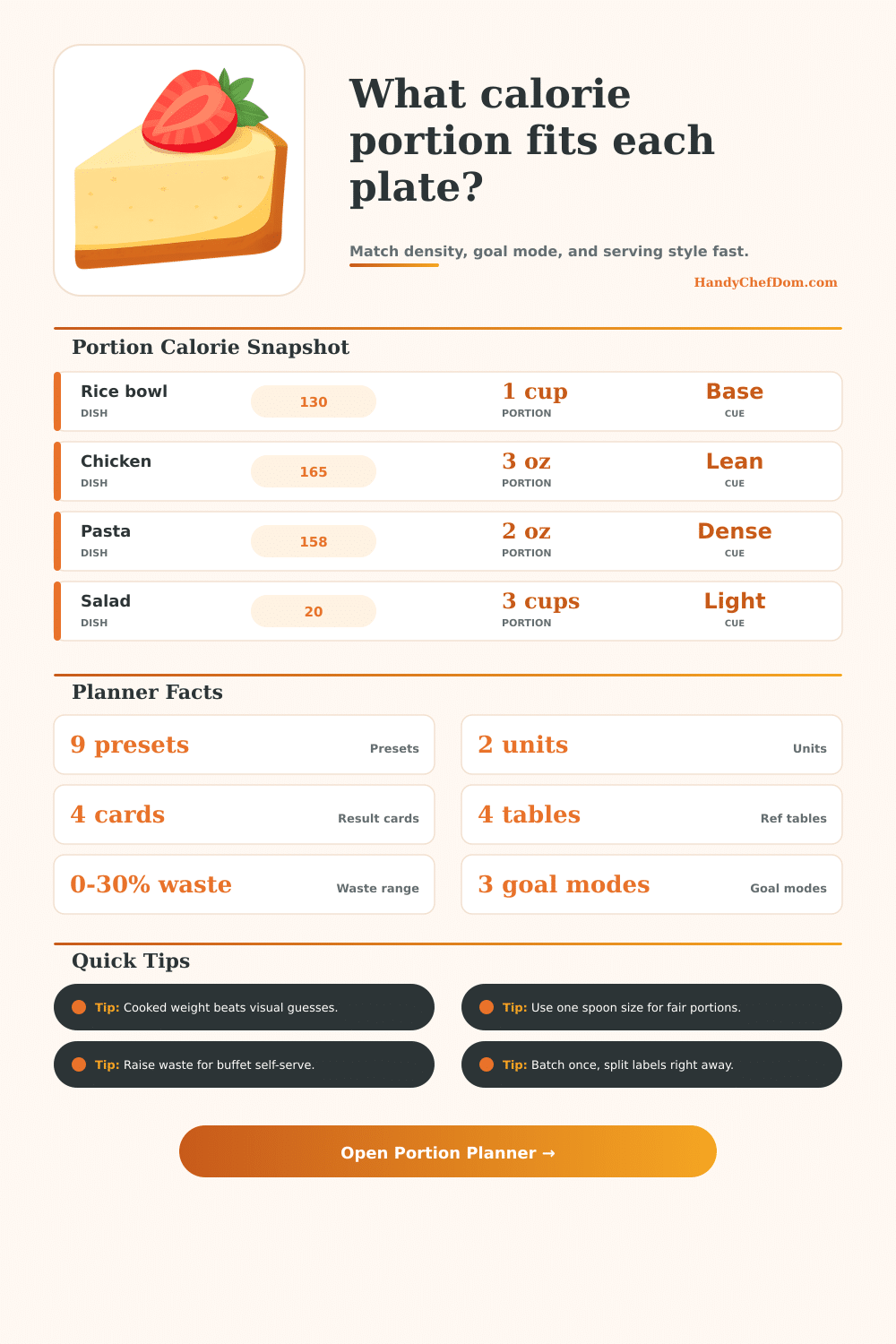
| Dish | kcal/100g | Std gram | Cue |
|---|---|---|---|
| Rice bowl | 130 | 158 g | Base |
| Chicken | 165 | 85 g | Lean |
| Pasta | 158 | 140 g | Dense |
| Salad | 20 | 85 g | Light |
| Soup | 60 | 240 g | Broth |
| Beef | 250 | 85 g | Rich |
| Oats | 379 | 40 g | Hearty |
| Dessert | 320 | 95 g | Sweet |
| Format | Factor | Portion cue | Use case |
|---|---|---|---|
| Plated line | 1.00x | Exact scoop | Cafeteria |
| Family share | 1.08x | Passing bowls | Home table |
| Buffet | 1.15x | Self-serve | Events |
| Boxed prep | 0.95x | Portioned box | Meal prep |
| Goal | Factor | Plate cue | When to pick |
|---|---|---|---|
| Cut calories | 0.90x | Lean plate | Deficit days |
| Steady calories | 1.00x | Normal plate | Baseline use |
| Build calories | 1.12x | Full plate | Training blocks |
| Hunger lift | 0-40% | Dynamic | Busy days |
| Imperial | Metric | Meaning | Portion cue |
|---|---|---|---|
| 1 oz | 28.35 g | Small add | Mini scoop |
| 4 oz | 113.4 g | Classic | Main protein |
| 6 oz | 170.1 g | Large plate | Hearty meal |
| 8 oz | 226.8 g | Big serving | Active day |
Meal planning require that you understand how calories and food volume dont always change at the same rate. While many people may attempt to plan there meals based off the calories that they calculate from the food that they plan to cook, people may find that they are either not satisfied with the food that they prepared, or they are too full. The reason for this is that certain foods contain more calories than others.
The caloric density of the food determine how many calories are contained in a specific volume of that food. For instance, foods like salad contain very few calories but have a large volume, while foods like oatmeal or beef contains alot of calories but have a small volume. Thus, individuals must consider the caloric density of the food that they intend to cook in order to ensure that they can effectiveley manage there caloric intake.
Easy Meal Planning: Calories, Food Volume, Waste and Portions
In addition to considering the caloric density of the food that is to be prepared, individuals must also account for the fact that food waste will occur during the meal preparation process. Food waste may occur when food stick to a pan, when food remains within a ladle, or when food spills during the preparation process. Therefore, if individuals prepare the food according to the amount that they calculate that is required for each individual, they may find that the food lasts for each individual before any of the individuals has finished eating.
To avoid this, individuals should include a waste buffer within their meal planning. The inclusion of a waste buffer within meal planning will ensure that individuals dont run out of food during the service of the meal. Another factor to consider is that individual hunger levels may change throughout the day or the week.
Individuals may feel hungrier after sleeping poorly, for instance, or they may feel increased hunger due to stress. If individuals attempt to prepare meals that contain a specific amount of calories every single day, individuals may find it difficult to adhere to that diet. Thus, individuals should incorporate a hunger lift into their meal planning.
This hunger lift will allow for the meals to be adjusted based upon individual hunger levels, preventing individuals from feeling deprive of food when they should of being eating. The method by which the cook serves the food can also impact the portion of food that are prepared. For instance, if the food is to be served in plated portions, the cook who prepare the meal controls the portion sizes.
In contrast, if the individuals serve the food at a buffet, the individuals who are to eat the food self-serve the portions. At buffets, individuals tend to take larger portions of food than they intend to eat, and many individuals who visit buffets tend to eat more than they intend to. Thus, individuals should use a higher multiplier to determine the amount of food to prepare for those who will visit a buffet.
The specific goal that individuals have for there nutrition can dictate the type of food that they eat. For instance, if an individual is in “cut mode,” they will consume food that has low density and high volume so that the individual will feel full while burning more calories than they consume. If an individual is in “building mode,” however, they may eat food that contains high density so that they can gain energy without consuming a large volume of food.
Thus, individuals must consider their nutritional goal in determining the type of food that they will eat. It is also important to consider the difference between raw food weights and cooked food weights. When food is prepared, the raw food may have a specific weight, but the food may change in weight after it is cooked.
For instance, pasta may double in weight when it is cooked. Therefore, if the food is measured in its raw state, the calories may be inaccurately calculate. Most kitchens prepare food to its cooked weight so that the weight of the food that will be served is accounted for.
This method of measuring food by its cooked weight allow for the most reliabel calculation of the calories of the food. Finally, there are strategies that can be used to prepare food in a way that is repeatable and ensures that every individual gets there portion of food. For instance, plate planning allow for individuals to go from counting every grain of food to using specific scoop sizes to represent calories.
By accounting for food density, service style, and waste buffer, individuals can effectiveley manage the food that is prepared. Thus, managing the food that is prepared through plate planning will ensure that individuals know how much food to prepare, and that each individual will recieve the same portion.