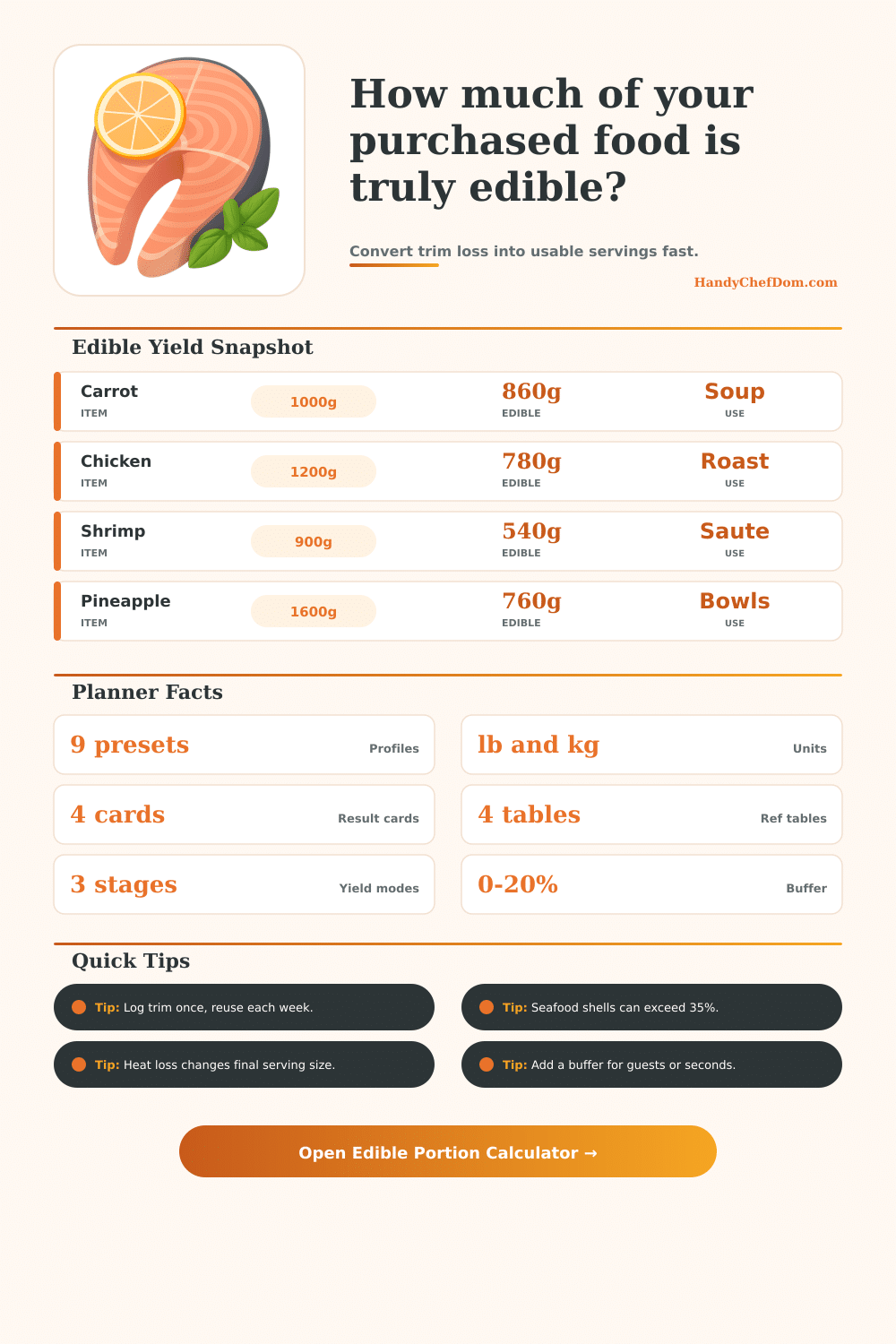
Edible Portion Calculator for Trim, Yield, and Shopping Weight
Turn as-purchased weight into edible portions with visible trim, peel, shell, and cooking loss adjustments so your shopping list matches real plate output.
Start with item defaults: adjust losses to match your kitchen method, then compare edible output before and after cooking.
| Item | Yield % | Main loss | Prep cue |
|---|---|---|---|
| Carrot | 84-92 | Peel | Thin peel |
| Pineapple | 45-55 | Skin/core | Deep eyes |
| Chicken thigh | 60-70 | Bone | Debone |
| Shrimp shell-on | 52-65 | Shell | Peel raw |
| Broccoli | 70-82 | Stem trim | Crown cut |
| Mango | 60-72 | Pit/skin | Cheek cut |
| Profile | Trim % | Peel % | Notes |
|---|---|---|---|
| Root veg | 5-10 | 3-8 | Brush first |
| Tropical fruit | 4-8 | 25-40 | Core heavy |
| Leafy bunch | 8-18 | 0 | Stem discard |
| Bone-in meat | 4-10 | 0 | Fat trim |
| Shellfish | 2-6 | 0 | Vein clean |
| Method | Shrink % | Best for | Cue |
|---|---|---|---|
| Steam | 3-8 | Veg | Low loss |
| Roast | 8-18 | Roots/meat | Dry heat |
| Saute | 6-14 | Seafood | Quick pan |
| Braise | 5-12 | Tough cuts | Covered pot |
| Grill | 10-22 | Steaks | High heat |
| Form | Adj factor | Use case | Tradeoff |
|---|---|---|---|
| Whole | 1.03x | Low price | More waste |
| Trimmed | 1.00x | Balanced | Mid price |
| Ready | 0.97x | Fast prep | Higher cost |
This edible portion calculator translates market weight into practical kitchen yield, so prep plans stay realistic from first cut to final plated serving.
Use the comparison grid to see where weight drops: trimming, peel or shell removal, then cooking shrink. The buy target card rounds your final need to a shopping-friendly step.
As-purchased weight and edible portion weight are two different measurement of the same food item. In order to cook successfuly, it is essential to understands the difference between these two measurements. As-purchased weight is the total weight of the food items that you buy from the store.
Edible portion weight is the weight of the food item after removing all the non-edible portion of that food item. Many people experience a shortage of food due to the fact that the as-purchased weight of the food item is greater than the edible portion weight of those same items. This shortage in edible portions occur due to the discard of certain portions of the food items that are not edible for humans to consume.
As-Purchased Weight and Edible Portion Weight
Loss occur during the preparation of food during several different stages of preparation. Loss occurs due to the fact that some portions of food items is not meant to be eaten by humans. Trim loss is the loss that occurs when the butcher remove portions of the food that are bruised or woody.
Other types of loss include peel loss and core loss, where the skin or the center of food items are removed to make the food items edible. Food items like seafood and meats that contain bones has a high level of loss, as the shells and bones of the food items must be removed before they can be consumed by humans. This loss increase the gap between the as-purchased weight and edible portion weight of these types of food items.
Yield is a measurement of the amount of edible food that an item will contain. The yield of food items is calculated as a percentage of the total weight of the as-purchased food items. Carrots have a high yield for food preparation due to the fact that they require little peeling to prepare them to eat.
Pineappes, on the other hand, have a low yield due to the large amount of skin and the large amount of core contained within the pieces of pinnapples. A yield calculator can be used to calculate the percentage of edible portion weight of food items. Calculating the yield of food items allow cooks to prepare enough food for the number of guests they will have at the table without purchasing too much or too little food.
Cooking shrinkage is another type of loss in food preparation. Cooking shrinkage is different from the loss of food during preparation. Cooking shrinkage occur when cooks remove moisture from meats and seafood during the cooking process.
Additionally, fats will also render during the cooking process of meat and seafood. If cooks would like to prepare a large portion of meat or seafood, they will need to start with more food than the target weight of the food that will be served to the guests. For instance, cooks may need to start with raw meat that weigh six ounces when they would like to provide a six ounce portion of cooked meat for their guests due to the loss of weight of the food during the cooking process.
A guest buffer is another way to account for the loss of food during the meal. A guest buffer is the extra amount of food that cooks plan on the menu for the guests. Using a guest buffer allow cooks to account for the fact that some of their guests may eat multiple portions of certain food item.
A guest buffer also accounts for the fact that some of the food will be dropped or wasted during the meal. Another way to alter the yield of food items is to purchase pre-trimmed food. Pre-trimmed food items are more expensive than whole food items.
The reason that pre-trimmed food items are more expensive is due to the higher yield that these foods offer to chef. One of the best ways to improve accuracy within a kitchen is to log your own data. By logging the data from your own kitchens you can find your specific yield rate.
People have different knife skill than others. The skill with which cooks prepare food will alter the amount of food that is lost during preparation. By weighing the scraps of food that are prepared cooks can determine the amount of weight that is lost during the preparation process.
With this data cooks can prepare their own custom profile in their yield calculator. Reference tables are also available to cooks to provide typical yields of food items. Cooks can use these reference tables if they do not have their own data on the yields of food items in their kitchens.
These tables can indicate the yields of different food group. For instance, the reference tables may indicate that the yields of tropical fruits are different than the yields of root vegetables. If cooks use these tables they may realize that certain food items will have to be purchased in greater amounts due to their low yields.
These tables allow cooks to focus on the cost of food items on a per ounce basis rather than the total price of the food items at the store. Mastering the concept of edible portion weight will allow cooks to control the amount of food that is prepared in their kitchens. Additionally, if cooks master this concept they will experience less stress in the kitchen during the cooking process.
Cooks that understand edible portion weight will have confidence in the food that they are preparing. They will also waste less food. If cooks understand edible portion weight they will not have to make trips to the store to purchase food due to the fact that they ran out of food during the previous meal.
When cooks understand edible portion weight they will consider both the as-purchased and edible portion weight of food items when purchasing them in the future.