🍮 Gelatin Per Cup of Liquid Calculator
Calculate powdered or sheet gelatin for soft desserts, panna cotta, medium molds, aspic, and gummy-style firmness from the liquid you already measured.
Choose the target set, liquid style, and gelatin format. The calculator converts the liquid to cups, adjusts for bloom strength, and estimates powder teaspoons, packets, or sheet count.
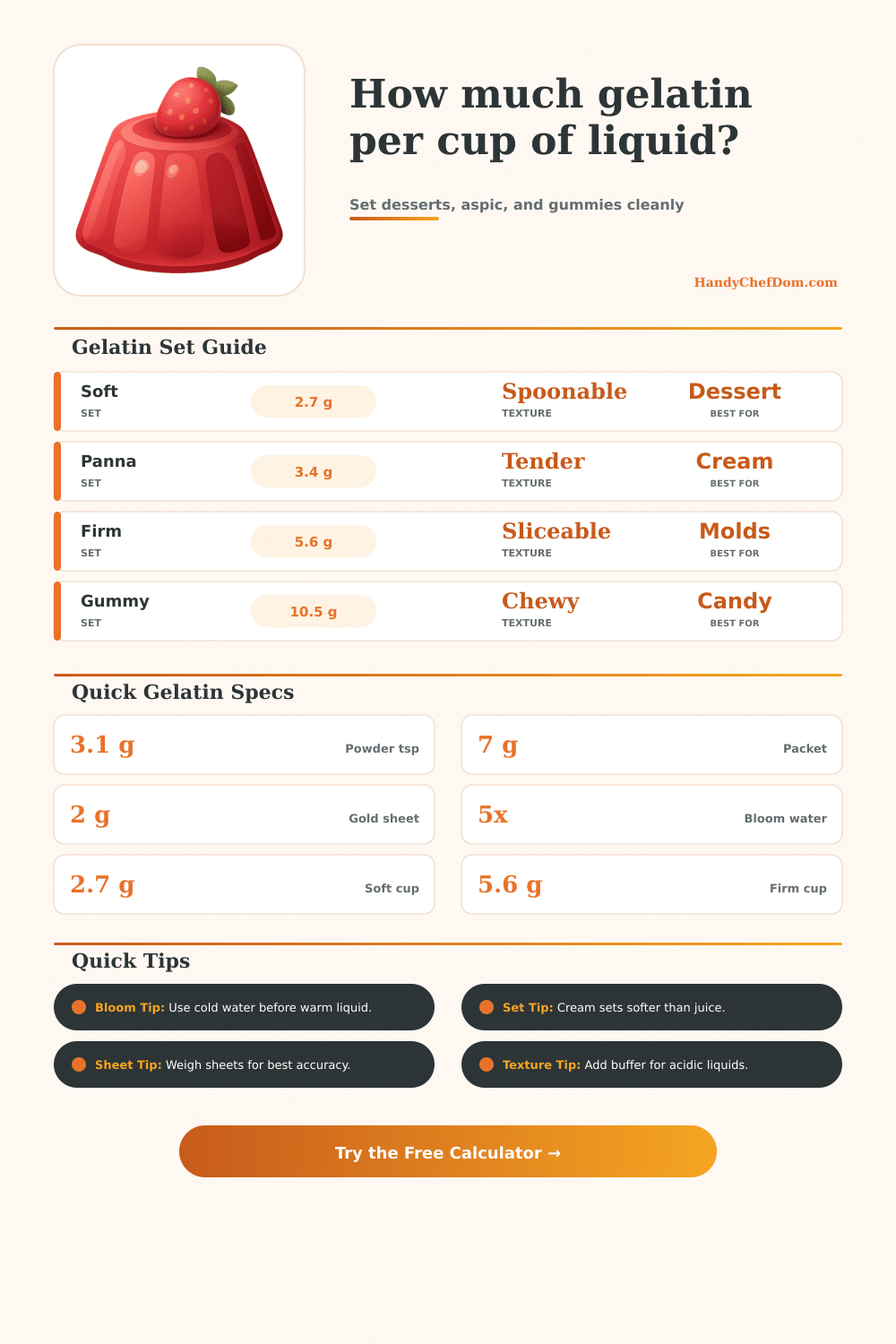
| Set Target | Base Gelatin | Texture | Best Liquid Use |
|---|---|---|---|
| Soft spoon dessert | 2.7 g per cup | Delicate and jiggly | Custard cups, light fruit gels |
| Panna cotta tender | 3.4 g per cup | Creamy but unmoldable | Panna cotta, cream desserts |
| Medium layered dessert | 4.2 g per cup | Clean scoop set | Layered gelatin, mousse inserts |
| Firm sliceable mold | 5.6 g per cup | Holds a cut edge | Terrines, molded desserts |
| Aspic or savory gel | 6.8 g per cup | Firm clear wobble | Stock gels, savory molds |
| Gummy-style chew | 10.5 g per cup | Dense and chewy | Gummy bites, gel candy |
| Liquid Base | Calculator Factor | Setting Label | Why It Changes |
|---|---|---|---|
| Milk or dairy custard | 1.00x | Balanced dairy set | Standard reference base for creamy desserts |
| Heavy cream blend | 0.95x | Soft cream set | Fat gives body, so slightly less gelatin may work |
| Fruit juice | 1.10x | Bright juice set | Acid and sugar can soften the final gel |
| Wine or cocktail base | 1.18x | Alcohol set | Alcohol weakens gel structure, so more is needed |
| Savory stock or broth | 1.05x | Clear aspic set | Salt and dissolved solids can loosen the gel slightly |
| Coffee or tea | 1.00x | Clean infusion set | Usually close to a neutral water-based liquid |
| Fruit puree | 1.25x | Thick puree set | Fiber and pulp interrupt a clean gel network |
| Coconut milk | 1.08x | Coconut dessert set | Fat and solids need a little extra structure |
| Gelatin Format | Typical Bloom | Average Weight | Calculator Use |
|---|---|---|---|
| Powdered gelatin | 200 bloom | 3.1 g per tsp | Reports teaspoons and 7 g packet equivalents |
| Bronze sheets | 140 bloom | 3.3 g per sheet | Needs more grams than gold for the same set |
| Silver sheets | 160 bloom | 2.5 g per sheet | Common pastry sheet with medium strength |
| Gold sheets | 200 bloom | 2.0 g per sheet | Matches the base calculation closely |
| Platinum sheets | 230 bloom | 1.7 g per sheet | Higher bloom means fewer grams are needed |
| Custom bloom powder | User value | Use label value | Change declared bloom strength if your label differs |
| Batch Volume | Soft Dessert | Panna Cotta | Firm Mold |
|---|---|---|---|
| 1 cup liquid | 2.7 g | 3.4 g | 5.6 g |
| 2 cups liquid | 5.4 g | 6.8 g | 11.2 g |
| 4 cups liquid | 10.8 g | 13.6 g | 22.4 g |
| 500 ml liquid | 5.7 g | 7.2 g | 11.8 g |
| 750 ml liquid | 8.6 g | 10.8 g | 17.8 g |
| 1 liter liquid | 11.4 g | 14.4 g | 23.7 g |
Have you ever been frustrated by a failed gelatin dessert? Have you watched as your fruit puree simmers away, only to add egg yolks and spend hours tempering them before pouring the whole mess into a mold? I chilled it all in the fridge. I turned it upside-down onto a plate. Did you watch it slide around like a puddle of nothingness?
That’s annoying, and it’s also typically not a problem with technique… It’s chemistry. In fact, the behavior of gelatin are more like a variable control: It’s not an on/off thing but can be made to work or not work based off what else is in the bowl.
Why Gelatin Deserts Fail and How to Fix Them
Depending on amount of liquid and level of firmness you want, the calculator calculates exactly the right dosage of gelatin for you. No more guessing about sheets or powder. Of course you should know which ingredients makes what kind of difference.
The strength of the gelatin depends on what it will be holding. Heavy cream make a great panna cotta; the fat strengthens the set. Less gelatin is needed here then when setting fruit juice. Sugar and acid will eat away at the gelatin network. Depending on the ingredients involved, the tool prompts you to input your liquid base and adjust to match.
Acid breaks down the gelatin structure. Acidic molecules break the bonding between proteins, whether in a wine- or citrus-gel based aspic. For high-acid ingredients, the calculator adjust accordingly. It might sound odd that you’d use more gelatin for a soft ingredient, but without it, the dessert remain liquid.
Alcoholic bases weakens the hold considerably. A cocktail gel require more gelatin than a neutral milk custard. Why? It is physics, not taste. Don’t ignore this factor and be disappointed.
Those measuring with volume (rather than weight) gets confused about bloom strength. There are multiple brands of powdered gelatin packs; they differs from region to region. Sheet strengths vary: platinum, gold, silver, and bronze. Generally, gold equals common powders. Platinum is stronger, requiring less by weight. To know the conversion, see table above.
For accuracy, weigh your gelatin! A heaping teaspoon of powder might give you thirty percent more or less than a level one and that variance is enough to ruin a delicate mousse layer.
Settling on the bloom. To let the gelatin swell and start to bond to other protein chains, it needs to be hydrated by soaking it in cold water prior to mixing with a warm liquid. Soaking in warm water instead, or skipping the soak altogether mean your gelatin will have lost its ability to set. The amount of water required for blooming is calculated by recipe calculator. And that’s what makes it slushy or firm. It wants to fully dissolve into the hot liquid, stirring til there are no more grains. Uneven lumps causes an uneven set.
Lastly, think about a textural buffer. The recipe says soft set? But you want something that can be presented on warm plate while holding its shape. Hedge your bet with a bit more gelatin. It’s insurance against measurement error and temperature fluctuation. You should of used more if it was too thin. That’s especially true when you have company. Nobody wants to hear about why the dessert is dripping down their chin.
Bloom properly, trust the math, and let the chemistry work for you. Your next dessert will be one you can stand behind.