🛠 Range Hood Duct Size Calculator
Balance hood CFM, run length, elbows, and duct shape to choose a cleaner vent path and a better-sized duct.
Imperial uses feet and inches. Metric uses meters and centimeters. The calculator converts every run into one equivalent round-duct load.
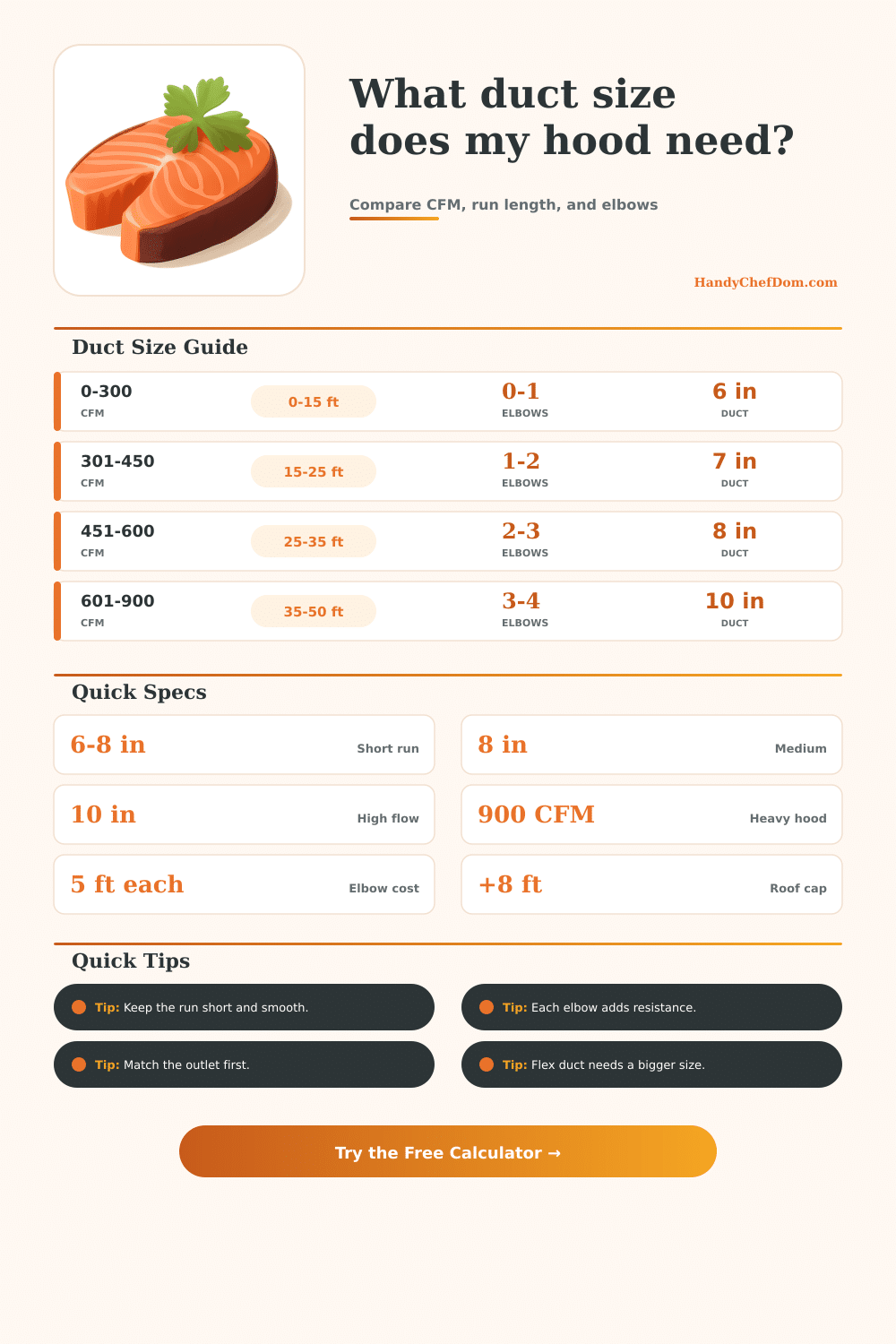
| CFM | Run | Elbows | Min duct |
|---|---|---|---|
| 0-300 | 0-15 ft | 0-1 | 6 in |
| 301-450 | 15-25 ft | 1-2 | 7 in |
| 451-600 | 25-35 ft | 2-3 | 8 in |
| 601-900 | 35-50 ft | 3-4 | 10 in |
| Part | Feet | Factor | Note |
|---|---|---|---|
| 90 elbow | 5 ft | x1 | Smooth turn |
| Roof cap | 8 ft | x1 | Short exit |
| Inline vent | 2 ft | x1 | Low drag |
| Flex run | 50% | x1.5 | More drag |
| Cooktop | Hood | Style | Note |
|---|---|---|---|
| 24-30 | 30-36 | Light | Small zone |
| 30-36 | 36-42 | Normal | Home fit |
| 36-48 | 42-48 | Heavy | Better capture |
| 48+ | 48-60 | Pro | Wide span |
| Round | Rect | Area | Use |
|---|---|---|---|
| 6 in | 3.25x10 | 28 in2 | Small |
| 7 in | 4x10 | 39 in2 | Mid run |
| 8 in | 5x10 | 50 in2 | Common |
| 10 in | 6x10 | 79 in2 | High flow |
When you installs a kitchen range hood, you have to consider the movement of air through the ducting. Many focus on the CFM of the range hood, which is the amount of air that the motor of the range hood can move. However, if the ducting is too narrow for the range hood, the ducting will create a bottleneck for the movement of the air.
When the air cannot move efficient through the range hood, the motor has to work harder to move the air through the kitchen range hood, thus creating a greater noise level from the range hood. Additionally, if the motor of the range hood is working harder than it should, there will be a decrease in the suction of the range hood. Another consideration when purchasing a range hood is the static pressure that the air will encounter as it moves through the ducting.
How Ducts Affect Range Hood Performance
Every elbow and inch of the range hood ducting will create static pressure because each portion of the ducting creates resistance for the movement of the air. For instance, every ninety degree elbow will make the air hit the side wall of the elbow. This will create a loss of the momentum of the air as it passes through that elbow.
The concept of equivalent length is used to describe the length of each turn in the ducting. The more elbows in the ducting system, the greater the equivalent length of the ducting system. The greater the equivalent length of the ducting system, the less air the range hood will move through the ducting system.
The path that the air take from the range hood to the outdoors will also impact the range hoods efficiency. The best path for the air to travel from the range hood to the outdoors is a short and straight path. The shorter the path, the less the air will encounter resistance as it moves through the ducting.
However, in many homes, the path of the air has to travel through the ceiling and attic of the home to exit through the roof. In these cases, the air will travel a longer path, and therefore there will be greater friction in the ducting system. If the air is traveling over a long distance, you must increase the diameter of the ducting to allow the air to travel more easily through the ducting.
Using a larger diameter for the ducting will allow the range hood to maintain its CFM. Another factor to consider is the material that you use for your ducting. Rigid galvanized steel is the best material to use for the ducting system because its interior walls are smooth.
The smooth interior walls allow the air to travel through the ducting with minimal friction. Many homeowners chooses flexible foil ducting for their kitchen range hood ducting systems because it is easier to install. However, flexible foil ducting will not be as efficient as rigid galvanized steel ducting.
Due to the ribbed interior of flexible foil ducting, there will be turbulence in the air within the ducting. This turbulence will reduce the movement of the air through the ducting system. Therefore, if you choose flexible foil ducting, you must increase the diameter of the ducting to allow for the air to travel through the ducting without encountering too much resistance.
If you cook heavy in your kitchen, such as sautéing meat, searing meat, or stir frying in a wok, you will produce a significant amount of smoke and grease. In contrast, light cooking, such as boiling water, requires less range hood and ducting system component. The heavy cooking requirements will require a range hood with a higher rate of air movement to ensure that the smoke and grease is removed from the kitchen.
If you have a wide cooktop, you will produce smoke over a wide area, so you will need a robust venting path in your kitchen. Another measurement to consider is the adjusted CFM of the range hood. The adjusted CFM measure the amount of air that the range hood will move through the ducting system.
If the range hood model has many elbows in its ducting system, for instance, the range hood will move less air through the system. If the range hood model has a rated CFM of 600, but the ducting system is too small to allow the air to move easy through the kitchen, the actual CFM of the range hood may drop to 300. In this case, ensure that the adjusted CFM that the range hood will move through the ducting is high enough to meet the requirements of your cooking area.
One of the most important considerations when purchasing a range hood is the diameter of the ducting that it employs. If the diameter is too small for the range hood, the velocity of the air will increase. Additionally, as the velocity of the air increases, the noise level of the range hood will increase.
Furthermore, the small diameter will place stress on the motor of the range hood. If you increase the diameter of the ducting, the range hood will move and exhaust the air more quiet. Additionally, the motor will not have to work as hard to move the air, so it will operate more efficiently.
Therefore, using a larger diameter for the ducting is a better choice than a small diameter. However, to ensure that the range hood operates correctly in your kitchen, account for the equivalent length of the ducting system and cooking requirements.