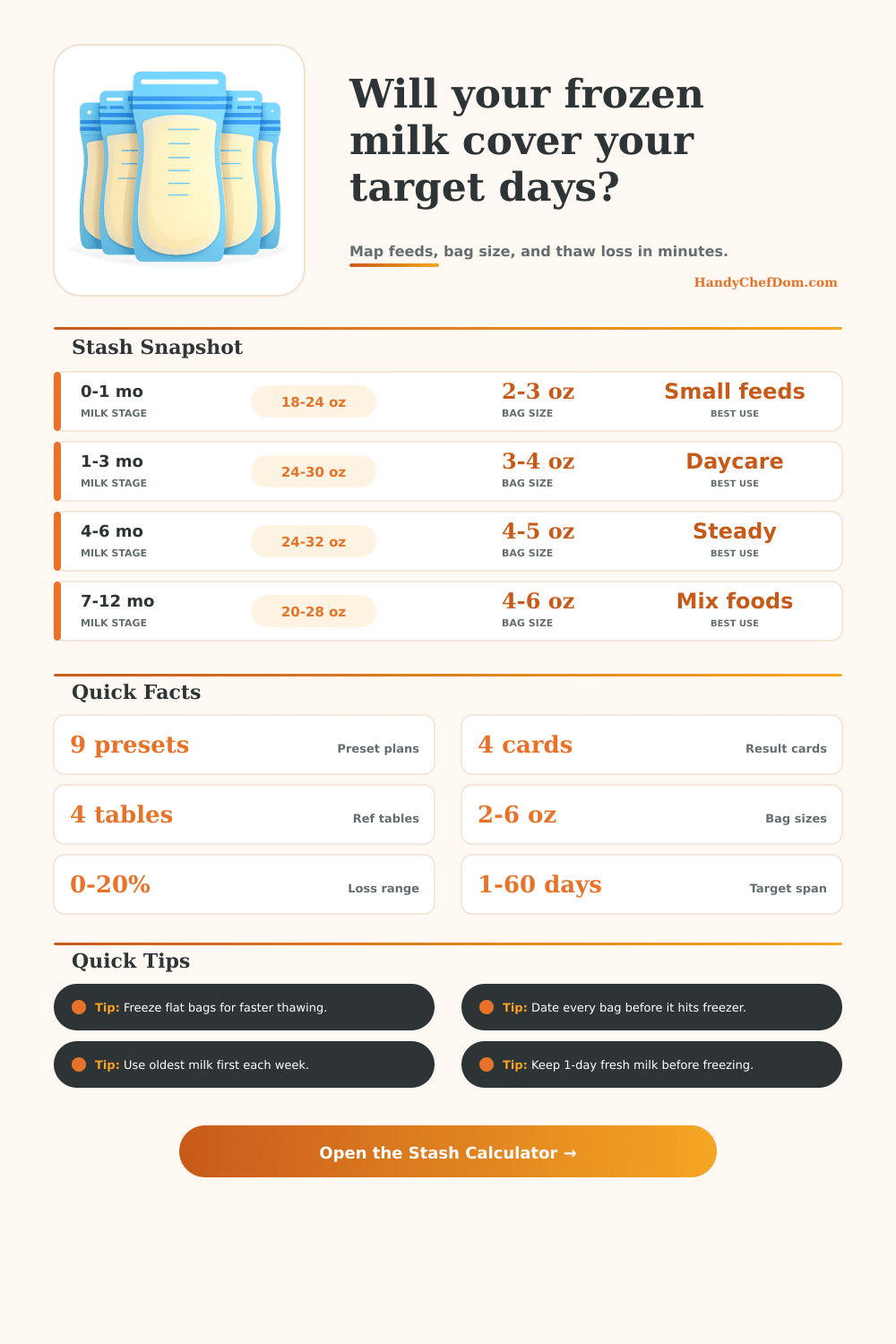
Breast Milk Freezer Stash Calculator
Project stash coverage from feeds, pumping output, bag size, and thaw loss so your freezer plan matches your baby's real daily intake.
Planning note: Use a bag count that reflects what is truly frozen, then add thaw loss to estimate usable milk instead of total poured milk.
| Milk state | Room 77F | Fridge 40F | Freezer |
|---|---|---|---|
| Fresh pumped | Up to 4 hr | Up to 4 d | 6 mo best, 12 mo max |
| Thawed milk | 1-2 hr | Up to 24 hr | Do not refreeze |
| Leftover feed | Use in 2 hr | Use in 2 hr | Discard after |
| Cooler + packs | Up to 24 hr | Move to fridge | Freeze soon |
| Bag fill | Metric | Best use | Typical thaw |
|---|---|---|---|
| 2 oz | 60 ml | Top-up feed | 10-15 min |
| 3 oz | 90 ml | Newborn feed | 12-18 min |
| 4 oz | 120 ml | Mid feed | 15-20 min |
| 5 oz | 150 ml | Daycare bottle | 18-24 min |
| 6 oz | 180 ml | Older infant | 20-28 min |
| Method | Milk size | Time | Rule |
|---|---|---|---|
| Fridge thaw | 4 oz bag | 8-12 hr | Warm after thaw |
| Warm water bowl | 4 oz bag | 10-20 min | No boiling water |
| Running warm tap | 3 oz bag | 8-15 min | Seal bag tight |
| Bottle warmer | 5 oz bottle | 4-8 min | Swirl, do not shake hard |
| Ounces | Milliliters | Approx grams | Use cue |
|---|---|---|---|
| 1 oz | 30 ml | 30 g | Medicine top-up |
| 2 oz | 60 ml | 60 g | Small bottle |
| 3 oz | 90 ml | 90 g | Short feed |
| 4 oz | 120 ml | 120 g | Standard feed |
| 5 oz | 150 ml | 150 g | Long nap feed |
| 6 oz | 180 ml | 180 g | Older infant |
This freezer stash calculator helps you plan with practical numbers: daily intake, pump output, thaw loss, and bag format. Use it to set realistic coverage goals and maintain a safer milk rotation rhythm.
To calculate the number of days of nutrition that a milk stash will provide to a baby, you must account for a few factors. The total number of bag of milk will not always provide the number of days of nutrition needed by the baby. For example, many people make the mistake of calculating the total volume of milk that will be used.
However, a person must calculate the amount of usable milk from the total milk quantities. Milk is lost in the thawing process, and milk is lost when the milk are moved from the storage bag to a bottle for the baby. If thaw loss isnt accounted for in calculating how long the milk stash will last, then the calculations will be incorrect regarding how much milk the baby will consume.
How Long Will Your Frozen Breast Milk Last
Babies of different ages require different amounts of milk to fulfill there nutritional requirement. For example, newborns require more milk than babies of six months of age. Thus, if a woman calculates the amount of milk required to satisfy the needs of a six month old baby based off the milk requirements of a newborn, she will not have enough milk to meet the requirements of the six-month-old baby.
Therefore, calculations for milk must be updated based upon the age of the baby. The relationship between the amount of milk that a woman pump from her breasts each day, and the amount of milk that her baby consumes is another factor that must be accounted for. If the woman pumps more milk than the baby consumes, the amount of milk in her milk stash will increase over time.
If she pumps the same amount of milk as the baby consumes, there will be a steady supply of milk for the baby, but the milk stash will not increase. If she pumps less milk than the baby consumes, her milk stash will decline over time. Thus, by understanding the relationship between milk pumped and milk consumed, she can understand how her milk stash is changing.
The type of freezer that is used to store the milk can also impact the amount of time that the milk will remain usable within her milk stash. For example, deep freezers maintain a constant temperature within the milk bags, while fridge freezers are frequently opened and closed to allow for the placement of food into the fridge. These temperature fluctuations within the fridge can impact the quality of the milk, and the length of time in which the milk can be used.
Thus, the type of freezer that is used to store milk impact the length of time that the milk will remain usable within her milk stash. It is also important to ensure that milk bags are properly rotated within the freezer. Many people place bags of milk into the freezer such that the new milk is placed upon the older milk.
In this case, if people dont rotate the milk bags, the oldest milk will remain at the bottom of the freezer compartment. If the oldest milk is not used, that milk may expire before it can be used. Thus, by rotating the milk bags within the freezer, a first-in, first-out system can be created, which ensures that the oldest milk bags are used before they become too old to use.
Another factor to consider is the size of the bags in which the milk is stored. For example, if six ounce bags of milk are used, but the baby only consumes four ounces of milk each time, then two ounce of milk will be left over in each bag. Any leftover milk within a bag is typically discarded, as it is difficult to re-freeze milk that has been removed from a storage bag.
Thus, using bags of the same size as the amount of milk that the baby consumes will reduce the amount of milk that is wasted, as well as the number of times that the breastfeeding mother must handle the milk. Finally, knowing the exact number of days that the milk stash will last will reduce the stress that is associated with the management of the milk stash. If a woman knows the exact number of days that her milk stash will last, she dont have to guess at the amount of milk that she has within the milk stash.
By knowing the number of days that the milk will last, she can make certain that she has enough milk to meet her babys requirements, or she can decide whether she needs to pump more milk to create a sufficient milk stash for her baby. Thus, when a mother goes from guessing the number of days of milk in her milk stash, to knowing this number in advance, she can manage her milk stash with readiness, rather than anxiety.