🍞 Rye Flour in Rye Bread Calculator
Split total flour into rye and wheat flour, estimate water from hydration, scale loaves, and check whether your rye bread style matches the selected flour type.
Use total flour as the flour-only basis. Seed add-ins are calculated separately so the rye percentage remains a true flour percentage.
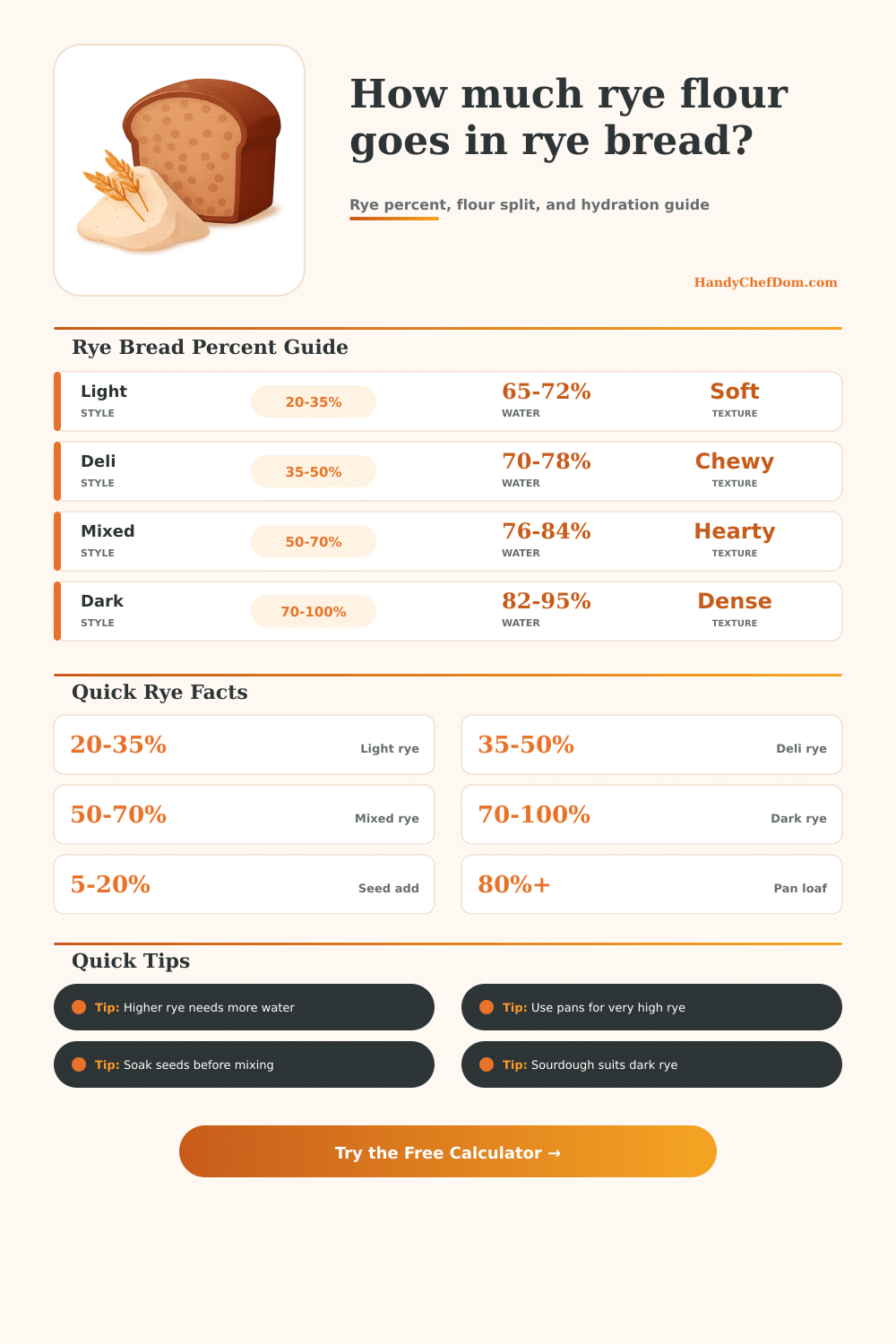
| Rye Percentage | Rye Flour Character | Common Bread Style | Dough Handling Note |
|---|---|---|---|
| 10% to 20% | Subtle rye flavor | Beginner rye or wheat-rye loaf | Handles much like wheat bread |
| 20% to 35% | Noticeable rye without much density | Sandwich rye, cocktail rye, soft rolls | Good for yeast or hybrid doughs |
| 35% to 50% | Classic deli rye balance | Deli rye, seeded rye, sourdough rye | Needs gentler shaping than wheat dough |
| 50% to 70% | Hearty and darker crumb | German mixed rye or rustic pan loaf | Benefits from sourdough acidity and rest |
| 70% to 90% | Dense, moist, strongly rye-forward | High rye pan loaf or Nordic rye | Usually better in a pan than free-form |
| 90% to 100% | All or nearly all rye flour | Pumpernickel-style or dense rye tin | Expect paste-like dough, not stretchy dough |
| Rye Type | Bran Level | Flavor and Color | Hydration Tendency |
|---|---|---|---|
| Light rye flour | Lower bran | Mild flavor and pale crumb | Lowest extra absorption in rye formulas |
| Medium rye flour | Moderate bran | Balanced rye taste and tan crumb | Often needs a little more water than light rye |
| Dark rye flour | Higher bran and ash | Robust flavor and darker crumb | Absorbs more water and likes longer rest |
| Pumpernickel meal | Coarse whole rye | Deep rye flavor and dense texture | Highest water demand, often with soaks |
| Whole rye flour | Whole grain | Earthy flavor with full grain character | Similar to dark rye, depending on grind |
| Sifted rye flour | Some bran removed | Smoother texture than whole rye | Between light and medium rye behavior |
| Rye Bread Style | Typical Hydration | Rye Range | Best Fit |
|---|---|---|---|
| Rye rolls or cocktail rye | 62% to 70% | 20% to 40% rye | Small loaves and sliced party bread |
| Soft sandwich rye | 65% to 72% | 20% to 45% rye | Flexible slices with familiar wheat structure |
| Deli rye | 70% to 78% | 35% to 50% rye | Classic balance of chew and rye flavor |
| Artisan rye boule | 72% to 82% | 25% to 55% rye | Free-form loaf with wetter handling |
| German mixed rye | 76% to 84% | 50% to 70% rye | Hearty crumb with enough wheat support |
| High rye pan loaf | 82% to 95% | 70% to 100% rye | Pan-supported dough with moist crumb |
| Nordic seeded rye | 85% to 100% | 60% to 90% rye | Seeded loaf with extra soak water |
| Pumpernickel-style loaf | 88% to 105% | 90% to 100% rye | Dense tin loaf or rye meal formula |
| Bread Style | Recommended Rye Percent | Typical Leavening | Structure Expectation |
|---|---|---|---|
| Beginner wheat-rye loaf | 10% to 25% | Yeast or hybrid | Still stretches and kneads like wheat dough |
| Sandwich rye | 20% to 45% | Yeast, hybrid, or mild sourdough | Softer crumb with enough wheat gluten |
| Deli rye | 35% to 50% | Yeast plus sourdough flavor or hybrid | Moderate chew and easy slicing |
| Artisan rye boule | 25% to 55% | Sourdough or hybrid | Good free-form loaf if wheat remains strong |
| German mixed rye | 50% to 70% | Sourdough preferred | Less elastic, more paste-like handling |
| Nordic seeded rye | 60% to 90% | Sourdough preferred | Dense, moist, seed-heavy pan loaf |
| Pumpernickel-style loaf | 90% to 100% | Sourdough preferred | Very little gluten structure, pan support needed |
Rye bread is a type of bread that exists in the middle of the spectrum between wheat bread and dense dark breads. The characteristics of rye bread depend upon the amount of rye flour that is use in the dough. The amount of rye flour that is used in the dough will determine the behavior of the dough itself.
If the amount of rye flour is high enough that it makes up a large portion of the total amount of flour that are used in the dough, the gluten that naturally forms in the dough will be more weaker, as well as the amount of water that the flour will be able to absorb. As a result, the dough will not behave in the same way as dough made with wheat flour alone, but will require a loaf pan to hold its shape. Thus, the percentage of rye flour that is used in a recipe for rye bread is a critical factor for the bread to contain the types of characteristics that is desired.
How Much Rye and Water to Use in Rye Bread
The calculator that is provided here will help to mathematicaly calculate the ingredients that is required to be made into a recipe for rye bread. You can enter the total weight of the flour that is to be used into the calculator, as well as the percentage of rye flour that is to be used and the desired hydration levels for the dough. The calculator will calculate the amount of both rye flour and wheat flour that will need to be used, as well as the amount of water that will be required for the recipe based off the percentage of rye flour that is to be used.
The type of rye flour that is to be used in the recipe is another important variable in the creation of rye bread. Dark rye flour contain more water than light rye flour, meaning that more water will be required in the recipe for darker rye flour to accomplish the same level of hydration as a recipe using light rye flour. Finally, any add-ins for the rye bread, such as seeds, is separate from the percentage of rye flour to wheat flour that is used.
The seeds will require their own amount of water to soak prior to incorporate them into the rye bread recipe, but their inclusion in the recipe will not impact the percentage of rye to wheat flour that is used to produce a bread with the desired type of crumb. A person will note the difference in the type of rye bread that is produced based upon the percentage of rye flour that is used in the dough. For instance, using twenty-five percent rye flour will result in a dough that behave in a similar way to dough that does not contain any rye flour at all, and is, therefore, easier for a beginner to prepare.
Forty percent rye flour will result in dough that is less elastic than bread that contains only twenty-five percent rye flour. Finally, if the percentage of rye flour is sixty or seventy percent, the dough will not behave in the same way as traditional breads. Because dough that contains seventy percent rye flour will not be able to hold its own shape, using a loaf pan in which to bake the bread will be required.
Additionally, bread that contains seventy percent rye flour will contain a crumb that is dense and moist, but will not contain a crumb that is expected from traditional bread, one that is open and chewy. The calculator will identify each of these variations in the type of bread based upon the percentage of rye flour that is selected, thus avoiding any issues with creating dough that will not rise proper. Because rye flour does not contain as much gluten as wheat flour, the type of dough that is produced will contain less elasticity.
Thus, more water must be added to compensate for the fact that rye flour does not create as strong a gluten web as wheat flour. The amount of extra water that will be required to counteract the low ability of rye flour to form gluten is relatively small if the percentage of rye flour is low. However, if the percentage of rye flour is higher than fifty percent, the amount of extra water that is required increase to very large amounts.
For instance, to make a loaf of light rye bread that will be used as sandwich bread, sixty-eight percent hydration will be required. For a loaf of Nordic style bread that contains seventy-five percent rye flour, however, ninety percent hydration is required. In addition to the amount of water needed for the flour, an additional amount of water will be required to soak the seeds that will be added to the bread.
This water will be used to prevent the seeds from removing moisture from the dough itself, but it will increase the total amount of water that will be used in the recipe. Thus, the calculator for rye bread recipes mathematically separates these two variable so that the recipe can be properly repeated. Finally, the type of leavening agent that is used will also impact the type of bread that is produced.
Using sourdough for recipes that contain high percentages of rye flour will result in rye bread with improved shelf life. Commercial yeast can be used for recipes that contain low percentages of rye flour, but may result in a flat flavor for the bread if it does not contain enough acidity to neutralize the flavor of the rye. The leavening agent selector will not impact the mathematical calculation of the recipe, but will change the hydration percentages that are required according to the type of leavening agent that is to be used.
As with most things in life, mistakes will be made in the baking of rye bread. For instance, an individual may be unaware that seventy percent of the recipe should be rye flour, but may still attempt to shape the dough as if it were wheat flour. Furthermore, most individuals who attempt to bake bread at home will not be aware of the need to allow the dough to rest to permit the rye flour to absorb the water.
These types of mistake will result in bread that either does not rise properly, or that spreads out across the baking sheet when it is baked. The reference tables will allow an individual to recognize these types of baking mistakes, so that the adjustment to the recipe can be made. Once an individual understands the relationship between the percentage of rye flour that is used in the recipe and the type of bread that is produced, an individual will find it easier to make decision regarding the composition of rye bread.