🍷 Back Sweetening Wine Calculator
Estimate the exact sweetener addition to reach a residual sugar target while tracking dilution, final batch size, and dosing details for stable cellar work.
Batch Presets
Sweetness Labels
Cellar Inputs
Formula: Required sugar = (target RS - current RS) x final volume, solved with sweetener sugar density and addition volume feedback.
Back Sweetening Breakdown
Sweetener Comparison Grid
Reference Tables
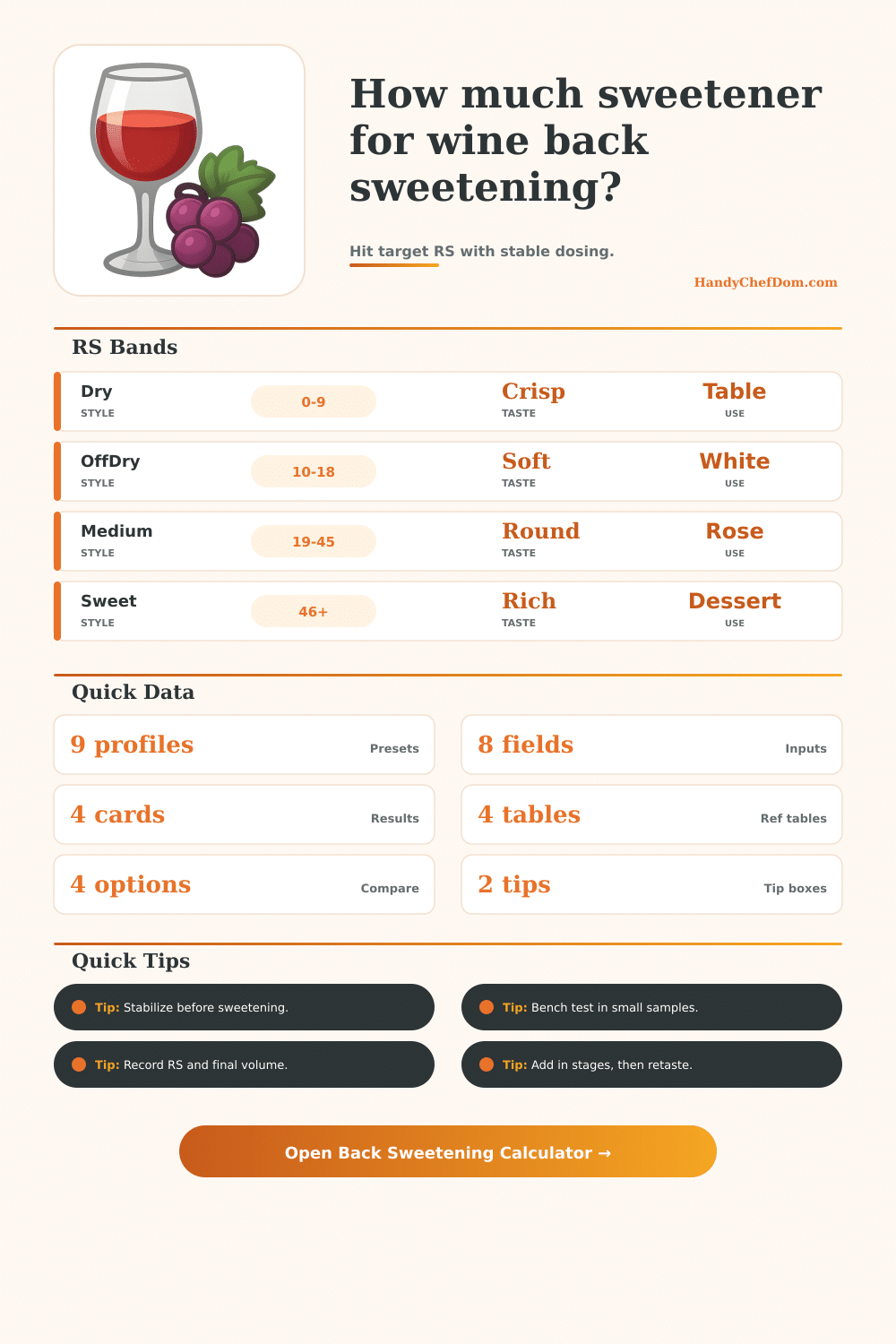
| Band | RS g/L | Perception | Common use |
|---|---|---|---|
| Bone dry | 0-4 | Sharp | Brut base |
| Dry | 5-9 | Crisp | Table white |
| Off-dry | 10-18 | Soft | Riesling |
| Medium dry | 19-30 | Round | Rose |
| Medium sweet | 31-45 | Lush | Aperitif |
| Sweet | 46-120 | Rich | Moscato |
| Dessert | 121+ | Dense | Late hvst |
| Style | Target RS | Typical acid | Note |
|---|---|---|---|
| Sauv Blanc | 6-10 g/L | 6-8 g/L | Keep crisp |
| Riesling | 12-28 g/L | 7-10 g/L | Acid balance |
| Rose | 15-30 g/L | 5-7 g/L | Fruit lift |
| Chenin | 18-40 g/L | 6-9 g/L | Broad range |
| Moscato | 45-90 g/L | 5-7 g/L | Aromatic |
| Dessert | 120-220 g/L | 6-10 g/L | Serve cool |
| Sweetener | Sugar g/ml | Volume need | Impact |
|---|---|---|---|
| Simple 1:1 | 0.50 | Higher | Light body |
| Rich 2:1 | 0.67 | Lower | Less dilute |
| Grape conc | 0.68 | Lower | Wine match |
| Honey 70:30 | 0.72 | Lower | Floral tone |
| Dry sugar | 1.00* | Lowest* | Needs stir |
| Step | Sorbate | SO2 | Hold |
|---|---|---|---|
| Rack clean | No | Check | 24 h |
| Bench test | No | Check | Same day |
| Stabilize | Yes | Adjust | 48 h |
| Add sweet | Done | Stable | Mix well |
| Retest RS | Done | Stable | 24 h |
| Package | Done | Target | Cellar |
Back sweetening are the process of adding sugar to wine after the fermentation process is complete. Winemakers use back sweetening because they must decide how sweet the wine will be. Some wines will be dry because the yeast have consumed all the sugar in the wine.
However, other wines will contain some residual sugars after fermentation. Winemakers must decide how many sugar to add to the wine to achieve there desired level of sweetness. The calculator include several fields for the winemaker to include information about the wine.
How to Make Wine Sweeter After Fermentation
The winemaker must enter the batch size of the wine into the calculator. Additionally, the winemaker must enter the amount of sugar that is alredy in the wine (residual sugar) into the calculator. The winemaker must also enter the target level of residual sugar that the winemaker desire the wine to contain into the calculator.
The winemaker must also select the type of sweetener that will be added to the wine. Different sweetener will change the volume of the wine. For instance, adding simple syrup will add more liquid volume to the wine than adding dry sugar.
Many winemakers will also use the buffer field to account for a margin of error in the amount of sugar that is added. If the wine contain residual sugar, it is possible that the initial test of the amount of residual sugar was not accurately. A persons taste for sweetness can change depending upon the amount of alcohol and acid that is contained in the wine.
By using the buffer, winemakers can avoid adding too much sugar to the wine. The temperature at which the wine will be served is another factor that should of be consider when calculating how much sugar to add to the wine. Sugar can taste different in the wine at 60 degrees compared with a higher temperature.
Therefore, the amount of sweetness of the wine should be measured at the temperature at which the wine will be served. Additionally, the winemaker should stabilize the wine before back sweetening. To stabilize the wine, winemakers will add sorbate and sulfur to the wine to prevent the yeast from continuing to ferment the wine.
If the winemaker add sugar to wine that has not been stabilized, the yeast may begin to ferment the added sugar. The staged addition option for the calculator allow winemakers to add the sweetener in small amounts. By adding the sweetener in increments, winemakers can taste the wine after each addition to determine when to stop adding the sweetener.
There are also reference tables on the calculator that provides information about different wine styles and the amount of residual sugar that is typicaly found in those types of wines. However, these tables are not rules that winemakers should follow. It is helpful to record the starting level of residual sugar and the final volume of the wine after back sweetening has been completed.
By keeping a record of these numbers, winemakers can better understand their wines in the future. Additionally, if they make wines of similar type with similar fruit and yeast, they can use these records to understand the potential outcomes of their winemaking process. The flavor of the sweetener that is to be used in the back sweetening process should also be consider.
For instance, grape concentrate may have a different flavor to the wine than cane sugar. Similarly, honey may have a different flavor than grape concentrate. To test the flavor that sweetener will have on the wine, winemakers can perform a bench trial.
A bench trial is a small test of the wine to determine how the sweetener will taste in the wine. This is the best way to determine the effect that the sweetener will have on the wines flavor. While the wine and winemaking calculator provide winemakers with a mathematical path to achieve the target level of residual sugar in their wine, the winemaker must use their own judgment to decide whether or not the resulting wine taste good.
The calculator removes the uncertainty of mathematical calculations, but winemakers must use there own senses to determine if the wine tastes the way they would like it to taste.