🫘 Dried Chickpeas Per Can Calculator
Convert canned chickpeas into dried chickpea cups and grams using can size, drained weight, desired cans, cooking yield, recipe use, texture target, and leftover buffer.
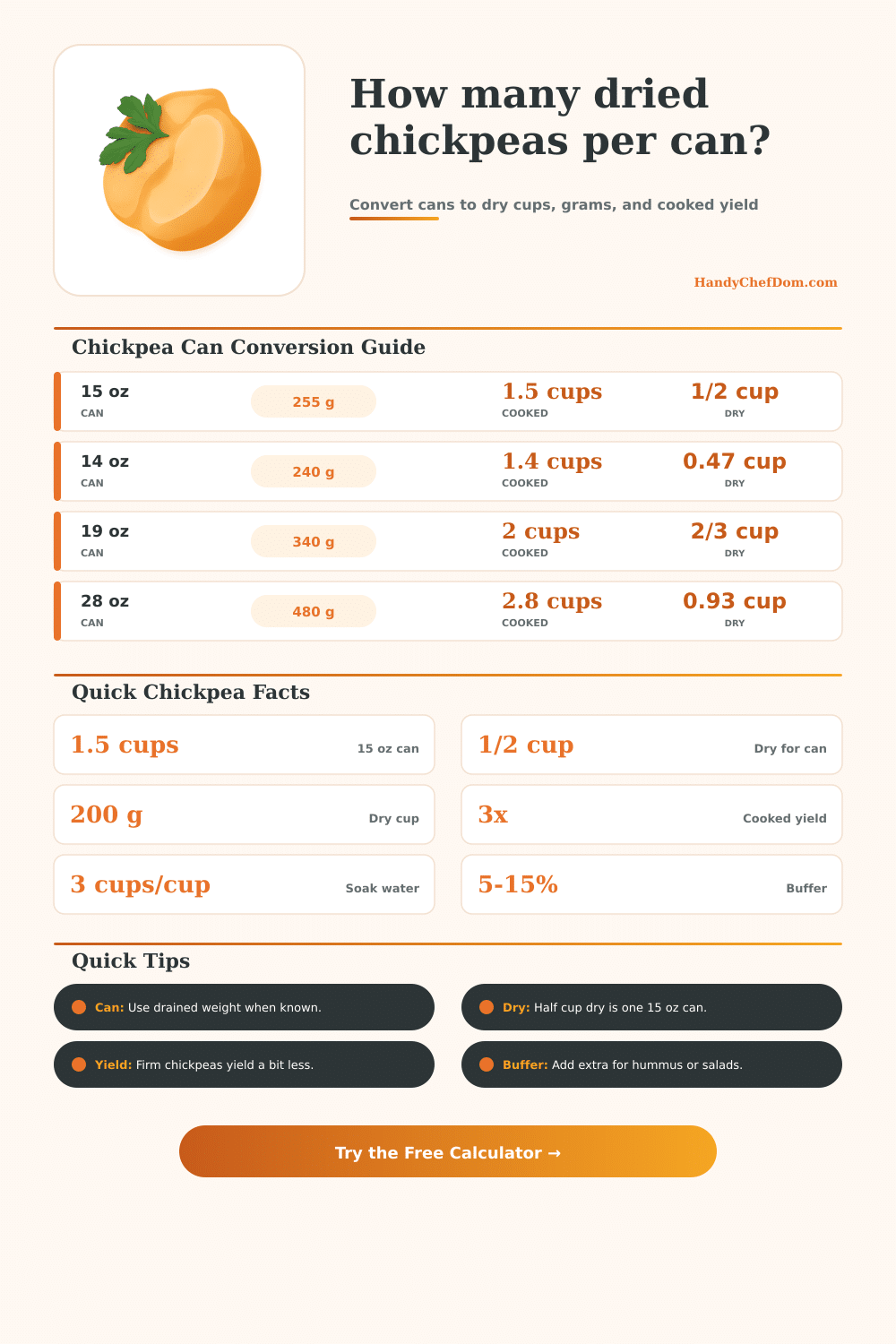
Kitchen reference: a 15 oz can of chickpeas usually drains to about 1.5 cups cooked chickpeas. Dried chickpeas roughly triple after soaking and cooking, so about 1/2 cup dry chickpeas replaces one standard 15 oz can.
Best match for canned garbanzos, hummus, salads, curries, and meal prep bowls.
Cook softer and smaller, so their dry-to-cooked conversion is close but not identical.
Do not replace chickpeas one for one by dry cups because lentils cook faster and softer.
Useful as a bean comparison, but the texture is creamier than cooked chickpeas.
| Can size | Typical drained weight | Cooked chickpea cups | Dried chickpea equivalent |
|---|---|---|---|
| 14 oz can | About 240 g drained | About 1.4 cups cooked | About 0.47 cup dry, or 93 g |
| 15 oz can | About 255 g drained | About 1.5 cups cooked | About 0.5 cup dry, or 100 g |
| 15.5 oz can | About 265 g drained | About 1.56 cups cooked | About 0.52 cup dry, or 104 g |
| 19 oz can | About 340 g drained | About 2 cups cooked | About 0.67 cup dry, or 133 g |
| 28 oz can | About 480 g drained | About 2.82 cups cooked | About 0.94 cup dry, or 188 g |
| Dried chickpeas | Approx dry weight | Cooked yield at 3x | Can equivalent |
|---|---|---|---|
| 1/4 cup dry | About 50 g | About 3/4 cup cooked | About 1/2 of a 15 oz can |
| 1/2 cup dry | About 100 g | About 1.5 cups cooked | About one 15 oz can |
| 2/3 cup dry | About 133 g | About 2 cups cooked | About one 19 oz can |
| 1 cup dry | About 200 g | About 3 cups cooked | About two 15 oz cans |
| 2 cups dry | About 400 g | About 6 cups cooked | About four 15 oz cans |
| Recipe use | Texture target | Why yield shifts | Planning note |
|---|---|---|---|
| Hummus or puree | Soft to very soft | Soft beans look fuller and mash smoothly | Use a small buffer if the dip must fill a bowl. |
| Salad or grain bowl | Firm and intact | Firm chickpeas stay compact | Plan a little more dry volume for the same can count. |
| Curry, stew, or soup | Tender but whole | Liquid in the dish makes small yield shifts less visible | Standard 3x yield works well for most recipes. |
| Roasted chickpeas | Firm | Draining and drying reduce apparent volume | Add buffer because some volume is lost during roasting prep. |
| Meal prep | Tender but whole | Batch variation matters across several portions | Weigh dry chickpeas when repeating the same prep. |
| Bean or legume | Typical cooked yield | Can swap similarity | Calculator note |
|---|---|---|---|
| Chickpeas or garbanzos | About 3 cups cooked per dry cup | Direct match for this calculator | Use for canned chickpea replacement in recipes. |
| Black beans | About 2.7 cups cooked per dry cup | Moderate | Similar pantry math, but softer and smaller than chickpeas. |
| Kidney beans | About 2.8 cups cooked per dry cup | Moderate | Large beans need their own can conversion and texture plan. |
| Cannellini beans | About 2.8 cups cooked per dry cup | Moderate | Creamier texture makes volume feel different in salads. |
| Lentils | About 2.5 cups cooked per dry cup | Low | They cook faster and do not behave like canned chickpeas. |
Converting canned chickpeas to dried chickpeas requires an understanding of how chickpeas changes in volume, and converting canned chickpeas to dried chickpeas requires an understanding of how chickpeas change in texture. Canned chickpeas are already cook, so they will remain in the same volume once they are drained from a can. Dried chickpeas will remain small and dry until they are soaked in water, and the soaked dried chickpeas will expand in volume when the soaked chickpeas are cooked.
Using dried chickpeas in place of canned chickpeas in recipes require that a person understand that the volume of dried chickpeas cannot be one to one with canned chickpeas; using a one-to-one replacement may lead to having too few or too many chickpeas in the recipe. The amount of expansion that dried chickpeas will experience depend on different factors. The age of dried chickpeas and the variety of dried chickpeas both plays a role in the expansion of the chickpeas.
How to Convert Canned Chickpeas to Dried Chickpeas
Chickpeas that are of an older variety may expand less than newer varieties of dried chickpeas. Furthermore, firm varieties of chickpeas may expand less when cooked than softer varieties. The way that the dried chickpeas is drained will also play a role.
Some recipes may require chickpeas to be drain with a colander, while other recipes may require a coffee filter to remove excess water. The type of draining method may impact the final volume of chickpeas in the recipe, so a person must calculate how many dried chickpeas to use in place of cans of chickpeas. The calculator that is provide allows a person to enter the size of the cans of chickpeas that the recipe requires, as well as the number of cans of chickpeas that is needed for the recipe.
Furthermore, the calculator allows a person to select the texture of the chickpeas that are required for the recipe. For example, chickpeas can be soft or firm; soft chickpeas will occupy more space within a measuring cup than firm chickpeas of the same weight. Recipes like hummus require chickpeas to be soft, but other recipes may call for firm chickpeas.
Therefore, the texture of the chickpeas impact the volume of chickpeas that are required for the recipe. The calculator also includes a buffer setting. This buffer setting accounts for the way in which different cans of chickpeas may vary in texture, age, and draining method.
Adding a small amount of extra chickpeas to the calculation with the buffer setting ensures that there will be enough chickpeas for the recipe. The amount of water that is used when soaking the dried chickpeas is another variable. Using too little water may prevent the chickpeas from properly soak, while using too much water may make it hard to manage the soaking process.
The calculator provides an estimate for the amount of water that will be needed for soaking the dried chickpeas to remove the guesswork involved in the soaking process. The rule of using half a cup of dried chickpeas for every can of chickpeas that is used in a recipe is common among cooks. However, the rule isnt always accurate.
For instance, recipes that require chickpeas to simmer in a curry for long periods of time will produce softer chickpeas than recipes that use chickpeas in salads. Simmering chickpeas increases their volume. Therefore, the length of time that the chickpeas are cooked will impact the amount of dried chickpeas that must be use.
Reference tables are provided for common sizes of cans of chickpeas and the ratio of dried chickpeas to cooked chickpeas. These tables allow for a quick estimation of the number of dried chickpeas that is needed. However, these tables dont provide the specific calculation that a person can use to determine the exact amount of chickpeas required for a recipe.
Additionally, the numbers in these tables are specific to chickpeas. For instance, dried beans like black beans or cannellini beans has different textures to chickpeas. Therefore, the number of dried beans of those varieties that are required to replace cans of chickpeas will be different.
Using dried chickpeas is economical in comparison to canned chickpeas. Furthermore, using dried chickpeas allows a person to control the amount of salt that is in the chickpeas and the amount of time that the chickpeas are cook. However, using dried chickpeas requires that a person plan ahead and soak the beans prior to cooking them.
Once a person understand how to convert the number of cans of chickpeas to the amount of dried chickpeas needed, they will be able to accurately replace any number of cans with the proper amount of dried chickpeas. This calculator is an essential tool to allow a person to make these calculation for any number of cans of chickpeas. Its actualy an important part of the kitchen when your working with bulk food.
You should of used this tool to avoid mistakes.