Juice Yield Calculator for Fresh Produce Batches
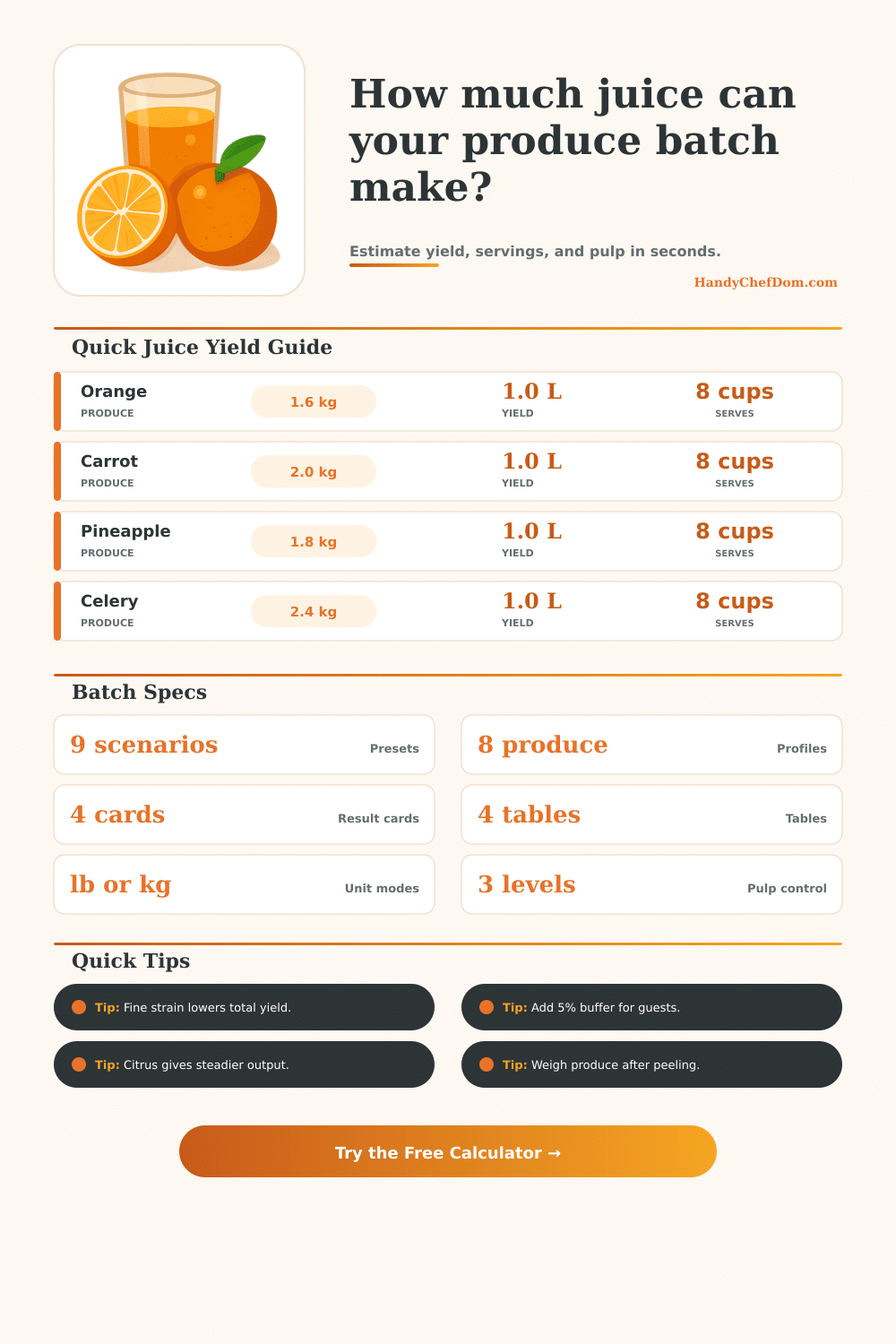
Estimate juice output, serving count, and produce needs for citrus, roots, and greens with quick unit switching, pulp control, and batch-ready planning presets.
Mode guide: Produce mode forecasts output from current stock. Serving mode back-calculates produce weight needed for your target pour plan.
| Produce | Avg ml/kg | Cups per kg | Main note |
|---|---|---|---|
| Orange | 620 | 2.6 | Stable citrus output |
| Grapefruit | 540 | 2.3 | Low pulp by default |
| Carrot | 510 | 2.1 | High fiber pomace |
| Celery | 420 | 1.8 | Watery but fibrous |
| Pineapple | 580 | 2.4 | Core loss affects yield |
| Watermelon | 650 | 2.8 | Highest easy extraction |
| Apple | 600 | 2.5 | Good blend backbone |
| Green blend | 470 | 2.0 | Leaf loss reduces yield |
| Group | Pour size | Juice target | Produce need |
|---|---|---|---|
| 4 guests | 240 ml | 1.01 L | 1.63 kg |
| 8 guests | 240 ml | 2.02 L | 3.26 kg |
| 12 guests | 240 ml | 3.02 L | 4.88 kg |
| 25 guests | 240 ml | 6.30 L | 10.16 kg |
| Setting | Factor | Texture | Best use |
|---|---|---|---|
| Light pulp | 0.94x | Clean | Brunch service |
| Balanced pulp | 1.00x | Classic | Daily pours |
| Pulpy | 1.08x | Thick | Smoothie blends |
| Fine strain | 0.92x | Silky | Cocktail base |
| Standard strain | 1.00x | Even | General batch |
| Coarse strain | 1.06x | Rustic | Fiber forward |
| Profile | Calories | Carbs | Sugar |
|---|---|---|---|
| Orange | 112 kcal | 26 g | 21 g |
| Grapefruit | 96 kcal | 23 g | 19 g |
| Carrot | 94 kcal | 22 g | 12 g |
| Celery | 70 kcal | 16 g | 9 g |
| Pineapple | 132 kcal | 32 g | 26 g |
| Watermelon | 84 kcal | 21 g | 18 g |
| Apple | 114 kcal | 28 g | 24 g |
| Green blend | 88 kcal | 20 g | 11 g |
Juicing planning require an understanding of how much liquid certain produce will yield. Knowing how much of a certain fruit or vegetable you have will allow you to calculate how many servings of juice your fruits and vegetables can produce. The amount of juice that they will produce will depend on the type of produce that you use to make your juice.
The type of produce will determine how much liquid will be released. Additionally, the amount of juice that will be released will depend on how much pulp is removed from the produce. Certain type of produce will release more liquid than others.
How to Plan How Much Juice You Will Get
For instance, watermelon will release a large amount of liquid due to the high amount of water contained in the watermelon. Celery will contain less liquid due to the fiber content in the vegetable. Carrots contains a moderate amount of liquid.
These differences in produce will have an impact on the amount of juice that will be produced during the juicing proces. Another factor that will impact the amount of juice that is released from the produce is the pulp level that is used in the juicer. A light pulp setting will remove more fiber from the produce.
However, because the fiber traps the liquid, removing the fiber also removes the liquid from the produce. Using a coarse pulp setting will result in more liquid being retained by the juice. Therefore, another factor to consider when making juice is the pulp level.
Depending on the texture of the juice that is desired, this factor will impact the total amount of juice that can be produced. When making juice, another factor that must be considered is the batch buffer for the juice. A batch buffer is a small amount of juice that can be added to the juicing calculations to account for liquid that may be lost due to evaporation or individuals pouring a large portion of the juice.
For instance, a five percent batch buffer can account for individuals who ask for refill juices. A batch buffer ensure that there is enough juice for individuals throughout the event. Another step in the juicing process is weighing the produce.
Once you have peeled and cored the produce, you should weigh it. The rind and the core of the produce will not yield any juice. Therefore, if you weigh the produce prior to being peeled, the measurement will be too high.
By weighing the produce after it is peeled, the calculation for the juice will be accurate. When planning for juice, it is important to take into account the size of the group that will be consuming the juice. A small group may only require one watermelon to supply the juice requirements for everyone in the group.
However, a large group will require more produce to meet the juice needs of each individual. Using a calculator will allow you to determine the juice requirements for any number of individuals. Juice also contains nutritional content that differs depending on the type of produce that is used to make the juice.
For instance, juice made from pineapple will contain more natural sugar than celery will contain. Additionally, the pineapple will also contain more calories than celery will contain. These nutritional differences should be considered when preparing juice for individuals who have specific nutritional need.
Some of the most common mistake when juicing includes assuming that all produce will produce the same amount of juice. Assuming that all heavy produce will yield the same amount of juice as another type of heavy produce is incorrect. Another mistake is to forget that fine straining will remove the liquid along with the produce pulp.
These mistakes can be avoided by using a juicing calculator to determine the amount of juice that will be released from the produce based off the pulp setting, the type of produce, and the amount of juice that will be produced. Another factor that can impact the amount of juice that is released from the produce is the environment in which the produce is juiced. For instance, produce that is harvested and stored at room temperature will release more liquid than produce that has been refrigerated.
The sharpness of the blade of the juicer can also impact the amount of juice that is expressed from the produce. Additionally, the longer produce is stored in the juicer, the more liquid that can be lost from the produce. Another step in the juicing process is to calculate how much juice is required before going to the store to purchase the produce.
By calculating the amount of juice that the produce will produce prior to going to the store, you can determine how much celery or how much watermelon will be purchased. Without performing these calculations, it is possible that there will not be enough produce to make the amount of juice that was promised to those who will drink the juice. By understanding how each of these factor will impact the juice that is produced, an individual can successfully manage the juicing proces.