Daily Salt Intake Calculator and Sodium Tracker
Estimate sodium from real eating habits, compare with your target limit, and see where to trim salt without guessing.
Set your profile and food pattern, then add daily sodium sources. The tool estimates total sodium, salt equivalent, remaining budget, and an easy reduction target.
| Profile | Daily limit | Salt equivalent | Planning note |
|---|---|---|---|
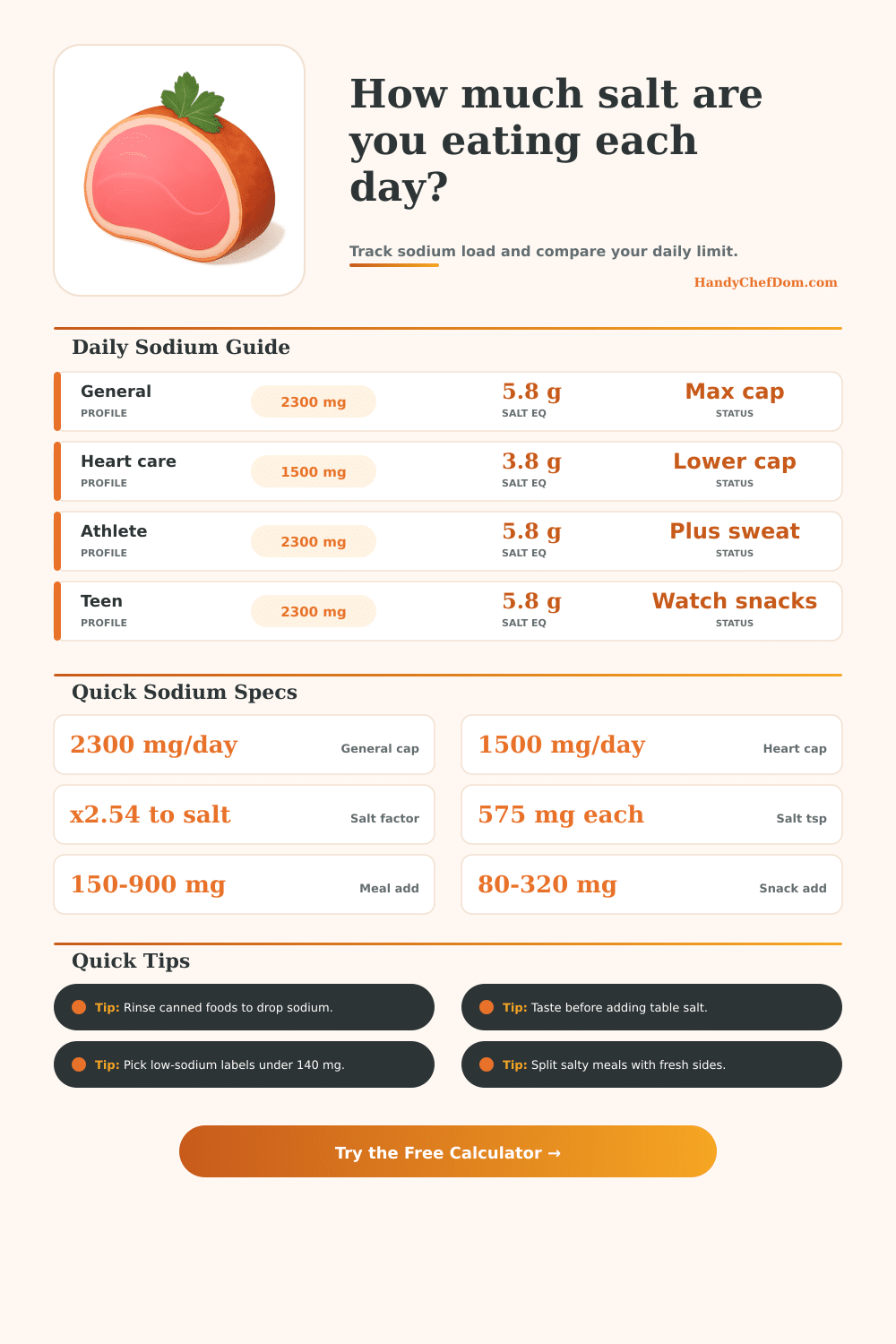
| General adult | 2300 mg | 5.8 g salt | Use as upper daily cap. |
| Teen | 2300 mg | 5.8 g salt | Watch packaged snacks. |
| Older adult | 2000 mg | 5.1 g salt | Favor fresh over boxed. |
| Athlete | 2300 mg + sweat | 5.8 g + add | Allow extra for long sweat. |
| Heart-focused | 1500 mg | 3.8 g salt | Tighter target, scan labels. |
| Kidney-sensitive | 1500 mg | 3.8 g salt | Use clinician guidance. |
| Source type | Low load | Typical load | High load |
|---|---|---|---|
| Restaurant meal | 450 mg | 700 mg | 1200 mg |
| Packaged serving | 120 mg | 250 mg | 500 mg |
| Salty snack serve | 80 mg | 160 mg | 320 mg |
| Added table salt | 290 mg | 575 mg | 1150 mg |
| Condiment tablespoon | 120 mg | 400 mg | 950 mg |
| Deli meat serving | 350 mg | 650 mg | 1050 mg |
| Daily total | Salt equivalent | Target status | Suggested move |
|---|---|---|---|
| 0-1200 mg | 0-3.0 g | Low | Add balanced whole foods. |
| 1201-1800 mg | 3.0-4.6 g | Moderate | Keep current meal pattern. |
| 1801-2300 mg | 4.6-5.8 g | Near cap | Skip salty extras tonight. |
| 2301-3000 mg | 5.8-7.6 g | Over cap | Cut one high-sodium item. |
| 3001-4000 mg | 7.6-10.2 g | High | Replace takeout with home meal. |
| 4000+ mg | 10.2+ g | Very high | Reset with low-sodium day. |
Sodium can be hid in many different types of food. Additionally, sodium can be present in higher amount than most individuals realize. For example, one deli sandwich can contain a large amount of sodium, and one deli sandwich can account for one-third of the daily sodium intake that many adult should consume.
The daily salt intake calculator will help you to track the amount of sodium that you consume each day. Specifically, the calculator will perform the mathematical calculations to determine your sodium intake. These calculations will help you to remove the guesswork regarding your daily sodium intake.
Track Your Daily Salt Intake
The various inputs into the daily salt intake calculator will determine your sodium intake. For example, you may consume more sodium from the restaurant meal that you consume than the home cooked meals that you eat. Additionally, you may consume more sodium from the packaged foods that you eat than the fresh foods that you consume.
Furthermore, adding salt to your food while you are eating will increase your sodium intake. As another example, if you are physically active, you will lose sodium through your sweat, but if you do not exercise, your sodium level will not change significant. Additionally, you can use the safety buffer to alter your sodium limit according to your blood pressure or physical event that you are training for.
The outputs of this calculator will indicate to you the difference between the amount of sodium that you consume and the amount of sodium that your body can handles. For instance, the budget that is remaining for sodium will indicate to you the amount of sodium that you can consume before you reach your sodium limit. Should the result indicate a negative number, you have exceeded your sodium limit; in this case, you will have to choose lower sodium food for the next days meals.
Additionally, the cut-to-target figure will show you the amount of sodium that you need to consume to reach your target sodium limit. This figure will help you to understand the amount of sodium that you should consume daily. Most adults will set the sodium limit at 2300 mg because most nutrition labels list this amount.
However, healthy adults should not consume more than 2300 mg of sodium daily. Individuals with heart and kidney conditions may need to limit there sodium intake to 1500 mg daily. The 1500 mg limit is set for individuals because excess sodium in their system can cause fluid retention and high blood pressure.
Teenagers and older adults requires a sodium limit between the amounts of 1500 mg and 2300 mg. Athletes may require more sodium because they will lose sodium through perspiration. The calculator will automatically apply the sodium limit that you input to your dietary intake, so you will not have to remember the various limit for each group of individuals.
The reference tables will list the amount of sodium that is in various foods. For example, one cup of canned soup contains 700 mg of sodium, and one fast-food combo meal will have more than 1100 mg of sodium. These types of food can quickly increase your sodium intake to more than your limit.
These tables will allow you to view the difference between the sodium content of high-sodium foods as compared to low-sodium foods. It is not enough to skip the salt shaker at the table to lower your sodium intake. Approximately 70 percent of the sodium that you consume is already in the food that you eat.
For example, you will consume more sodium if you eat a diet high in processed foods. To account for this, you will have to choose your eating pattern. If you choose a fresh-cooked meal pattern, you will consume less sodium then if you choose a diet heavy in processed foods.
Your eating pattern will establish the baseline amount of sodium that you consume daily. Your sodium intake should be for the entirety of your day, not just for one meal. For instance, if your lunch contains a high amount of sodium, the calculator will allow you to see how much sodium the remainder of your meals can contain for you to remain within your target sodium intake.
Fresh vegetable, grains, and proteins are examples of foods that are low in sodium content. By consuming these foods, you will find it easier to remain within your sodium budget. Additionally, if you consume a low-sodium diet during the morning meals, you will have more room for the sodium content for the rest of the day.
However, if you consume a high amount of sodium during lunch, you will have less room for sodium for the remainder of the day. The buffer will allow you to change your sodium limit to accommodate specific situation in your body. For instance, if you use the conservative buffer for your sodium limit, you will reduce your sodium limit by five or ten percent.
However, if you choose the flexible buffer, you will increase your sodium limit. These limits will automatically be applied to your sodium limit input. Your eating habits may include both home-cooked meals and restaurant meals.
However, the daily salt intake calculator will be able to produce a total sodium count for the foods that you consume regardless of their place of preparation. The goal of using this calculator is not to change your eating habits to perfection. However, the goal will be to understand how much sodium that you consume daily and how much that you have remaining for the rest of your day.
By knowing your sodium budget, you will be able to make small changes to your diet that will allow your total sodium intake to remain within your target range.