🌿 Rosemary Sprig Yield Calculator
Convert rosemary sprigs into fresh chopped teaspoons, tablespoons, grams, dried equivalents, and per-serving herb amounts.
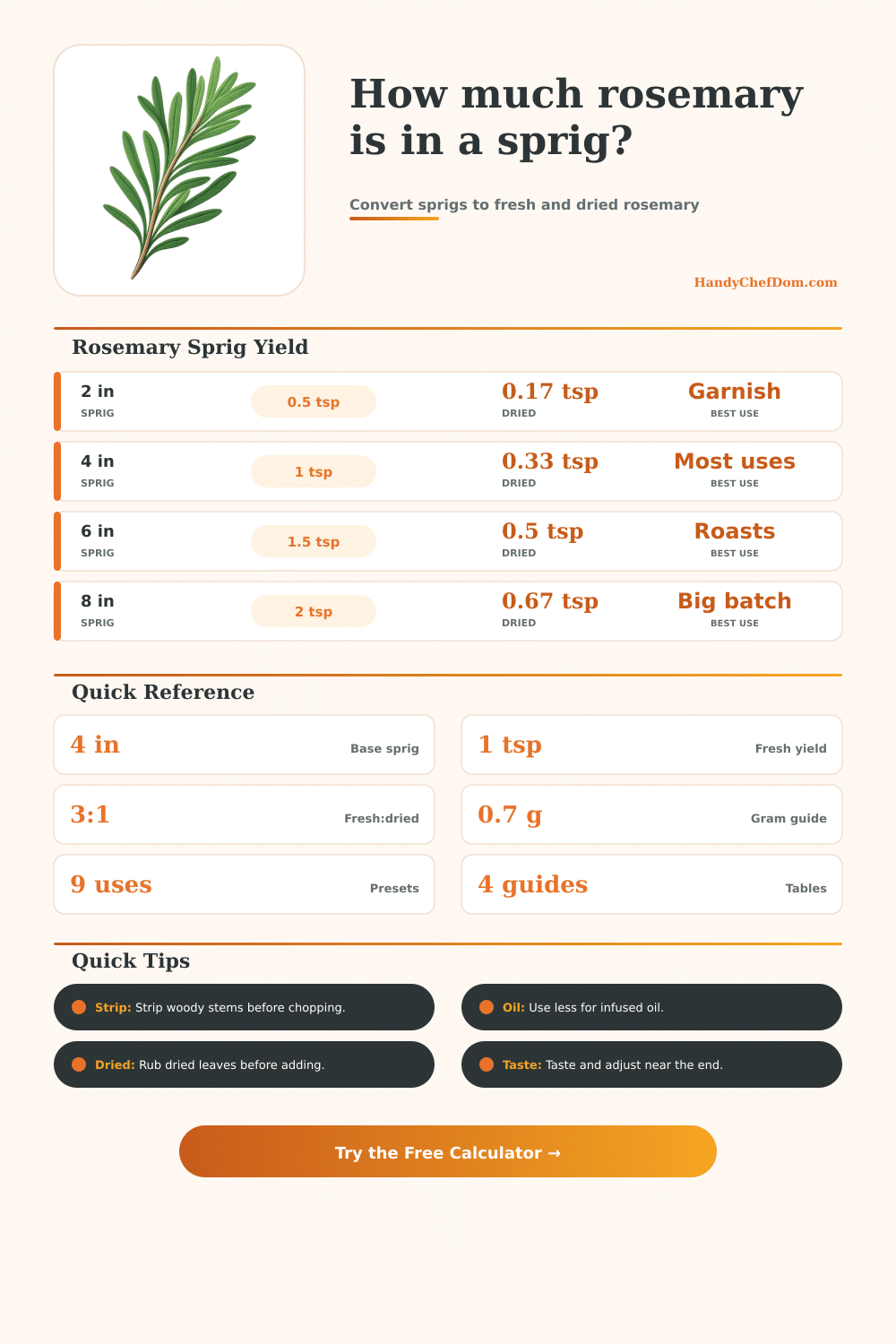
The baseline is one 4-inch fresh rosemary sprig yielding about 1 teaspoon chopped leaves. Fresh-to-dried conversion uses 1 tablespoon fresh equals 1 teaspoon dried.
| Average sprig length | Fresh chopped yield | Dried equivalent | Typical use |
|---|---|---|---|
| 2 inches | About 1/2 tsp | About 1/6 tsp | Small garnish or butter |
| 3 inches | About 3/4 tsp | About 1/4 tsp | Single skillet or small pan |
| 4 inches | About 1 tsp | About 1/3 tsp | Standard recipe sprig |
| 6 inches | About 1 1/2 tsp | About 1/2 tsp | Roast tray or focaccia |
| 8 inches | About 2 tsp | About 2/3 tsp | Large roast or big batch |
| 10 inches | About 2 1/2 tsp | About 5/6 tsp | Holiday pan or infusion |
| Fresh rosemary | Dried rosemary | Kitchen note | Best adjustment |
|---|---|---|---|
| 1 tsp fresh | 1/3 tsp dried | One standard 4-inch sprig | Round to a heaped 1/4 tsp |
| 1 tbsp fresh | 1 tsp dried | Classic culinary ratio | Rub dried leaves first |
| 2 tbsp fresh | 2 tsp dried | Strong roast quantity | Use less for oil |
| 1/4 cup fresh | 4 tsp dried | Big batch herbs | Add in stages |
| 1/2 cup fresh | 8 tsp dried | Very large prep | Check salt balance |
| 1 cup fresh | 16 tsp dried | Bulk conversion | Measure by weight if possible |
| Recipe use | Suggested fresh per serving | Calculator factor | Flavor note |
|---|---|---|---|
| Roast potatoes | 3/4 to 1 tsp | 1.00x | Can handle bold chopped leaves |
| Focaccia | 1/2 to 3/4 tsp | 0.90x | Even sprinkle gives better coverage |
| Lamb | 1 to 1 1/4 tsp | 1.15x | Rosemary pairs well with rich meat |
| Chicken | 1/2 to 1 tsp | 0.85x | Balanced amount keeps it bright |
| Infused oil | 1/3 to 1/2 tsp | 0.70x | Oil carries rosemary strongly |
| Herb butter | 3/4 tsp | 0.95x | Fine chop spreads flavor evenly |
| Herb form | Potency impression | Weight guide | Use with care when |
|---|---|---|---|
| Fresh woody rosemary | Medium piney | 0.7 g per tsp | Stems are mature and resinous |
| Fresh tender rosemary | Soft and green | 0.65 g per tsp | Adding raw or near finish |
| Dried rosemary leaves | Concentrated | 1.0 g per tsp | Long cooking or oil infusion |
| Powdered rosemary | Very direct | 0.9 g per tsp | Using in rubs or crumbs |
| Whole sprig garnish | Gentle aroma | Variable | Removing before serving |
| Minced fresh rosemary | Fast release | 0.75 g per tsp | Serving immediately |
A single sprig of rosemary dont provide a clear measure of how much flavor it will contribute to a dish. The flavor that each sprig of rosemary provides depend on several physical factors. For instance, the length of the sprig, the thickness of the stem, and the moisture level of the leaves will affect the amount of chopped rosemary that will be available for a recipe.
Depending on the physical characteristic of the rosemary sprigs, a person may add too little or too much of the herb to a recipe. However, if a person can calculate the yield of the rosemary sprigs that will be used in a recipe prior to beginning to cook the recipe, it will be easier for that person to avoid making these error with rosemary quantity. The rosemary calculator ask for the number of sprigs of rosemary that are to be used in a recipe.
How to Measure Rosemary for a Recipe
Additionally, the calculator asks for the average length of the rosemary sprigs. A person must provide information regarding the type of rosemary sprig that are to be used, such as whether the sprigs are woody or tender. Other questions ask for information about how fine the rosemary is to be chopped and the type of dish that is to be made.
This information is important to the calculator in determining the amount of rosemary that is needed for the recipe. The calculator provides information on the fresh volume of the rosemary, the weight of the rosemary in gram, the amount of dried rosemary that is equivalent to the fresh rosemary, and the amount of rosemary that is required for each serving of the prepared dish. Fresh rosemary and dried rosemary have different characteristic.
One of the main difference between fresh and dried rosemary is the water content in each type of herb. Because fresh rosemary contains more water than dried rosemary, it has a different density from dried rosemary. Due to this different density of each form of rosemary, a person must use three time as much fresh rosemary as dried rosemary to achieve the same amount of flavor from the herbs.
Many cooks make a mistake when using both types of rosemary by assuming that the three times ratio refer to the leaves of the rosemary plants only. However, cooks often use whole rosemary sprigs, which contain the rosemary stem. Therefore, another function of the rosemary calculator is to allow people to account for the stripping of the leaves from the rosemary stems to provide a realistic amount of rosemary that will be contributed to the recipe.
The type of dish that is to be prepared will change the amount of rosemary that is required to be added to the recipe. For instance, recipes for roast potato will require more rosemary than recipes for dishes like chicken or focaccia. Additionally, recipes for dishes that use infused oil will require even less rosemary than recipes that do not use infused oils.
These different rule can be accounted for in the rosemary calculator so that cooks need not memorize these rules for different type of recipes. The size of the chop of the rosemary will affect the amount of rosemary that is released into a dish. Rosemary that is chopped into whole leaves will release its flavor slow and remain distinct within the prepared dish.
If the rosemary is chopped into a rough chop, more of the herb will release its flavor than if the rosemary was only roughly chop into leaves. If a recipe calls for a fine chop or the use of rosemary paste, the rosemary will release its flavor quick. This is useful for dishes where rosemary is to be added near the end of the cooking process.
However, using very fine piece of rosemary may result in an unpleasant taste if there is too much rosemary in the recipe. Additionally, very fine pieces of rosemary may easily dissapears into the food that is being prepared. This aspect of the calculator allow cooks to determine how the chop size of the rosemary may affect the amount of rosemary that needs to be measured for the recipe.
Another method of determining the amount of rosemary that is needed for a recipe is to weigh the amount of chopped rosemary. One teaspoon of chopped fresh rosemary weigh approximately seven-tenths of a gram. However, dried rosemary is more dense than fresh rosemary.
Weighing the amount of rosemary in grams that is indicated in the rosemary calculator will help cooks to learn how to measure the amount of rosemary in the future. One of the most common mistake that cooks make with rosemary is treating every sprig of rosemary the same. Woody rosemary sprig will contain less rosemary leaf than tender rosemary sprigs.
Additionally, dried rosemary loses its potency over time if it is stored in a pantry for long period of time. Thus, cooks may have to adjust the amount of dried rosemary that they use in their recipes. While the rosemary calculator can provide the best estimation of the amount of rosemary that should be used in a recipe, cooks may have to make adjustments to the amount of rosemary based on the potency of the rosemary that they purchase.
The rosemary calculator is useful not only for determining how much rosemary is needed for an existing recipe, but also for scaling that recipe up or down. If cooks would like to prepare a larger batch of a recipe than the original recipe require, they can enter this new batch size into the rosemary calculator. The calculator can provide cooks with the amount of rosemary that should be added to each serving of the dish, preventing cooks from adding too much of the herb to their dishes.
By knowing how much flavor each sprig of rosemary provides, cooks can make an informed decision on whether they should use more or less of the herb when they prepare their dish. A recipe may ask for rosemary to be used in different ways in the preparation of the dish. For instance, the recipe may ask for rosemary to be used both chopped and unstripped from its stems for some part of the recipe, yet require the use of finely chopped rosemary that has been stripped from its stems for other parts of the recipe.
Knowing how much rosemary is required for the recipe will help cooks to determine how to prepare and measure the rosemary for the recipe. The rosemary calculator can assist cooks in a variety of situation and scenarios. However, cooks will have to apply some knowledge of rosemary to understand how to best use the calculator to their advantage.
By learning about the way in which rosemary work in recipes and what type of adjustments may need to be made due to various factor, cooks will find it easier to use the rosemary calculator to determine the amount of the herb that is needed in their recipes.