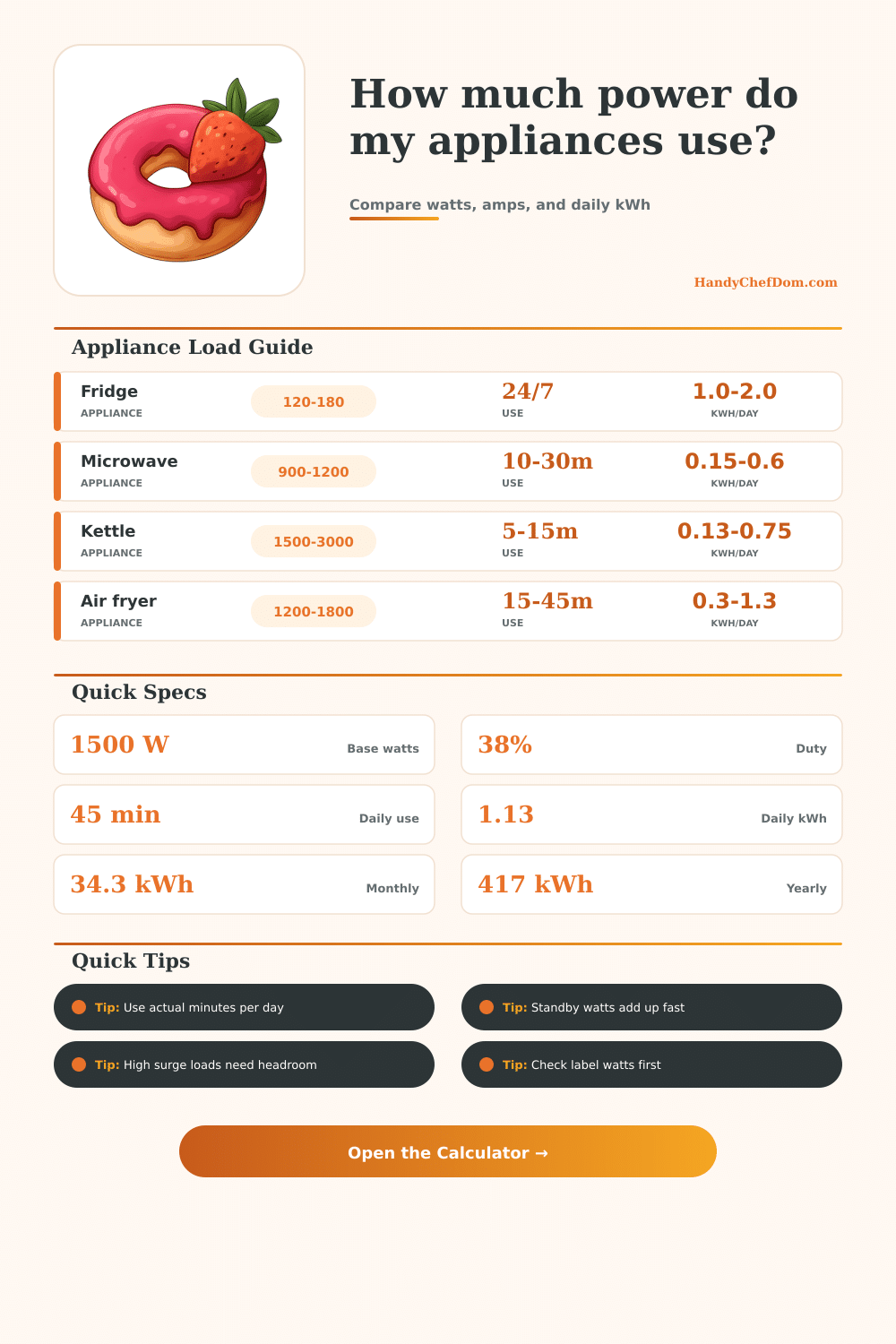
Appliance Power Consumption Calculator
Compare watts, amps, and energy use across common appliances with quick presets and clean home-load references.
Pick a preset or edit the fields. The first card can show watts or kilowatts, while the rest keep the energy story readable in kWh.
| Appliance | Run W | Use | Note |
|---|---|---|---|
| Fridge | 120-180 | 24/7 | Always |
| Microwave | 900-1200 | 10-30m | Short burst |
| Kettle | 1500-3000 | 5-15m | Big spike |
| Air fryer | 1200-1800 | 15-45m | Hot load |
| Device | Idle W | Sleep | Note |
|---|---|---|---|
| TV | 0.5-3 | Standby | Low draw |
| Console | 1-10 | Rest | Sleep mode |
| Fridge | 2-8 | Cycling | 24/7 load |
| Dehumidifier | 0-5 | Timer | Cycle use |
| Pattern | Mins | Days | Effect |
|---|---|---|---|
| Light | 10-20 | 2-3 | Low kWh |
| Normal | 30-60 | 5-7 | Base use |
| Heavy | 60-120 | 7 | More kWh |
| Always | 1440 | 7 | 24/7 load |
| Circuit | Watts | Amps | Note |
|---|---|---|---|
| 15A line | <1800 | <15A | Kitchen |
| 20A line | <2400 | <20A | Stronger |
| Spiky set | 2000+ | 20A+ | Surge care |
| Shared plug | <1000 | <10A | Light use |
An electrical load is an amount of power that an appliance use from the electrical circuit. When many appliance are in use at the same time, the electrical load peak because many appliances are drawing power from the same system. Many appliances is designed to create heat or motion, and each of these appliances require electricity to operate.
Because every electrical outlet have a physical limit to the amount of power that it can supply to the appliances, understanding the electrical load of each appliance will allow people to not exceed the limit of the outlets. An appliance has a certain amount of wattage for the appliance, known as a rated wattage. This is the maximum amount of power that the appliance will use.
How Home Appliances Use Electricity
However, the appliance will not always use the rated wattage of the appliance. For instance, refrigerator are appliances that are always on. However, refrigerators are not continuous on.
Instead, they cycle on and off in order to maintain the temperature of the fridge. In terms of the energy that the fridge use over the course of a day, it is much less than a fridge that is on for 24 hour. If you look at the kilowatt hours of the fridge, this is a measurement of the average amount of energy the fridge uses over a period of time.
People often assume that the appliance use its rated wattage every minute, but it does not; the appliance is often using less power than its rated wattage. Other appliances has what are known as burst loads. Burst loads are appliances that use a mass amount of power for a short time.
Appliances like microwave and electric kettles often use burst load of power. This does not necessarily add to the yearly energy requirements of a household as much as, say, a space heater do. However, appliances with burst loads place an immense amount of strain on the electrical circuit.
If you use appliances like electric kettles and air fryers in the same circuit in a home, the electrical circuit may fail due to the amperage of the appliances. The amperage of an electrical device is the amount of current that move through the appliance. If there is too many amperage in the electrical circuit, the wires begin to heat up.
Circuit breakers stop the movement of electricity through the circuit to prevent the wires from melting due to amperage. Some appliances use energy even if the appliance is not perform its function. Appliances like televisions, game consoles, and coffee maker remain on in order to be ready to respond to the user with a remote control.
While the amount of energy that one appliance requires in this standby mode is small, the number of appliances that sit in this mode for 24 hours a day create an amount of energy waste each day. Therefore, turning off these appliances will reduce the amount of energy waste in the home. Another factor to consider in the determination of electrical load is the surge factor.
Some appliances requires an extra amount of energy in order to start the appliance. Appliances that have motor, like refrigerators, require an amount of energy in order to start the motor. Instead of use a small amount of power in order to maintain the refrigerators temperature, the refrigerator will use several time the wattage for a split second in order to start the compressor that maintains the refrigerator’s temperature.
When determining appliances for a solar battery or generator, you will need to account for the extra headroom due to the surge in power from the appliances. The appliance and the habit of the individual determine the energy that each appliance use. For instance, using a dishwasher five days a week will use less energy than using the dishwasher every day.
The habits of the individual in a household will change the energy footprint of the house. If a person determines the yearly energy projection for each appliance, a person can make a logical decision regarding whether to upgrade appliances or to unplug appliances that use standby power. Through understanding the electrical load of appliances, individuals can understand how each appliance is a load on the system of energy in the home.