Egg Substitute Calculator
Convert eggs into measured substitutes by baking role, texture target, and batch scale, then view support liquid, lift boost, and role-fit strength in one planner.
Start with egg count and recipe role. Then choose a substitute and texture target. The tool scales your swap and adds support values for better repeatability between small and large batches.
| Substitute | Per 1 large egg | Best recipe styles | Notes |
|---|---|---|---|
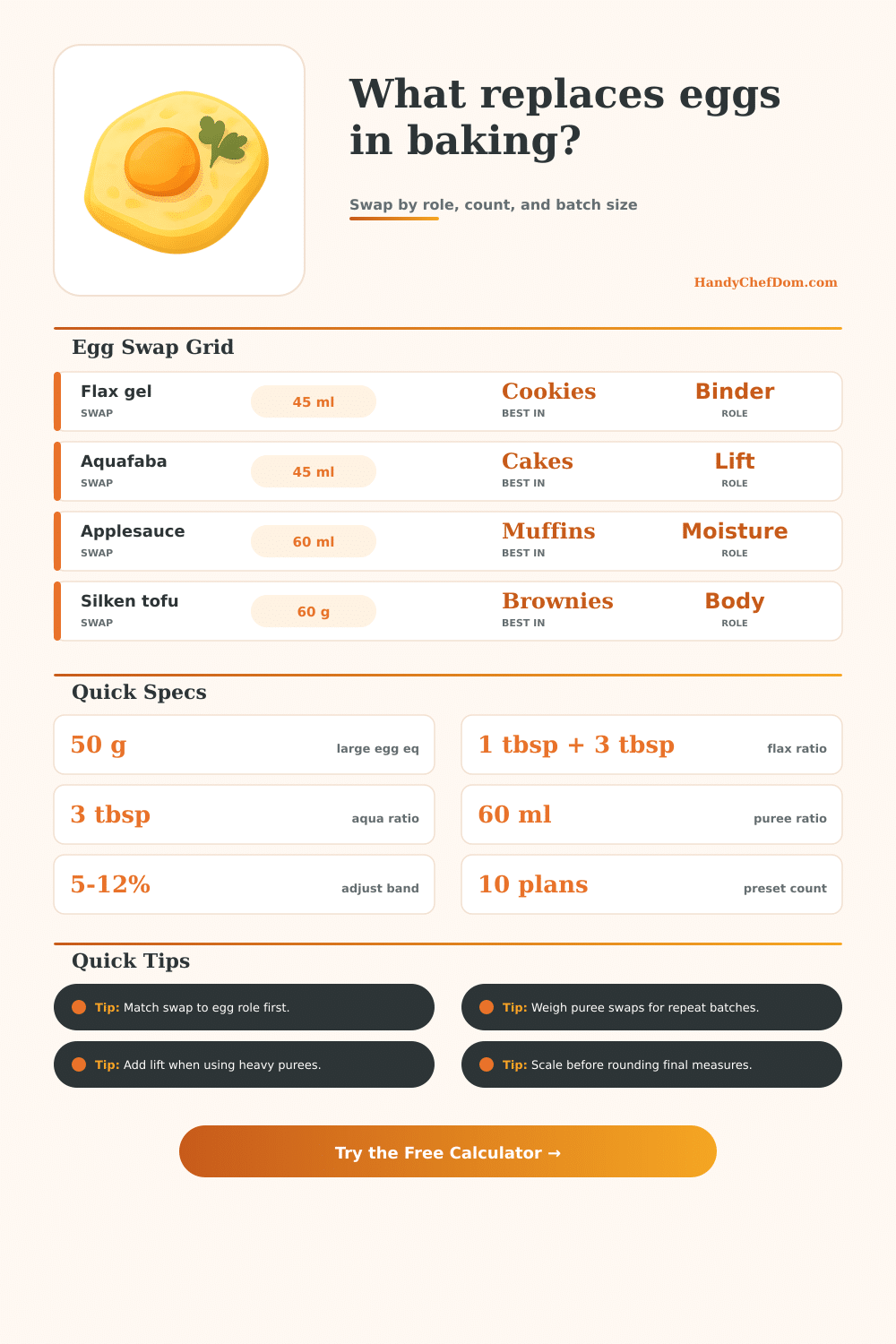
| Flax gel | 1 tbsp meal + 3 tbsp water | Cookies, muffins | Great binder, lower lift |
| Chia gel | 1 tbsp chia + 3 tbsp water | Waffles, breads | Strong hold, denser bite |
| Aquafaba | 3 tbsp liquid | Cakes, sponge | Best lift among swaps |
| Applesauce | 1/4 cup | Muffins, snack cake | Moist and mildly sweet |
| Mashed banana | 1/4 cup | Quick bread | Sweeter flavor impact |
| Plain yogurt | 1/4 cup | Pancakes, cakes | Tender crumb and moisture |
| Silken tofu | 1/4 cup blended | Brownies, bars | Dense but stable body |
| Egg replacer powder | 1.5 tsp + 2 tbsp water | General baking | Most neutral profile |
| Substitute | Binding | Leavening | Moisture |
|---|---|---|---|
| Flax gel | High | Low | Medium |
| Chia gel | High | Low | Medium |
| Aquafaba | Medium | High | Medium |
| Applesauce | Medium | Low | High |
| Mashed banana | Medium | Low | High |
| Plain yogurt | Medium | Medium | High |
| Silken tofu | Medium | Low | Medium |
| Egg replacer powder | High | Medium | Medium |
| Eggs | Aquafaba | Applesauce | Flax Meal |
|---|---|---|---|
| 1 egg | 3 tbsp | 1/4 cup | 1 tbsp |
| 2 eggs | 6 tbsp | 1/2 cup | 2 tbsp |
| 4 eggs | 3/4 cup | 1 cup | 1/4 cup |
| 6 eggs | 1 1/8 cup | 1 1/2 cup | 3/8 cup |
Eggs serves several functions in a recipe. These function include binding ingredients together, providing lift to a recipe, adding moisture to a recipe, and preventing the recipe’s ingredient from separating from one another. When choosing an egg substitute, determine which of these functions is the most important for the recipe.
For instance, cookies requires the ingredients to be bound together to ensure the cookie does not crumble. For cakes, however, the ingredients need to provide some lift to ensure the cake does not remain flat. Before using an egg substitute, determine whether the eggs in the original recipe were used to trap air, bind the ingredients together, or adding moisture to the ingredients.
How to Choose the Right Egg Substitute
Each of the egg substitutes provide certain functions but not others. For instance, flax gels and chia gels is used to bind ingredients together, but they do not provide much lift to a recipe. Aquafaba is used to provide lift to a recipe, but it does not provide much binding among the recipe’s ingredients.
Finally, fruit and yogurt purees adds moisture and tenderness to the ingredients but do not provide structural binding within a recipe. Another variable to consider with using egg substitutes is the size of the egg that was used in the original recipe. For instance, a medium egg contains approximately twelve percent less liquid and protein then a large egg.
Additionally, a jumbo egg contains approximately twenty percent more liquid and protein than a large egg. Therefore, if a recipe use large eggs but another ingredient is substituted for the egg based off volume, the volume of that ingredient may not account for the size of the egg that was required in the original recipe. Thus, you must adjust the amount of the egg substitute to account for the liquid and protein that is contained within an egg of a baseline size.
The target texture that a recipe will produce can also impact the type of egg substitute that should be used. For instance, an airy cake will require more lift to the batter than a fudgy brownie. Therefore, the texture of the final product will determine how the egg substitute is used in the preparation of the recipe.
For instance, cookie doughs can use denser egg substitutes than cake and quick-bread recipes. The sugar content of an egg substitute can impact the amount of sweetness of the recipe. For instance, mashed bananas contains sugar, which will impact the sweetness of a recipe.
Flax gels and aquafaba contains no sugar. Thus, if a recipe uses mashed banana as a substitute for the egg, the amount of added sugar to that recipe will have to be reduced. Any egg substitute that contains sugar will impact the sweetness of a recipe.
Another consideration in using egg substitutes is the size of the batch of the recipe. For instance, substituting for a single egg is different than substituting for six or eight eggs. The effect that the liquid from the egg substitute will have on a large batch of batter may be different from that of a small batch of batter.
Finally, the size of the batch will impact how much of the egg substitute is used. Common mistakes in using egg substitutes include treating each of the available substitutes as if it can be used in any recipe. Yet, each of the substitutes do not fulfill the same role within a recipe.
For instance, although applesauce may work in a muffin recipe, it may not provide the correct amount of lift for a chiffon cake. Additionally, using heavy fruit or yogurt purees in a recipe may require additional baking powder to compensate for the fact that these purees will create a denser final product. To avoid these types of mistakes, determine what score an egg substitute receives in each of the essential categories will allow for the proper use of egg substitutes.
Finally, several environmental variables may impact the use of egg substitutes in the kitchen. For instance, the humidity in the kitchen may impact the setting of a flax gel. Additionally, the protein content in aquafaba may vary from brand to brand.
Thus, any amount of an egg substitute that is calculated will likely need to be adjusted based on the texture of the first batch of the recipe that used the egg substitute. The use of an egg substitute tool will allow cooks to determine which type of function the recipe requires. Thus, knowing the function of the egg will allow cooks to use egg substitutes proper.