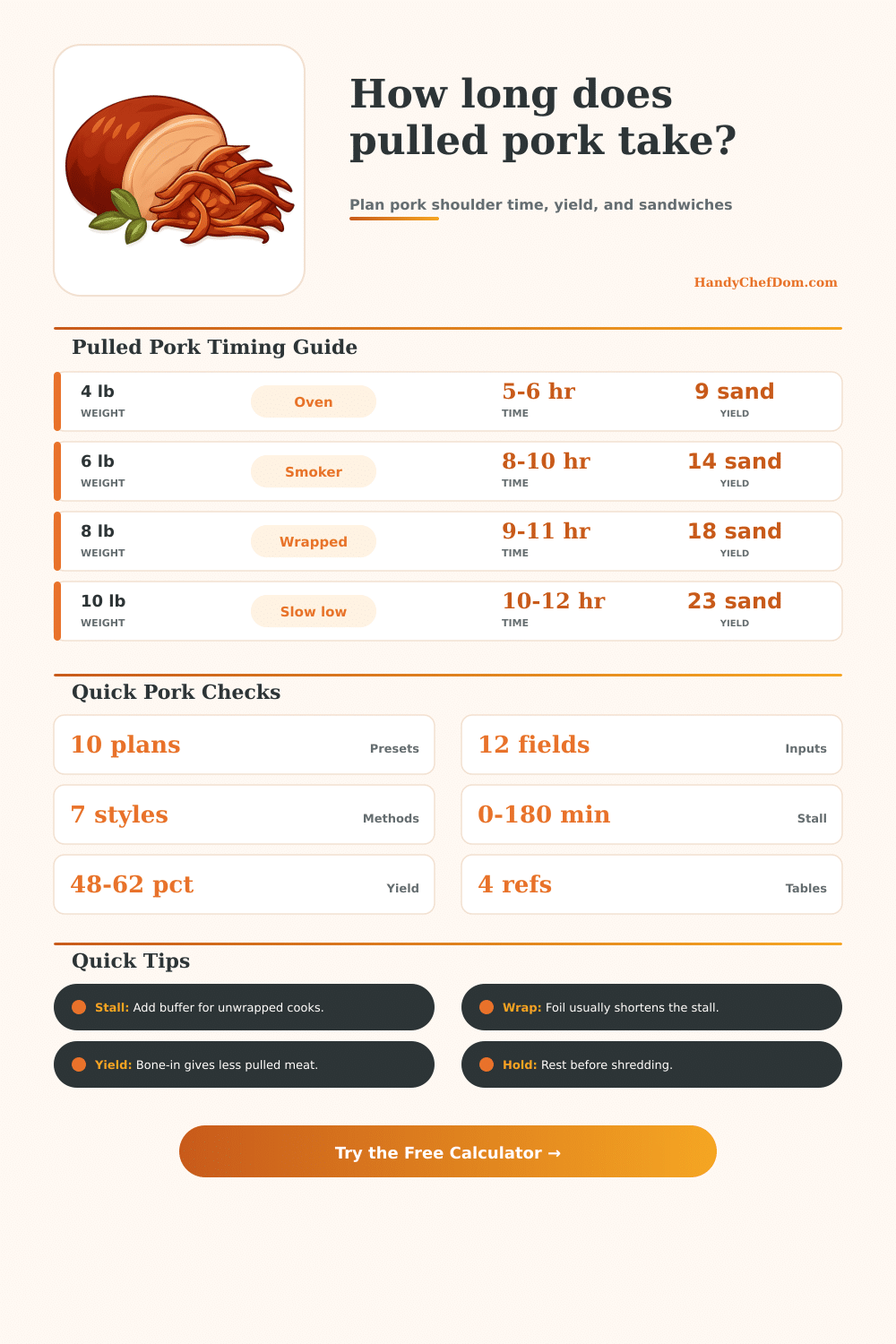
🥩 Pulled Pork Cooking Time Calculator
Estimate pulled pork timing from pork shoulder weight, bone-in or boneless choice, smoker, oven, or slow cooker method, cooking temperature, stall buffer, wrap plan, tenderness target, cooked yield, and sandwich count.
Choose a starting plan or enter your own pork shoulder details. The calculator returns a first tenderness-check time, wrap window, ready time, yield, and sandwich coverage.
Longest clock, strongest stall risk, and best match for unwrapped or butcher paper plans.
Shorter estimate with enough buffer for large butts, wrap timing, and party holds.
Stable heat usually shortens swings, especially with a pan and foil cover after the stall.
Moist enclosed cooking uses a minimum time floor rather than only minutes per pound.
| Method | Common setting | Approx rate | Stall behavior | Best calculator use |
|---|---|---|---|---|
| Smoker low and slow | 225°F | 90 to 110 min/lb | Longest stall, especially unwrapped | Use 90 to 180 min stall buffer. |
| Smoker balanced | 250°F | 75 to 95 min/lb | Moderate stall | Good default for weekend barbecue. |
| Hotter smoker | 275°F | 60 to 80 min/lb | Shorter stall | Useful when a same-day finish matters. |
| Oven shoulder | 250°F to 300°F | 55 to 85 min/lb | Lower stall variation | Best with a pan cover or foil finish. |
| Slow cooker low | Low setting | 8 to 11 hr floor | Minimal dry stall | Use for enclosed, moist pulled pork. |
| Slow cooker high | High setting | 5 to 7 hr floor | Minimal dry stall | Use for smaller shoulders and faster plans. |
| Raw pork shoulder | Smoker 225 F | Smoker 250 F wrapped | Oven 300 F covered | Slow cooker low |
|---|---|---|---|---|
| 4 lb boneless | 6 to 8 hr | 5 to 6.5 hr | 4 to 5 hr | 7 to 8 hr |
| 6 lb bone-in | 8.5 to 10.5 hr | 7 to 9 hr | 5.5 to 7 hr | 8 to 10 hr |
| 8 lb bone-in | 10.5 to 13 hr | 8.5 to 11 hr | 7 to 8.5 hr | 9 to 11 hr |
| 10 lb bone-in | 12.5 to 15.5 hr | 10 to 13 hr | 8.5 to 10.5 hr | 10 to 12 hr |
| 12 lb picnic | 15 to 18 hr | 12.5 to 15 hr | 10 to 12 hr | Split first |
| Raw weight | Typical cooked yield | 3 oz sandwiches | 4 oz sandwiches | 5 oz sandwiches |
|---|---|---|---|---|
| 4 lb boneless butt | 2.2 to 2.5 lb pulled | 12 to 13 | 9 to 10 | 7 to 8 |
| 6 lb bone-in butt | 3.0 to 3.4 lb pulled | 16 to 18 | 12 to 14 | 9 to 11 |
| 8 lb bone-in butt | 4.1 to 4.6 lb pulled | 21 to 24 | 16 to 18 | 13 to 15 |
| 10 lb bone-in butt | 5.1 to 5.8 lb pulled | 27 to 31 | 20 to 23 | 16 to 18 |
| 12 lb picnic shoulder | 5.4 to 6.2 lb pulled | 29 to 33 | 22 to 25 | 17 to 20 |
| Wrap or target choice | Timing effect | Yield effect | Calculator cue | Best match |
|---|---|---|---|---|
| Unwrapped whole cook | Adds the most stall buffer | Slightly lower yield | Wrap card shows stall check | Bark-forward smoked pork. |
| Butcher paper after stall | Moderate stall reduction | Balanced yield | Wrap near 60 percent of cook | Smoker cooks with firmer bark. |
| Foil wrap after stall | Largest stall reduction | Higher yield | Wrap near 55 percent of cook | Faster tender pulled pork. |
| Pan and foil cover | Strong oven acceleration | Highest moisture retention | Cover near halfway point | Oven or indoor cooking. |
| Pullable target | Baseline tenderness | Standard shred yield | First check near 203°F | Classic sandwiches and plates. |
When planning to cook a pork shoulder, there are many differently variables that must be considered. A person must decide if the pork shoulder will be cooked wrapped in foil or paper, and another decision that must be made is whether or not the pork shoulder will be cooked uncovered. Each of these decision will have an impact upon the cooking time that is required to cook the pork shoulder, as well as upon the amount of pork shoulder that can be utilized to make sandwich.
The calculator helps a cook to manage each of these variables, since it mathematically calculate the cooking time for a pork shoulder of a given weight. Pork shoulder cut contain a significant amount of collagen. The cook must convert the collagen to gelatin through the application of heat.
Pork Shoulder: Cooking Time and How Much Meat You Get
The longer that the pork shoulder is cooked, the more collagen that will be converted to gelatin. The rate at which this occurs is dependent upon the thickness of the pork shoulder roast, as well as whether or not the roast contain a bone. Those pork shoulders that contain bone will require longer cooking time than those that are boneless; the bone blocks the path of the heat that is required to cook the roast.
Additionally, picnic shoulder roasts are different than other cut of pork shoulder; picnic shoulder roasts feature a different shape and contain extra connective tissue. It is important for cooks to identify the specific cut of pork shoulder that is to be cooked; the cut impacts the minutes per pound that should be applied to the roast, as well as the amount of meat that will be obtained from the roast. The temperature at which the pork shoulder is cooked is another variable; the temperature will impact the cooking time required for the pork roast.
The higher the temperature of the cooker, the less time that will be required for cooking; however, higher temperatures may lead to the “stall” occurring at a faster rate. Additionally, cooking to a higher temperature may lead to the bark to become too tight relative to the tenderness of the interior portion of the pork roast. Thus, the calculator also incorporates a factor for the cooking temperature; this factor allows cooks to view the impact of various cooking temperatures upon the required time to check for tenderness.
For instance, a 300-degree oven will result in a different cooking time than an oven that reach 225-degree temperatures. The “stall” in the cooking process is the period during which the temperature of the pork shoulder remains relatively the same. This period occurs due to the evaporation of moisture from the roast; the evaporation of the liquid create evaporative cooling.
If the roast is covered with foil or paper, the moisture will be trapped; this will shorten the stall period by preventing the evaporative cooling. Additionally, covering the pork roast will lead to an increased yield of pork meat. Thus, pork roasts that are uncovered will require longer period of time to allow for the stall to occur.
The yield of the roast is the amount of meat that will be obtained after the roast has been cooked. The pork shoulder will lose some of it’s weight during the cooking process due to the evaporation of moisture and the rendering of fat contained within the roast. Additionally, the cook will remove the bone from the roast; the removal of this bone also contribute to the loss of some of the weight of the roast.
Thus, the raw weight of the roast will not necessarily equal the weight of the cooked roast. The calculator allows the cook to input the percentage of trim and moisture loss that the roast will experience; the percentage may vary depending upon the amount of fat that is contained within the roast. The calculator can use this input to output the number of sandwiches that the cooked roast will be able to fill.
Rest time for the cooked pork shoulder is required for the texture of the roast to relax. Smaller roasts may only require thirty minutes of rest; however, larger roasts may require more time to allow the roast to remain safe and edible for the host party. The cook can keep the roast at an appropriate temperature by placing the roast in a cooler; this will ensure that the internal temperature of the roast remain within the safe eating temperature.
Such a time is accounted for in the cooking time that the calculator calculates. Many cooks make mistake when preparing pork shoulder roasts. Many cooks believe in a rule of thumb for the number of minutes per pound that should be applied to pork shoulder roasts of any weight; however, a six-pound roast will not take the same length of time to cook as an eight-pound roast.
The variations in cooking time is due to the bone, trim, the wrapping of the roast, and the cooking temperature. Thus, the calculator can help cooks to avoid these mistakes by forcing cooks to consider each of these variable. Additionally, cooks should calculate the number of sandwiches that can be made with the roast prior to beginning the cooking process.
It is possible that the output of the calculator will reveal that the number of sandwiches that can be prepared with the pork shoulder is not enough to feed all of the guests that are to be fed. In such case, cooks will know prior to beginning the cook that they will need to purchase a second pork shoulder.