Custard Ratio Calculator
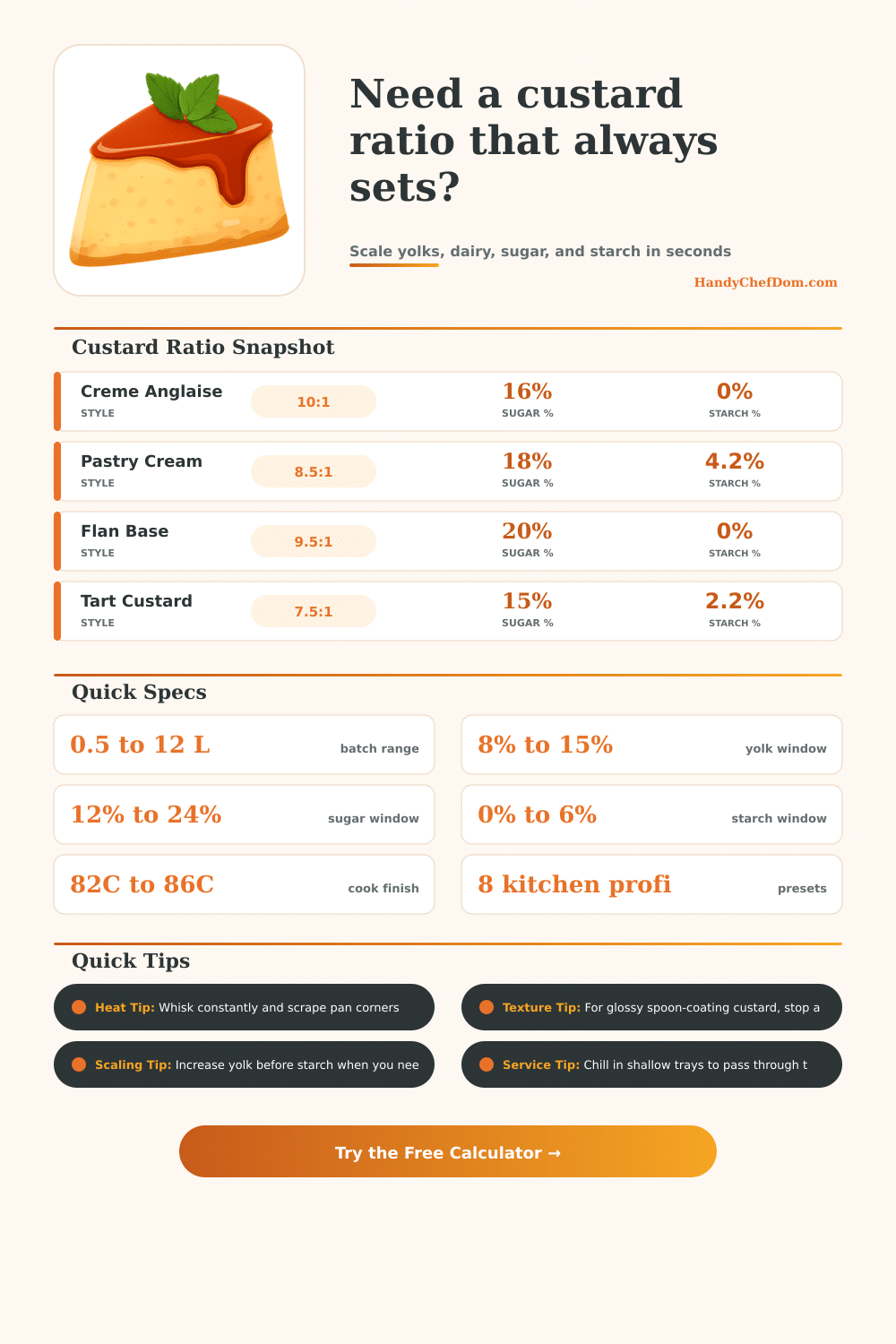
Dial in yolks, dairy, sugar, starch, and final yield for spoon custard, sliceable tart filling, pastry cream, or flan-ready bases with repeatable texture control.
Preset Kitchen Profiles
Calculator Inputs
Choose style, volume, and texture intent. The ratio engine adjusts yolk share first, then sugar, starch, and finish temperature to keep body stable across batch size.
Yield and Cost Snapshot
| Phase | Target | Control Point | Expected Cue |
|---|---|---|---|
| Base heat | 60 to 65C | No boil at edges | Steam starts, no bubbles |
| Yolk temper | +15C in 45 sec | Whisk non-stop | Glossy pale stream |
| Main cook | 82 to 84C | Silicone spatula sweep | Coats spatula back |
| Strain and chill | Below 5C in 90 min | Shallow tray depth | Set and smooth surface |
Operational Tips
Custard is made from specific ratio of ingredients. The ingredients will ultimately determine teh texture of the custard that is produce. Thus, an understanding of the role that each of the ingredients play in the custard will allow cook to determine the texture of the custard that the cook will produce by altering the ratio of each of those ingredients.
Changing the ratio of the ingredients will result in a change of the texture of the custard. One ingredient that can be used in the custard are egg yolks. Egg yolks contains the fat and protein that will contribute to the texture of the custard, as well as the emulsifying power that will provide the custard with its thick texture.
How to Make Custard Thick or Thin
Using more egg yolks will produce a custard that contains more thickness. However, if too many of the egg yolks are used in the custard, and the custard reaches too high a temperature during it’s preparation, the egg yolks may scramble. Using fewer egg yolks will produce a custard that contains less thickness.
Another ingredient is dairy product, and the amount of dairy that is used goes in the opposite direction than the amount of egg yolks that is used in the custard. Using more liquid from dairy products will thin the custard mixture, and will stretch the proteins that are contained within the custard. The type of dairy that is used will also have an impact on the custard.
For example, cream will add richness to the custard, while milk will provide a different flavor to the custard and is often less expensive than cream. Additionally, the dairy products that the cook uses must also be matched to the sweetness of the custard that is prepared, as well as the temperature of the custard. Sugar is another ingredient that perform several functions within custard.
For one, sugar will sweeten the custard. Additionally, sugar raises the temperature at which the custard will coagulate. Using too little sugar will produce a custard that is not sweet enough, while using too much sugar will prevent the custard from setting proper.
Starch can be added to custard to provide extra stability to the custard. Adding starch to custard will prevent the custard from breaking when reheated. However, the addition of starch may affect the texture of the custard.
Many cooks use starch to prepare large batches of custard so that the custard will retain its shape while resting in a warm environment. The temperature to which custard is cooked is also important to the texture of the resulting custard. Most custard recipes requires the custard to reach a temperature between 82 and 86 degrees Celsius.
If the custard is cooked to a temperature below 82 degrees Celsius, the proteins in the custard will not fully set, leading to custard that loosen when allowed to cool. If custard is cooked to a temperature above 86 degrees Celsius, the custard may become grainier. Because the ideal temperature of custard depends upon the amount of egg yolks and starch that are used, a thermometer should be used to ensure that the custard reaches the proper temperature.
Another factor that will impact custard is the size of the batch of custard that is to be prepare. Small batches of custard will heat to the proper temperature quick, but will also cool quickly, too. Large batches of custard will retain heat longer, and may continue to cook after being removed from the heat source.
The shape of the pan in which the custard is cooked will also impact the texture of the custard. The larger the surface area of the pan, the more quickly the custard will cook. It is best to avoid changing the ingredients of custard at the same time.
For instance, changing the amount of egg yolks, the amount of sugar and changing the type of dairy product at the same time will make it impossible to determine which changed ingredient led to the change in texture. By changing only one ingredient at a time, though, cooks can gain an understanding of which ingredients have which impact on the texture of custard. Thus, by using this strategy, cooks can ensure that the process of making custard is repeatable and predictable.