Food Protein Calculator
Set a food type, tune your serving plan, and see total protein, protein per serving, and batch weight in a clean pink calculator.
📌Quick Presets
📊Protein Snapshot
⚙Calculator Inputs
Choose a food, enter a batch weight, and var the calculator estimate protein totals using the portion plan you want to serve.
Protein snapshot
See total protein, per-serving protein, and a rounded batch weight in one quick view.
📑Reference Tables
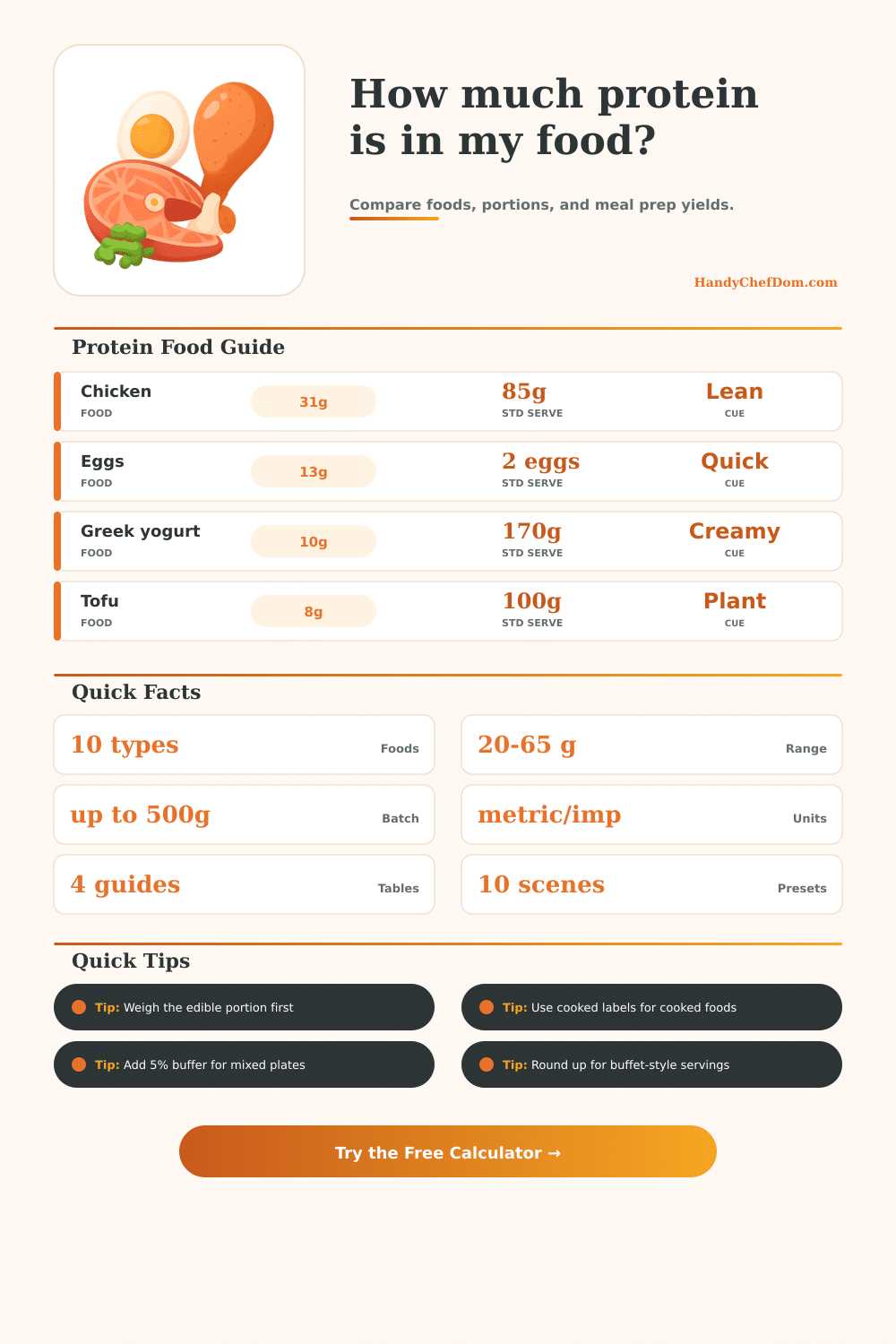
| Food | Protein | Std serve | Cue |
|---|---|---|---|
| Chicken breast | 31 g | 85 g | Lean plate |
| Eggs | 13 g | 2 eggs | Fast plate |
| Greek yogurt | 10 g | 170 g | Creamy bowl |
| Tofu | 8 g | 100 g | Plant base |
| Food | Portion | Metric | Use |
|---|---|---|---|
| Salmon | 1 fillet | 85 g | Dinner |
| Tuna | 1 can | 85 g | Salad |
| Cottage cheese | 1 cup | 226 g | Snack |
| Beans | 1 cup | 170 g | Mix-in |
| Style | Factor | Use | Note |
|---|---|---|---|
| Snack | 0.80x | Small plate | Light bite |
| Standard | 1.00x | Meal plate | Baseline |
| Hearty | 1.15x | Big plate | More fill |
| Buffet | 1.25x | Tray | Second helpings |
| People | Light | Standard | Hearty |
|---|---|---|---|
| 2 | 30 g | 50 g | 60 g |
| 4 | 60 g | 100 g | 120 g |
| 8 | 120 g | 200 g | 240 g |
| 12 | 180 g | 300 g | 360 g |
💬Quick Tips
When preparing food for the week, it is common for individuals to not know the protein content of the foods that they prepare. Many individuals attempt to measure an amount of protein in there food by measuring the size of they hands. However, measuring the protein content of food by hand isnt accuratley.
The protein content of foods can change during the cooking process of the food, as the food can lose weight during the cooking process. As a result, if individuals does not calculate the protein content of the food that they prepare, they may consume less protein then that which they have planned to consume. Protein density is a measurement of the amount of protein that contain within a specific weight of food.
How to Measure Protein in Your Food
Individuals must understand the protein density of foods, as not all foods contains the same amount of protein per gram of food. For instance, foods like chicken breast contains more protein per 100 grams than foods like tofu. However, if individuals understand the protein density of the foods that they consume, they can easily swap foods for each other while still maintaining their protein goals.
Additionally, if individuals understand the protein density of the foods that they eat, they can adjust the amount of food that they cook in order to meet their protein goals. Another factor that must be considered is the difference between raw weight and cooked weight. For instance, meat will lose weight during the cooking process as the meat lose water.
Thus, the cooked weight of the meat will be less then the raw weight of the meat. Additionally, individuals may need to account for the waste factor of the food. For instance, if a cook trims fat from meat, the weight of the cooked meat will decrease.
Accounting for these factors will ensure that the protein that an individual tracks is the protein that the individual actually consume. Another factor that may impact the food that is prepared is the serving style for the food. For instance, some occasion may require more food than others.
By adjusting the portion of food that is prepared according to the serving style for that days food, individuals can prevent feeling hungry during the day. An individual may use a protein calculator to assist with the calculation of the amount of protein that is contain in the food that is prepared for the week. Additionally, if the protein calculator indicates that the food does not contain enough protein to meet an individual’s protein goal, there will be a protein gap that adding protein to that meal can bridge.
Furthermore, using a protein calculator can eliminate the need for manual calculation, and using such a calculator will provide certainty to individuals regarding there protein intake for the day. Reference tables are also useful in calculating the protein content of meals. Reference tables indicates the amount of protein that is contained in various foods.
For instance, if an individual utilizes lentils in place of fish in their meals, the reference table may indicate that more lentils must be consumed in order to gain the same amount of protein as the fish. Thus, reference tables allow individuals to understand the different foods as a means of providing specific nutrients to the body. In addition to calculating the protein content of meals, individuals should also plan their meals for potential leftovers.
To plan meals for potential leftovers is to prepare the meals in advance in quantities that will allow for some of the food to be prepared as leftovers. Thus, if individuals plan their meals to contain leftovers, they will have more food available during days when the individual needs more fuel. Planning meals that contain leftovers will prevent individuals from run out of food during the week.
Overall, the goal in measuring the amount of protein that is consumed by an individual each day is to ensure that the individual is consuming the exact amount of protein that is required by the individual. By utilizing protein density, raw and cooked weights of food, and the concepts of serving styles, individuals can remove the guesswork from meal preparation. Thus, by removing the guesswork, individuals will gain a confidence in their ability to prepare meals with the proper amount of protein.