🍺 Beer to Shot Calculator
Convert any beer serving into shot equivalents using real ABV math, shot size, and serving count so your comparisons stay honest and practical.
Set beer details, shot strength, and waste. The tool converts pure alcohol volume so beer and shots compare on the same basis.
| Beer style | Low ABV | High ABV | Typical |
|---|---|---|---|
| Light Lager | 3.8% | 4.5% | 4.2% |
| Pilsner | 4.4% | 5.2% | 4.8% |
| Pale Ale | 5.0% | 6.2% | 5.6% |
| IPA | 6.0% | 7.5% | 6.8% |
| Imperial IPA | 8.0% | 10.0% | 9.0% |
| Dry Stout | 4.0% | 5.0% | 4.3% |
| Shot format | Size | ABV | Pure alc |
|---|---|---|---|
| US shot | 1.5 oz | 40% | 0.60 oz |
| UK single | 25 ml | 40% | 0.34 oz |
| UK double | 50 ml | 40% | 0.68 oz |
| AUS nip | 30 ml | 40% | 0.41 oz |
| JP shot | 30 ml | 40% | 0.41 oz |
| Proof | ABV | 1.5oz alc | US std eq |
|---|---|---|---|
| 70 | 35% | 0.53 oz | 0.88 |
| 80 | 40% | 0.60 oz | 1.00 |
| 90 | 45% | 0.68 oz | 1.12 |
| 100 | 50% | 0.75 oz | 1.25 |
| 114 | 57% | 0.86 oz | 1.43 |
| Container | ABV | Std drinks | Shot eq |
|---|---|---|---|
| 12 oz beer | 5% | 1.0 | 1.0 |
| 16 oz beer | 5% | 1.3 | 1.3 |
| 22 oz beer | 5% | 1.8 | 1.8 |
| 40 oz beer | 5% | 3.3 | 3.3 |
| 12 oz malt | 7% | 1.4 | 1.4 |
A beer to shot calculator are a tool that helps a person to compare the amount of alcohol in a bottle of beer to the amount of alcohol in one or more shots of liquor. Many people dont consider the number of alcoholic drink that they consume in terms of shots until either when they are planning a nights activities, or when they are looking at the alcohol content in different types of drinks. A beer to shot calculator is useful in that it can help a person understand how much alcohol they will consume if they take a certain number of drinks of beer of a certain volume and alcohol strength, and compare that to a certain number of shots of liquor of a certain volume and alcohol strength.
Beer bottles comes in a variety of sizes and alcohol strengths. For instance, a twelve ounce bottle of beer with a five percent alcohol strength is not the same as sixteen ounce bottle of beer with a higher alcohol strength, and is not the same as a small bottle of a high strength beer. The alcohol content of any bottle of beer is a function of both the volume of the beer as well as the alcohol strength of the beer.
How to Use a Beer to Shot Calculator
To use a beer to shot calculator, a person must enter information about the volume of the beer, the strength of the beer, the number of servings of beer that they will consume, the size of the shots that they will consume, and the strength of those shots. Additionally, many beer to shot calculators also ask that a person enter the percentage of the beer that is lost due to pouring it into the glass and creating foam on the surface of the beer, as an individual will drink less beer than that poured into their glass. The amount of pure alcohol in a serving is the most important value to consider when comparing the alcohol content of beer and shots.
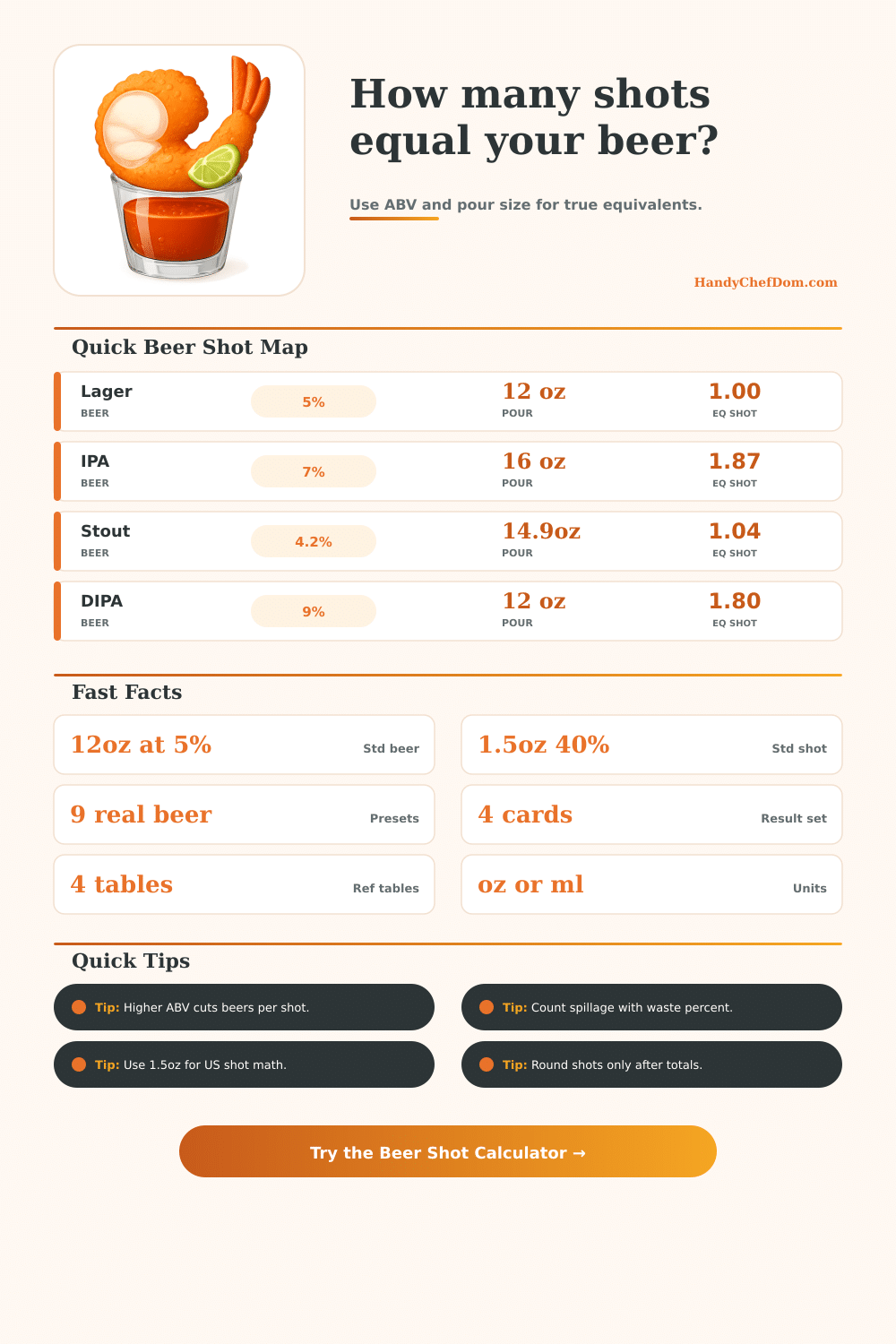
For instance, a standard shot of forty percent alcohol liquor contains about zero point six ounces of pure alcohol, and a twelve ounce bottle of five percent alcohol beer also contains about zero point six ounces of pure alcohol. Thus, the two types of drinks may appear to have the same alcohol content. However, a twelve ounce bottle of double IPA beer that is nine percent alcohol contains almost twice the amount of alcohol as a twelve ounce bottle of five percent beer.
A beer to shot calculator makes it possible for a person to see these differences in alcohol content without performing the calculations in their head. Many people believe that a pint of liquid is the same as a pint of any other liquid, and that a shot of liquor is the same as a shot of any other liquor. However, both of these assumptions are often incorrect.
For instance, sixteen ounces of a session beer that is four point eight percent alcohol may contain the same amount of alcohol as a standard lager bottle of beer. Additionally, a stout poured into a fourteen point nine ounce pint may contain the same amount of alcohol as a standard lager beer. These small differences in alcohol content and strength can have a significant impact on the individual that consumes a number of drinks of either type of liquor.
The rate at which a person drinks liquor can impact the way that the alcohol affects the body. For instance, a person may sip on their beer slow over time, but chug shots of liquor quickly. Such differences in the rate at which alcohol is consumed can impact the body in different ways.
Other factors in the evening, such as the consumption of food, water, and the length of the evening can also impact the effect that alcohol has upon an individual. For instance, one individual may consume three beers over the course of three hours, but another individual who consumes the same amount of alcohol in three quick shots will feel different. Thus, while a beer to shot calculator can provide an individual with information about the alcohol content of the drinks that they will consume, a beer to shot calculator cannot consider or convey the effect that the alcohol will have upon those who consume it.
In addition to being able to determine the alcohol content of the drinks that an individual will consume, a beer to shot calculator can be useful in planning an event with others. For instance, when preparing for a party, an individual may want to know how many servings of beer may be consumed to equal a certain amount of spirits. The comparison grid that a beer to shot calculator often includes allows for the individual to easily see how one beer, six beers or four pints of beer may compare to a bottle of spirits.
Thus, the comparison grid is useful in making a decision of whether to arrange alcohol beverages for a party that include beer or spirits. Common errors that a person may make with a beer to shot calculator are assuming that each bottle of beer has the same alcohol strength and content, or forgetting that the size of shots can be different according to the region of the country in which the individual lives. For instance, a shot in the UK may be of a different size than a shot in the US, and a nip of liquor in Australia may be of a different size than a shot in the US.
Thus, the ability to enter the size and strength of the shots that will be consumed allows the calculations to remain accurate. Additionally, the ability to switch between the use of ounces and milliliters allows the tool to be used if the alcohol beverage labels use different units of measurement than those requested by the calculator. Another common error is to not account for any waste of the alcohol beverages when they are poured.
For instance, if an individual pours their beer into their glass, some of the liquid will be lost due to the creation of foam on the top of the liquid. Such loss of the beverage is invisible to the individual if they are only counting the number of bottles of that alcohol that they drink, but can be accounted for in the beer to shot calculator. The same logic can be used to calculate the amount of beer lost from pouring into a keg, as well.
The reference tables that are included with many beer to shot calculators have a different purpose than the calculator itself. The reference tables often display the range of alcohol content within different types of beers. Additionally, the reference tables often include the size and proof of common shots of liquor, as well.
These tables are useful in allowing individuals to understand information about the alcohol beverages that are bottled in a manner that is different than that which the beer to shot calculator itself requires. Overall, a beer to shot calculator can help an individual to avoid guesswork in determining the amount of alcohol that they will consume. Beyond understanding the alcohol content of the different beverages that they will drink, the calculator can help them to consider other factors in the evening, as well.
However, the calculator will only provide the information regarding the alcohol content of the beverages that are to be consumed. The effect of those drinks upon the body, however, is something that an individual and their evening could of not been accounted for.