Lemonade for Guests Calculator
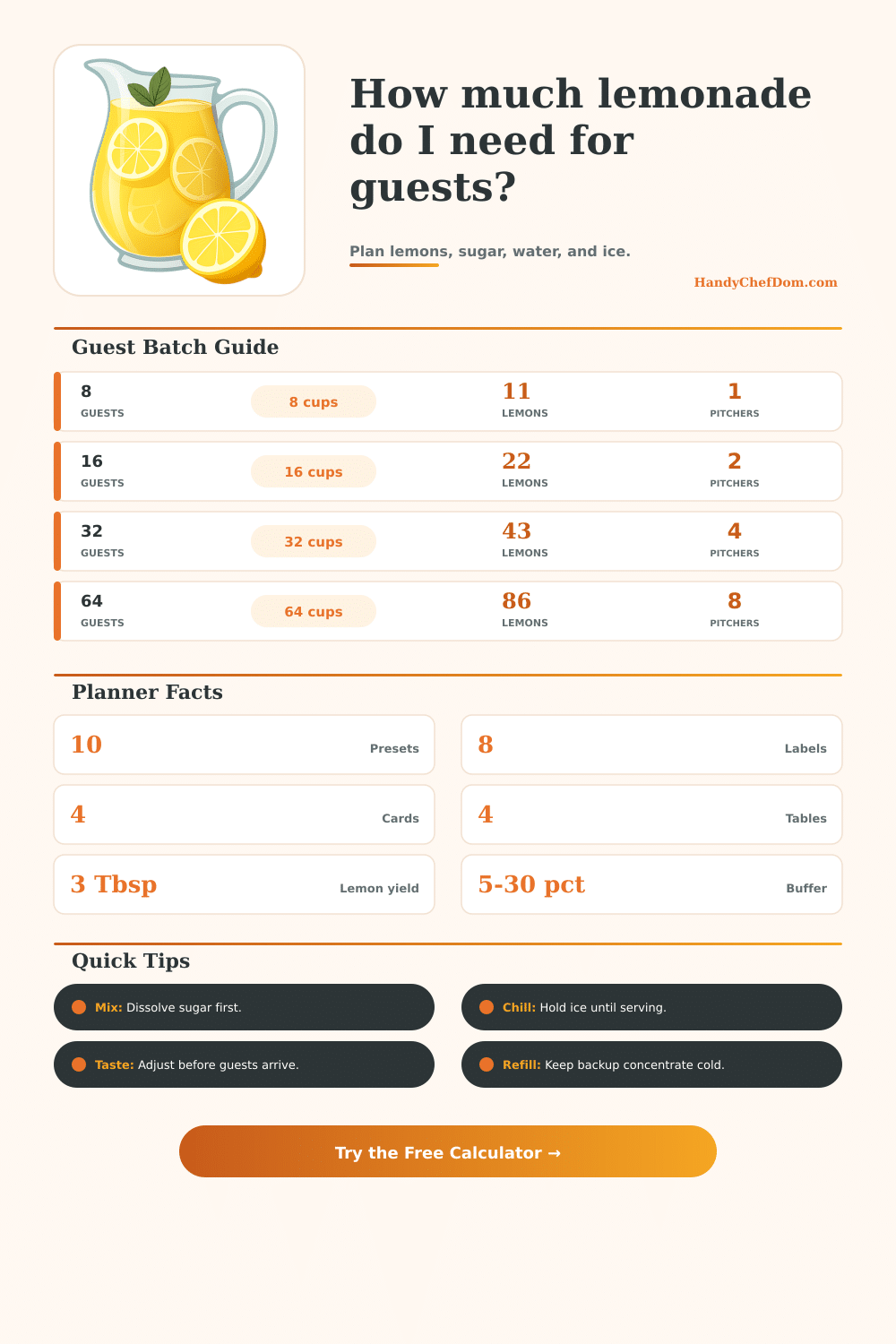
Plan a guest-ready lemonade batch from headcount instead of guessing. This calculator estimates finished volume, lemons, lemon juice, sugar, water, ice, pitcher count, refills, garnish, and a practical serving buffer.
Start with a common hosting scenario or enter your own numbers. Presets adjust cup size, refill behavior, ice, lemon strength, sweetness, and buffer so the batch fits the way guests actually drink.
Your lemonade guest plan
Best when lemonade is one of several drinks and guests sip once.
Good for lunch, showers, picnics, and indoor gatherings.
Use for outdoor BBQs, sports days, and sunny buffet tables.
Plan this when the dispenser is the main nonalcoholic drink.
How this guest lemonade estimate works
The calculator starts with guest count, cup size, servings per guest, and a buffer. It then splits the finished volume into lemon juice, sweetener, and water using the selected style. Ice melt is treated as future water, so the cold water amount is reduced before serving.
Lemons are rounded up from fresh juice yield, then garnish lemons are added separately. This keeps the shopping list honest: lemons used for slices should not be counted as lemons available for squeezing.
| Guests | Light reception | Standard party | Hot day | Pitcher note |
|---|---|---|---|---|
| 6 guests | 4.5 cups | 9 cups | 13.5 cups | One 10 cup pitcher works for standard pours. |
| 10 guests | 7.5 cups | 15 cups | 22.5 cups | Use two pitchers or a one gallon dispenser. |
| 18 guests | 13.5 cups | 27 cups | 40.5 cups | A two gallon cooler gives room for ice. |
| 25 guests | 18.8 cups | 37.5 cups | 56.3 cups | Make concentrate if refrigerator space is tight. |
| 40 guests | 30 cups | 60 cups | 90 cups | Use multiple dispensers or refill in waves. |
| 60 guests | 45 cups | 90 cups | 135 cups | Stage backup water, ice, and concentrate. |
| Style | Lemon share | Sugar share | Water share | Best use |
|---|---|---|---|---|
| Classic balanced | 1 part | 1 part | 5 parts | Most family parties and picnic pitchers. |
| Tart fresh squeeze | 1.2 parts | 0.9 part | 4.9 parts | Guests who like a sharper lemon finish. |
| Sweet party stand | 1 part | 1.25 parts | 5 parts | Kid tables, stands, and dessert buffets. |
| Light brunch | 0.8 part | 0.7 part | 6 parts | Morning events and lighter sipping. |
| Sparkling top-off | 1 part | 0.95 part | 4.2 parts | Mix still base first, add bubbles last. |
| Pink lemonade | 1 part | 1.05 parts | 5 parts | Add berry juice or cranberry for color. |
| Item | Typical yield | Planning conversion | Hosting note |
|---|---|---|---|
| Average lemon | 3 Tbsp juice | About 5.3 lemons per cup of juice | Buy a few extras if lemons feel firm or dry. |
| Granulated sugar | 1 cup is about 200 g | Four cups is about 1.75 lb | Dissolve as syrup so no grit settles in the dispenser. |
| Cold water | 16 cups per gallon | 4 cups per quart | Chill water ahead so ice is for serving, not cooling. |
| Ice | 2 lb fills about 6 cups loosely | 10 lb bag suits many small parties | Keep serving ice separate from mixing ice. |
| Garnish lemon | 8 to 10 wheels | One lemon garnishes about 4 to 8 drinks | Slice thin so guests still have room in cups. |
| Mint or berries | Optional accent | Use small amounts per dispenser | Add delicate garnish close to serving time. |
| When | Task | Why it matters | Calculator tie-in |
|---|---|---|---|
| Day before | Buy lemons, sugar, water, cups, and ice. | Large batches run out of lemons faster than expected. | Use the lemon card plus garnish line. |
| Morning of | Juice lemons and strain seeds. | Fresh juice tastes bright but needs prep time. | Use the juice cup amount in the breakdown. |
| 2 to 4 hours before | Dissolve sugar and chill the base. | Cold syrup mixes smoother and uses less ice. | Use the sugar and concentrate lines. |
| 30 minutes before | Fill dispensers, add water, taste, and adjust. | This is the best moment to correct tartness. | Use the water before ice row. |
| At serving | Add ice, garnish, cups, and a ladle or tap label. | Ice added too early dilutes the first pours. | Use the ice melt allowance and pitcher count. |
| During refills | Refresh with concentrate, water, and ice. | Refills stay consistent without remeasuring sugar. | Use the container and refill estimate. |
When making lemonade for a group of people, calculating the amount of lemonade that is required depend on the number of guests that will be drinking the lemonade. Many peoples will guess at the amount of lemonade that is required for the guests. If the amount of lemonade is guessed, it is possible that there may not be enough lemonade for all of the guests (leading to dehydration!), or that the lemonade may be to weakly because the ice melts into the lemonade.
To avoid these problems, people can use a calculator to determine the amount of lemonade, sugar, and lemons that will be needed to make enough lemonade for the guests. The amount of lemonade that will be needed can be calculated by considering several different factor. For example, the number of guests, the size of the cups that will be used for the lemonade, the environmental factors (how hot the weather will be), the amount of ice that will be used, and the amount of lemonade that each guest will drink.
How to Make the Right Amount of Lemonade
For example, if the guests will be using small six-ounce cups of lemonade, but if the weather will be hot, more lemonade will be needed than if the guests were using large eight ounce cups and the weather cooler. Additionally, the amount of ice that will be used melts into the lemonade, which may dilute the lemonade flavor, so that consideration should be made in the calculations. These factors can all be entered into the calculator to determine a shopping list for the lemonade.
In addition to the factors that relate to the amount and type of lemonade that is to be made, there are additional factors regarding the preparation of the lemonade that can be considered. For instance, it may be helpful to include a buffer percentage in the calculations of the amount of lemonade that will be needed. For example, a percentage between 5 and 30% of the total amount of lemonade can be added to provide enough lemonade for the guests to have a second helping.
Additionally, people may want to use an ice-melt setting on the calculator so that the amount of water that is used in the lemonade can be accounted for. If the amount of water is reduced at the beginning of the preparation of the lemonade, the lemonade will be more flavorful once the ice melts. In addition to the amount of lemonade that will be needed, the balance between sugar and lemon juice in the lemonade can be calculated.
The ratio between the amount of sugar and lemon juice will determine the flavor of the lemonade. For example, if lemon juice is to be more prevalent in the lemonade than sugar, the cook will increase the amount of lemon juice and the cook will decrease the amount of sugar. The opposite can be true for lemonade that is to be sweeter then acidic.
Additionally, the amount of juice that can be yielded from lemons may be considered before making the lemonade. For example, some lemons may yield only three tablespoons of juice, while other lemons may contain more than four tablespoons of lemon juice. Thus, a correct amount of juice must be considered when calculating the number of lemons that will be needed.
The number of lemons that will be used for the juice in the lemonade may be calculated separately from the number of lemons that will be used for garnish. For example, lemons used for garnish will not contribute to the amount of lemon juice in the lemonade, but may be used for decorative purposes. Additionally, people may choose to make a lemonade concentrate.
For example, making a lemonade concentrate will save space in the refrigerator. However, the amount of water that will be used to prepare the concentrate must be adjusted in the calculation of the amount of water that will be used in making the lemonade. The calculator will show the adjusted amount of sugar and water for making the lemonade concentrate.
In addition to the number of lemons and the amount of lemonade that will be made, the way in which the lemonade will be served may be considered. For example, if one large cooler will be used to hold the lemonade, the amount of space in the cooler can be considered. However, if multiple small pitchers will be used to hold the lemonade, only one pitcher will need to be refrigerated.
These different plans for serving the lemonade can be compared with the comparison grid that is provided with the calculator. Finally, consideration must be made for when the lemonade will be prepared. For instance, the lemonade can be prepared the day before the event, or in the morning of the event.
If prepared the day before, the sugar will dissolve in the lemonade. However, if prepared on the day of the event, the lemonade will taste more bright. Thus, mixing the lemonade syrup the night before, but adding the water and ice the morning of the event may be the best choice.
The calculator can show the volume of the lemonade concentrate separately from the volume of the finished lemonade. Common mistakes when making lemonade can include a variety of different error. For instance, many people do not consider that the hot weather will increase the amount of lemonade that is consumed by the guests.
Additionally, many people do not consider that the hot weather will also impact the amount of ice melt in the lemonade. Furthermore, people may purchase the number of lemons that are suggested by calculating the amount of lemonade that will be needed, but if the lemons have a low yield of lemon juice, they may run out of lemons! However, by using the buffer settings and garnish settings for the lemonade, these common mistakes can be avoided.
Thus, by using the calculator to determine the amount of lemonade, sugar, and lemons that will be needed, people can avoid any worry about whether the lemonade will match the needs of the guests!