🍷 Titratable Acidity Calculator
Calculate TA for wine, cider, kombucha, yogurt, vinegar, brines, and fruit ferments from titration data, then size acid adjustments or blends.
Enter the actual titration run. Sample volume stays in milliliters because most food and cellar TA methods use a measured aliquot.
TA formula: titratable acidity in g/L equals corrected NaOH mL times NaOH normality times acid equivalent weight times dilution factor, divided by sample mL.
Acid basis: tartaric, malic, lactic, acetic, citric, and gluconic reporting styles use different equivalent weights, so the same titration can show different g/L values.
Dosing: the acid correction converts the TA gap into chemical equivalents, then adjusts for the selected acid and its strength or purity.
| Food or Ferment | Common TA Range | Report As | Typical Endpoint |
|---|---|---|---|
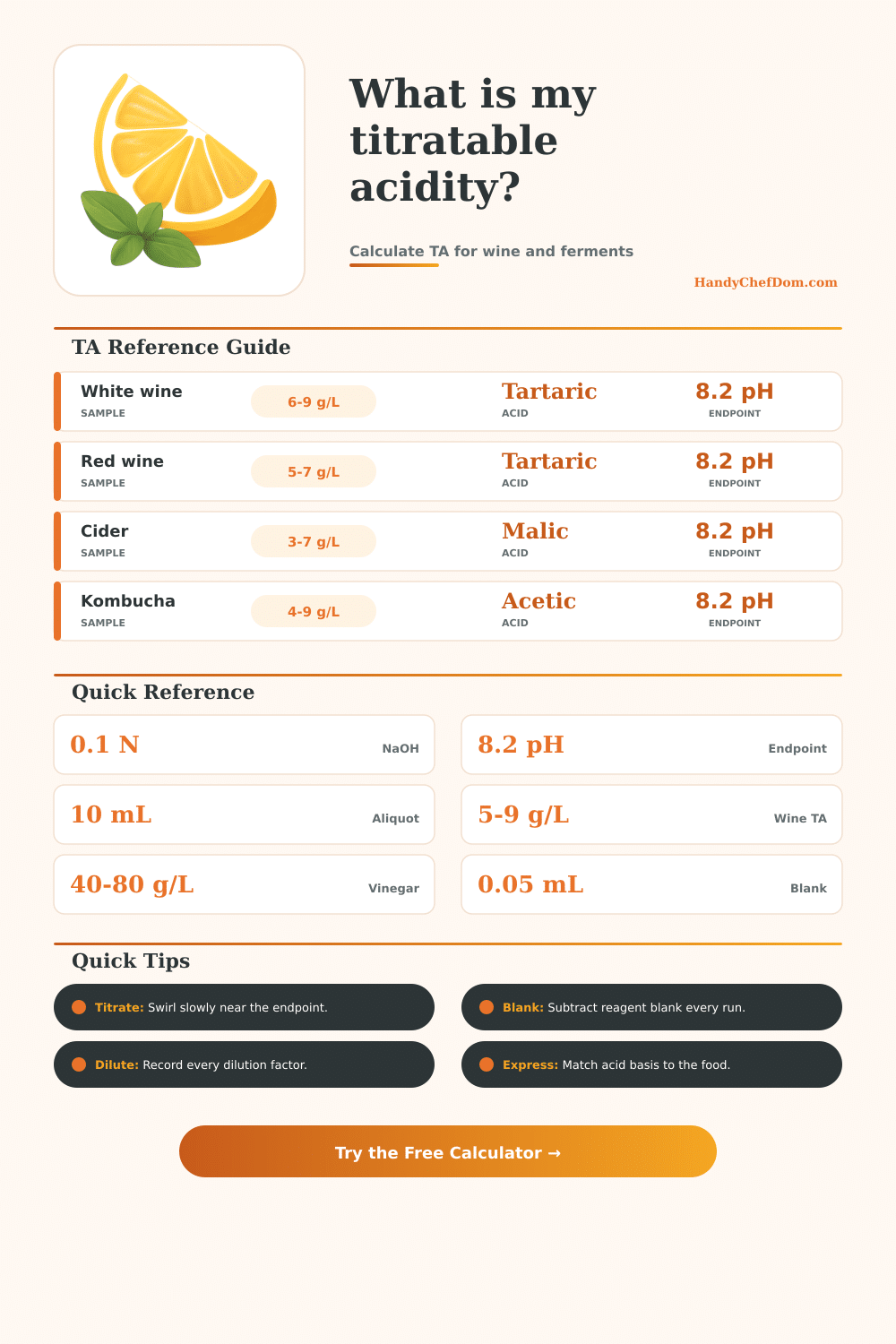
| Dry white wine | 6.0 to 9.0 g/L | Tartaric | pH 8.2 |
| Dry red wine | 5.0 to 7.5 g/L | Tartaric | pH 8.2 |
| Hard cider | 3.0 to 7.0 g/L | Malic | pH 8.2 |
| Kombucha | 4.0 to 9.0 g/L | Acetic | pH 8.2 |
| Yogurt slurry | 7.0 to 12.0 g/L | Lactic | pH 8.3 |
| Table vinegar | 40 to 80 g/L | Acetic | pH 8.2 |
| Pickle brine | 6.0 to 18.0 g/L | Acetic | pH 8.2 |
| Pepper mash | 6.0 to 16.0 g/L | Lactic | pH 8.2 |
| Acid Basis | Equivalent Weight | Best Match | Interpretation Use |
|---|---|---|---|
| Tartaric acid | 75.05 g/eq | Wine and mead | Cellar TA sheets |
| Malic acid | 67.05 g/eq | Cider and apples | Fruit balance trials |
| Lactic acid | 90.08 g/eq | Yogurt and lactic ferments | Culture progress |
| Acetic acid | 60.05 g/eq | Vinegar and kombucha | Sharpness tracking |
| Citric acid | 64.04 g/eq | Citrus and berry bases | Fruit acid labeling |
| Gluconic acid | 196.16 g/eq | Kombucha blends | Tea ferment context |
| Run Setup | Suggested Aliquot | NaOH Strength | Why It Helps |
|---|---|---|---|
| Wine bench test | 10 mL | 0.1 N | Easy g/L math |
| Cider must | 10 mL | 0.1 N | Works with apple acidity |
| Kombucha tea | 5 to 10 mL | 0.1 N | Allows foamy samples |
| Yogurt slurry | 9 to 10 g slurry | 0.1 N | Dilution improves endpoint |
| Strong vinegar | 1 to 5 mL | 0.5 N | Prevents huge titrant volume |
| Hot sauce mash | 5 to 10 mL | 0.1 N | Blend solids before testing |
| Adjustment Goal | Preferred Acid | Strength Entry | Use Case |
|---|---|---|---|
| Raise wine TA | Tartaric powder | 99.5% | Clean cellar correction |
| Lift cider brightness | Malic powder | 99.5% | Apple style acidity |
| Round dairy acidity | Lactic solution | 88% | Cultured dairy trials |
| Sharpen fruit base | Citric powder | 99.5% | Berry and citrus blends |
| Build vinegar bite | Vinegar stock | 5% | Acetic stock addition |
| Balanced fruit wine | Acid blend | 90% | Mixed acid correction |
Titratable acidity is an measurement that tells you how much acid is in a liquid sample. Titratable acidity is also a measurement that helps you to make decisions about the fermentations of that liquid. Titratable acidity differ from pH measurements in that pH measurements tell you the strength of the acid at one specific moment in time, while titratable acidity measurements allow you to determine the total amount of acid in the sample.
Titratable acidity is used to understand the flavor of a product, as well as to understand its microbial stability. Because titratable acidity measure the total amount of acid in the product, it is a more important measurement to track over time then the pH of the product. The calculator will handle all of the mathematical calculations for you; you dont have to calculate the equivalent weights of the sample by yourself.
How to Test and Adjust Titratable Acidity
Many people use titration to ensure that the product they are making has an acidity level in the target range indicate for that type of product. However, it is important for those who performs titration to understand what that target acidity range controls. For instance, white wines often require a higher level of titratable acidity than red wines.
Cider maker often use malic acid as their reference point for titratable acidity because this is the main acid found in apples. Vinegar producers will use titratable acidity to monitor the amount of acetic acid in the vinegar product that they create. The calculator also allows for you to change the units in which the titratable acidity is displayed to the units that is required by your recipe or customers.
This is useful for blending a high-acid product with a low-acid product to create a product with a specific specification for acidity. To use the calculator, you will have to follow some standard procedure for sampling the products. The first of these is to select the volume of the sample that is taken.
Following this, you will have to record the amount of milliliters of sodium hydroxide that were used in the titration. Another factor to account for is the blank; this is a correction for the amount of acid that is naturaly contain in the reagents or water. Other than this correction for the blank, you may have to also use a dilution factor for your product.
The result of titratable acidity will change if you change any of these value. Each of these values are a measurement of the product. The endpoint pH is standardized at 8.2 as this is the value at which many acid will be fully neutralized.
Once you have completed the titration, the calculator will display to you the titratable acidity of the product that you create. Additionally, it will show you what would be required to adjust the acidity of the product. For instance, if you found that the titratable acidity was too low, the calculator will show you how much acid must be added to bring the acidity to the desired reading.
This calculation consider the purity of the acid that you add to adjust the titratable acidity. This avoids adding too much acid to the batch. The other option on the calculator is to determine the results of blending the product with another batch of the same product.
Many batch producers will opt to blend another batch of the same product rather than adding acid to the batch. The reference tables can help you to understand whether or not your batch of product is typical for its specific product. For instance, a dry white wine often contains less than six grams of titratable acidity per liter of wine.
However, cider with six grams of titratable acidity per liter will taste good. Furthermore, forty grams of acetic acid per liter is the standard strength for vinegar. However, forty gram of titratable acidity per liter of wine would be too high.
Understanding these ranges will allow you to understand what is a normal range for the product; this avoids creating batches with titratable acidity that will not suit the product that is created with those batches. The reference tables also include common aliquot size and normalities for you to use in your titration tests in the future. It is important for you to understand the relationship between pH and titratable acidity.
These two values is often confused with one another. The pH of a sample will tell you the strength of the acid, but it will not tell you how much acid is in the sample. Two samples can have the same pH value, yet have different amounts of titratable acidity.
It is important for you to understand that these two measurements is different from one another. This calculator allows you to track each of these measurements separately; this allows you to understand the difference between the two measurements for the product that you created. There are some issues in the handling of samples that may affect the outcomes of the titration test.
For example, if the ferment that you are producing creates foam or is viscous like yogurt, it may be helpful to dilute the product before measuring the pH. Additionally, the temperature of the sodium hydroxide may affect the titration; warm liquids will expand. Therefore, it is always a good idea to record the actual condition in which the tests are performed.
In some cases, these conditions may impact what adjustments must be made to the product batch. When you must decide whether to adjust the acidity of the product or to blend it with another batch, there are some additional consideration beyond those required by the calculator. For instance, if you were to adjust the acidity, you must also consider how that will impact the sweetness, tannins, salt, and alcohol content of the product.
Each of these factor interact with acidity. For instance, increasing the acidity in wine may brighten the flavor, but it may also stimulate the microbe in the wine. In vinegar, too much acidity may overpower the ester created during the alcoholic fermentation stage.
These are factors beyond the calculator; however, your knowledge of your product will allow you to make such decisions. Another aspect of using this calculator and performing titrations is that you will eventually develop an understanding of the relationship between acidity and other aspect of the products that you create. For instance, you may find that red wines with a higher amount of titratable acidity have a different mouthfeel after being in contact with the barrels in which they are aged for six months.
You may also find that at a specific reading of acetic acid, kombucha tastes best. Through using this calculator and titrating each batch of products, you will develop an understanding of these relationships; thus, the calculator will become part of a quality system regarding the products that you create. The work that you perform will be the same each time; however, your understanding of the products that you create will grow over time.