🍋 Super Juice Calculator
Scale citrus peels, citric acid, malic acid, water, fresh juice, and batch loss for high-yield lemon, lime, orange, grapefruit, yuzu, and Meyer lemon super juice.
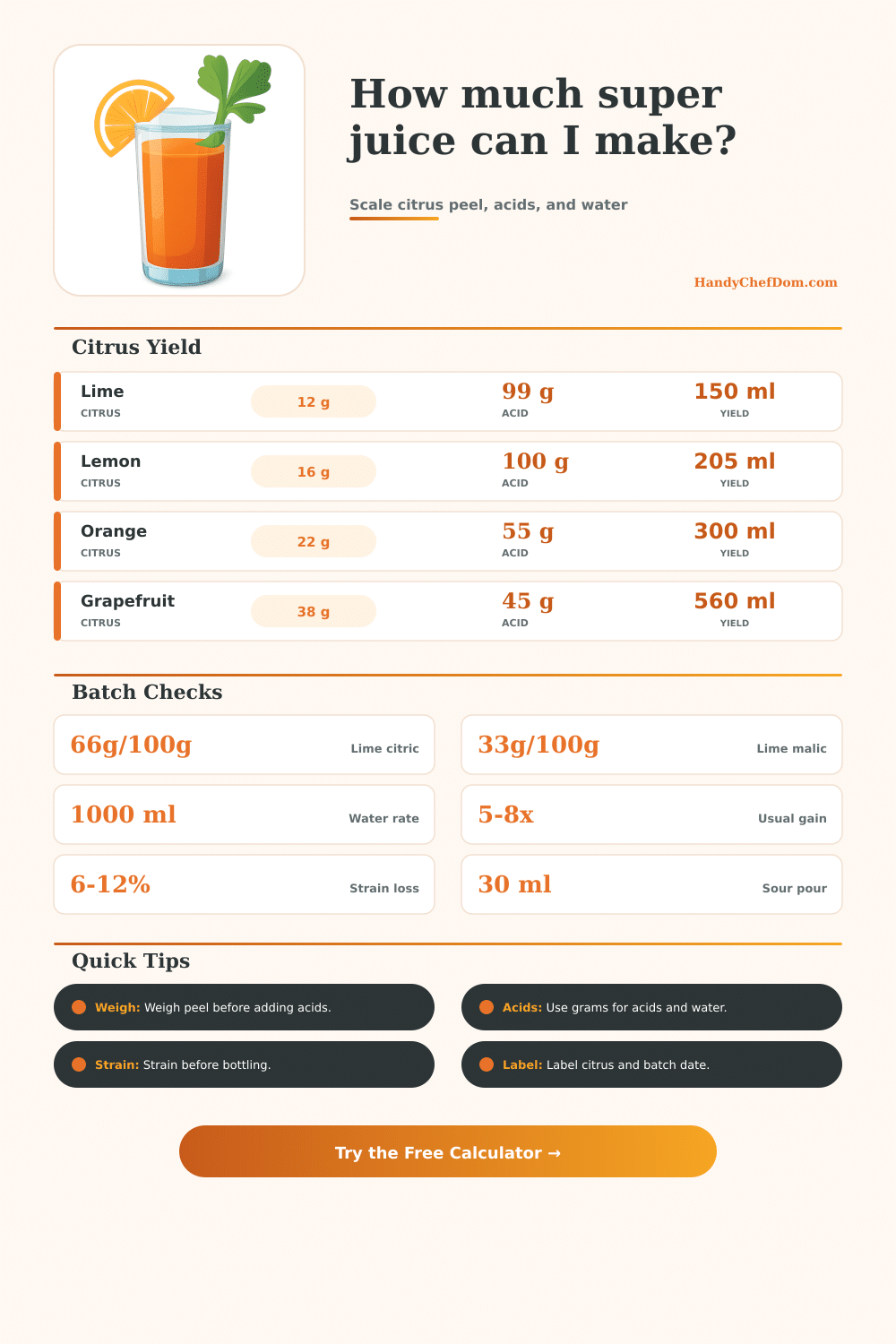
Pick a planning mode, citrus type, and sour pour. The calculator estimates fruit count, peel weight, acid grams, water, strained yield, and how many normal-juice portions the super juice replaces.
| Citrus | Avg Fruit | Juice/Fruit | Peel/Fruit | Citric/100 g Peel | Malic/100 g Peel |
|---|---|---|---|---|---|
| Lime | 67 g | 30 ml | 12 g | 66 g | 33 g |
| Lemon | 85 g | 45 ml | 16 g | 100 g | 0 g |
| Orange | 180 g | 80 ml | 22 g | 40 g | 15 g |
| Grapefruit | 246 g | 140 ml | 38 g | 35 g | 10 g |
| Yuzu-style | 100 g | 18 ml | 20 g | 55 g | 35 g |
| Meyer lemon | 90 g | 42 ml | 17 g | 65 g | 8 g |
| Tangerine | 88 g | 40 ml | 14 g | 30 g | 12 g |
| Blood orange | 160 g | 70 ml | 20 g | 42 g | 12 g |
| Citrus | Water/100 g Peel | Raw Yield/Fruit | After 8% Loss | Fresh Juice Lift |
|---|---|---|---|---|
| Lime | 1000 ml | 150 ml | 138 ml | 4.6x |
| Lemon | 1000 ml | 205 ml | 189 ml | 4.2x |
| Orange | 1000 ml | 300 ml | 276 ml | 3.5x |
| Grapefruit | 1100 ml | 558 ml | 513 ml | 3.7x |
| Yuzu-style | 950 ml | 208 ml | 191 ml | 10.6x |
| Meyer lemon | 950 ml | 204 ml | 188 ml | 4.5x |
| Tangerine | 900 ml | 166 ml | 153 ml | 3.8x |
| Blood orange | 950 ml | 260 ml | 239 ml | 3.4x |
| Use Case | Citrus | Serving Pour | Acid Profile | Planning Note |
|---|---|---|---|---|
| Daiquiri | Lime | 25-30 ml | Classic | Bright shaken drinks |
| Margarita | Lime | 30 ml | Bright | Salted, juicy finish |
| Whiskey sour | Lemon | 25-30 ml | Classic | Clean sour backbone |
| Tom Collins | Lemon | 20-25 ml | Soft | Lengthened with soda |
| Paloma | Grapefruit | 45 ml | Soft | Lower sharpness |
| Highball | Orange | 30-45 ml | Dessert | Rounder citrus body |
| Tea sour | Meyer lemon | 25 ml | Dessert | Gentle acidity |
| Yuzu sour | Yuzu-style | 15-20 ml | Bright | High aroma, small pour |
| Adjustment | Citric Factor | Malic Factor | Best For | Flavor Effect |
|---|---|---|---|---|
| Classic | 1.00x | 1.00x | Sours | Balanced sharpness |
| Soft | 0.85x | 0.80x | Highballs | Less bite |
| Bright | 1.12x | 1.08x | Shaken drinks | Extra snap |
| Dessert | 0.75x | 0.70x | Tea and brunch | Rounder finish |
| More peel | Same | Same | Thick skins | Oilier aroma |
| More water | Same | Same | Long drinks | Softer dilution |
Super juice are a concentrated, sour liquid that is used in cocktails to replace fresh citrus juice. Super juice is made by take the fragrant oils from citrus peel and combining those oils with acid and water. Super juice is more efficient than using fresh juice from citrus fruit in that super juice require the use of less fruit to create the same volume of liquid.
Because super juice uses citrus peel, acid, and water instead of squeezing juice from citrus fruit, super juice also allows for more consistent flavor from cocktail to cocktail. Both professional bar and home bartenders use super juice to prepare for parties and guests. Super juice can provide more volume than fresh juice from the same amount of citrus fruit.
How to Make and Use Super Juice for Cocktails
For instance, a lime will contain thirty milliliters of juice when squeezed. However, the same lime can create five or six times that amount of super juice when the oil from the citrus peel are used in combination with acid and water. A calculator can help bartenders plan for the amount of super juice that they will be able to create with the amount of citrus fruit that they have available.
For instance, the calculator can run the bartenders through the options of the amount of juice needed, the number of fruits available, or the number of cocktails that they need to serve. Each of these options requires the bartender to understands the different inputs into the recipe. Some of those different inputs are the efficiency of the citrus peel, the amount of water that will be added to the super juice, and the potential for strain loss of the citrus peels.
The efficiency of citrus peel can change if the bartender utilizes thin-skinned citrus fruits and/or uses a heavy hand with a peeler. Additionally, different amounts of water can change the acidity of the super juice, and the amount of strain loss will change with the use of a fine mesh filter versus a coarse filter. Other considerations to the recipe of super juice include the use of acid, such as citric and malic acid.
Citric acid creates the same flavor from citrus fruits like lime and lemon. Malic acid has a different flavor profile from citrus fruits like apples, and can also be used in drinks like grapefruit. These two acids can be measured together with the strength selector on the calculator to allow bartenders to easy create drinks with a bright flavor that is shaken vigorously, or to allow the drink to be served over ice with a more soft flavor.
Additionally, citrus fruits will contain different amounts of each fragrant oil. For instance, the oil from yuzu fruit contain a higher concentration of fragrant oils than other citrus fruits, meaning that there will be less peel needed to create super juice with a yuzu fruit than other citrus fruits. Grapefruit contains a different type of acid than other citrus fruits, requiring different ratios in the creation of super juice.
These differences are crucial to creating flavor balances in drinks like a Paloma cocktail or a whiskey sour. By understanding these differences, bartenders can choose the type of citrus fruit that will create the best yield of super juice with the same batch of citrus fruits. Many people tend to make mistake when creating super juice with citrus fruits.
For instance, many people use a scale to measure the weight of the entire citrus fruit, rather than just the weight of the peel. Additionally, people may not consider the loss of volume when straining the citrus peel juice. Furthermore, people may neglect to take a short rest period for the oil from the citrus peel to interact with the liquid from the citrus fruit.
If the bartender finds that the yield of super juice from their citrus fruit is lower than they had estimated, they should consider the chance of errors in strain loss or buffer percentage. Additionally, if the bartender finds that the flavor of the super juice is too acidic or too weak in acid flavor, it is possible that the bartender has set the strength of the acid to the wrong type of cocktail that they wish to create. Bartenders need to also consider the storage and use of super juice once it is created.
The fragrant oils in the super juice will cause the super juice to oxidize at a faster rate than plain juice from the same citrus fruit. Therefore, the bartender should store the super juice in the refrigerator and use it within a few days of creation. Additionally, each bottle of super juice should be labeled with the type of citrus fruit that is used and the date when the super juice was created.
Furthermore, bartenders may wish to first produce a small batch of super juice prior to producing a large batch. The calculator allow bartenders to preset a setting to calculate the ingredients necessary to create a small batch of super juice for testing. The notes on the method will allow bartenders to understand the effect that each process will have on the production of super juice.
For instance, the rest period that the super juice sits will determine how much oil is extracted from the citrus peel. However, a longer rest period will require more planning in the preparation of super juice. Additionally, blending the ingredients quickly after twenty minutes will allow bartenders to have their super juice ready in a short period of time.
Additionally, straining the super juice will allow it to be clear, but will result in a loss of some of the super juice batch due to the straining process. The calculator allows bartenders to turn the variable nature of citrus fruits into a repeatable product in super juice. For instance, citrus fruits can differ depending on the time of year that they are harvested, as well as the supplier from whom the fruits are purchased.
Additionally, citrus fruits may contain more oil than others due to the thickness of their peels, and may contain more juice than others. However, the ratio of acid to water can remain the same, allowing bartenders to prepare the same recipe at any time of year and ensure that the flavor of the cocktails created with the super juice will be the same. These concepts can also be applied at home.
For instance, if an individual creates the same cocktails at the same time each week, they can create a batch of super juice once per week to save time. The same amount of citrus fruits will be needed at the same rate as they will be the same amount of time per week. Additionally, while good citrus fruits are still required to make super juice, the cocktail will allow the citrus fruits to be used in a larger batch.
Furthermore, the calculator will remove the guesswork that bartenders must use when creating super juice at home.