🧪 Brix to Specific Gravity Calculator
Convert refractometer or hydrometer Brix readings into specific gravity, density, sugar load, degrees Plato, and potential alcohol with sample and temperature adjustments.
Enter the Brix shown on your tool. The calculator uses a sucrose Brix-to-specific-gravity equation for unfermented liquids, and switches to an alcohol-present correction when you choose a fermenting sample.
| Brix | SG | Density kg/L | Sugar g/L | Common sample |
|---|---|---|---|---|
| 0 | 1.000 | 0.998 | 0 | Water check |
| 5 | 1.020 | 1.018 | 51 | Kombucha |
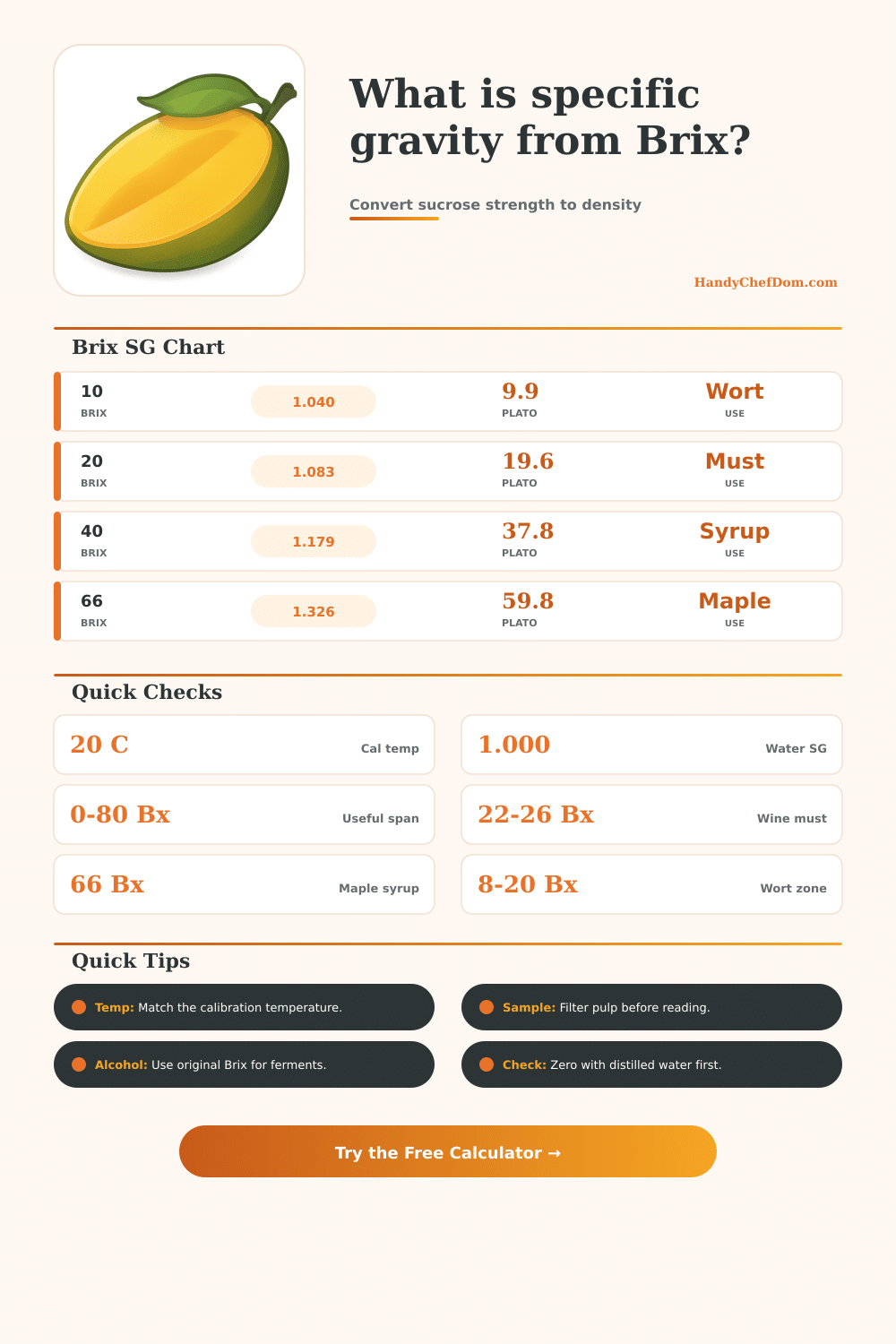
| 10 | 1.040 | 1.038 | 104 | Light wort |
| 15 | 1.061 | 1.060 | 159 | Cider must |
| 20 | 1.083 | 1.081 | 216 | Wine must |
| 25 | 1.106 | 1.104 | 276 | Rich must |
| 40 | 1.179 | 1.177 | 471 | Liqueur base |
| 66 | 1.326 | 1.324 | 874 | Maple syrup |
| Instrument | Best range | Cal temp | Correction style | Use note |
|---|---|---|---|---|
| ATC refractometer | 0-32 Brix | 20 C | Small temp trim | Juice and wort |
| Manual refractometer | 0-32 Brix | 20 C | Temp sensitive | Cool sample first |
| Brix hydrometer | 0-35 Brix | 20 C | Buoyancy trim | Needs deep jar |
| Digital density | 0-80 Brix | 20 C | Built-in temp | Lab style check |
| Syrup bench tool | 45-80 Brix | 20 C | Hot sample caution | Maple and jam |
| Hydrometer SG | 1.000-1.160 | 20 C | SG temp chart | Brewing standard |
| Food or drink | Typical Brix | Approx SG | Plato | Interpretation |
|---|---|---|---|---|
| Kombucha tea | 5-8 | 1.020-1.032 | 5-8 | Lightly sweet |
| Beer wort | 10-16 | 1.040-1.066 | 10-16 | Standard brew |
| Apple cider | 11-15 | 1.045-1.061 | 11-15 | Fruit sugar |
| Wine must | 21-26 | 1.087-1.111 | 21-25 | Ripe grapes |
| Honey must | 28-36 | 1.121-1.159 | 27-34 | Mead range |
| Soda syrup | 50-60 | 1.235-1.289 | 46-55 | Concentrate |
| Maple syrup | 66-67 | 1.326-1.333 | 60-61 | Finished syrup |
| Jam syrup | 65-69 | 1.320-1.344 | 59-62 | Set range |
| Check point | What to enter | Expected result | Why it matters |
|---|---|---|---|
| Distilled water | 0.0 Brix | 1.000 SG | Confirms zero |
| Ten percent sucrose | 10.0 Brix | 1.040 SG | Quick bench test |
| Hot syrup pan | High temp | Corrected Brix | Avoids false low |
| Cloudy fruit | Cloudy sample | Wider range | Pulp scatters light |
| Fermenting must | Original Brix | Corrected SG | Alcohol bends reading |
| Finished syrup | 66 Brix | 1.326 SG | Maple target |
Reference values are rounded for kitchen, brewing, syrup, and beverage work. For regulated production, verify readings with your calibrated instrument record.
Brix and specific gravity are two measurement that are important for processes in which the amount of dissolved sugar have an impact upon the end product. Brix and specific gravity are use in the processes of making wine, maple syrup, and measuring the starting gravity of beer. While a refractometer and a hydrometer can be used to take the initial reading of the product, that reading is only the first step in the calculation of the product’s specific gravity.
Beyond the initial reading is another calculation that accounts for factors like temperature, type of instrument used to take the initial reading, and the type of liquid being measured. The calculator that is provide can perform calculations that account for these factors. While the Brix scale may appear to provide a measurement of the amount of sugar in a liquid, the Brix scale is actually create with the assumption of pure sucrose solutions.
Using the Brix to Specific Gravity Calculator
Instead, the samples that are measured contain other substances besides sucrose, such as fruit acids, pectins, and other solid material. These solids can refract the light in different way than sucrose does, so the profile for the sample is an important selection. If the incorrect profile is chosen, then the measurement of specific gravity may report the liquid as if it were sucrose water instead of the actual type of liquid being measured.
Another variable to account for is the temperature of the sample being measured. A refractometer that is calibrated at 20 degrees Celsius may report a different Brix value for a sample that is warmer. As such, it is necessary to account for the temperature of the sample when specific gravity is being calculate.
The calculator allow for the temperature of the sample to be entered, as well as the temperature at which the refractometer was calibrated. Based on these two temperatures, the calculator can report the specific gravity for the sample without the need to reference a separate chart. The type of instrument that was used to take the initial Brix reading is a fourth variable in the calculation of the specific gravity of the sample.
For instance, automatic temperature compensating refractometers and manual model will display different Brix values for the same sample. Additionally, refractometers used for measuring syrup will display different values than Brix hydrometers, as the two different device follow different curves for Brix and specific gravity. While the type of instrument used can be entered into the calculator, the equation within the calculator will change according to the type of instrument that is used; the specific gravity will not drift between devices when using the calculator.
Beyond entering the Brix reading of a sample, the calculator can also derive the specific gravity of that sample. The specific gravity is calculated through the use of a polynomial equation that map the Brix reading to specific gravity. The specific gravity is displayed in both kilograms per liter and pounds per gallon.
In addition to specific gravity, the calculator can also derive the value for Plato and Baume for the sample. These two measurement are provided as a means of allowing users to easily compare the specific gravity of samples with specific gravity targets. The ability to calculate these two variable makes it easy for many users to understand the relationship between the specific gravity of a sample and its target.
Beyond calculating the specific gravity, the calculator can also calculate the sugar load of the sample. The sugar load is provided as a means of allowing the user to easily scale the recipe according to the amount of sugar that is require to achieve the target specific gravity. In addition to the sugar load, the user can calculate the batch total for the recipe; the total mass of the batch can be seen in grams.
This value is important for users who is purchasing the ingredients for the batch. Additionally, the batch total can be provided in both liters and gallons. Another factor that impact the Brix reading is the amount of alcohol that is contained within the sample.
Alcohol has the ability to change the refractive index of the liquid. As a result, wine samples that are undergoing fermentation will display an incorrect Brix reading for the amount of sugar in the wine, even if there is still some sugar remaining in the batch. The amount of alcohol in the batch can be entered into the calculator.
Based on this entry, along with the initial Brix reading of the batch, the calculator can report the potential amount of alcohol that can be created during fermentation. Another factor to consider is the clarity of the sample. Some samples may contain suspended solid, such as pulp from the juice of fruits.
These suspended solids can lead to incorrect Brix readings each time that the sample is measured. The calculator allows users to select the level of clarity of the sample; this input may adjust the specific gravity and other variable. A less clear sample may have a range of different Brix readings.
Despite the number of different processes in which Brix and specific gravity are used, the science behind each of these variable is the same for everyone. For instance, kombucha brewers use Brix measurement to both monitor the sugar content in their batches of kombucha, as well as to ensure that the amount of carbonation is not too high. Additionally, cider maker use the Brix scale to determine when to press their fruit batches, as well as to add sugar to their batches to increase the sugar content (chaptalization).
Furthermore, maple producer use refractometers that are set to measure the higher Brix rates of syrup rather than juice; syrup contains approximately 66 Brix, whereas juice has a considerably lower Brix rate. Despite the differences between the industries, however, the underlying physical science of Brix and specific gravity is the same. The reference tables provided on the page can be used as a means of sanity checking the calculations performed by the calculator.
For example, the table provide the Brix, specific gravity, and Plato values for various liquids, such as wort (unfermented beer) and maple syrup. In addition, the tables also provide the values for the various type of instruments. These tables should not be used in place of the calculator, but can provide a means of determining whether an instrument is within it’s normal range of readings.
Another potential point of confusion for many user of the calculator is the understanding of the difference between the original gravity and apparent gravity of a batch. The original gravity and apparent gravity both change according to the amount of alcohol created during the fermentation of a batch. Winemakers, for instance, may believe that the Brix value that is read on the refractometer indicates the total amount of sugar in the wine during the middle of fermentation, but this assumption is incorrect.
The calculator performs the correction for alcohol content due to the assumption that the Brix reading reflect the total amount of sugar in the wine. By entering the original Brix value, the calculator can calculate the current gravity of the batch. This current gravity value can be used to monitor the fermentation process.
In addition to the factors discussed in each of the previous paragraph, the Brix and specific gravity calculations can be applied to other factor related to the batches being measured. For instance, the drift of the calibration of the refractometer can be taken into account. Drift of the calibration may occur if the refractometer is dropped, or if it is exposed to extremely hot or cold temperature.
The user may calibrate the offset of the refractometer by comparing it to distilled water. The offset of the refractometer can be entered into the calculator; by entering the offset value, the rest of the calculations will be accurate. This initial offset ensure that no error are introduced into the batch calculations.
Beyond the factors described in each of the previous paragraphs, the volume of the batches can be considered. For instance, it is important to consider the batch volume in the scaling of a recipe. Additionally, the total mass of a batch can be calculated through the batch volume field.
The total mass in grams is a value that is important for understanding the total amount of ingredient that will be needed for the batch. Additionally, the total batch volume can be displayed in both liters and gallons. This unit field does not impact the calculations for gravity, sugar load, or batch totals.
Beyond understanding how each of the factor impacts Brix and specific gravity, it is also important for user of the calculator to understand which of those factor are the most important to account for in there given situation. For instance, in a situation in which the temperature of the batch is close to room temperature, the batch is clear, and the same type of instrument is used to measure the Brix of the batch, then it is not necessary to account for temperature, clarity, and type of instrument. In situations in which any of those three factor are outside of these standard range, however, it is important to make those corrections.
By making the impacts of these factor visible in the calculator, the user understands if any additional data need to be entered into the calculator. Overall, the goal of creating this calculator is to provide a link between the measurement of Brix and specific gravity, and the intended product. For winemakers, the specific gravity of the batches of wine can be measured, and the amount of sugar that is present in those batches can be calculated.
For those who use Brix to measure specific gravity, specific gravity can be obtained by entering the Brix reading of the batch. Thus, Brix is considered to be a convenient means of measuring specific gravity for many user. By accounting for important factor like temperature, volume, clarity, type of instrument, type of product, amount of alcohol, and calibration drift, the relationship between specific gravity (and Brix) and the desired products are reliably formed.