🍺 Beer Line Length Calculator
Balance a draft beer line using CO2 pressure, serving temperature, line inside diameter, line resistance, elevation, faucet height, target carbonation, and beer style.
Enter the regulator pressure you plan to serve at. The calculator compares that pressure with the style and temperature carbonation target, then sizes line length from usable pressure drop through the beer line.
| Beer style | CO2 volumes | Common temp | Pressure cue | Pour feel |
|---|---|---|---|---|
| Dry stout | 1.8-2.1 | 38-44 F | Low CO2 | Creamy |
| Porter or brown ale | 2.1-2.4 | 38-44 F | Moderate | Soft |
| Pale ale or IPA | 2.3-2.6 | 36-42 F | Standard | Bright |
| American lager | 2.5-2.7 | 34-38 F | Higher | Crisp |
| Wheat beer | 2.7-3.2 | 36-42 F | High | Lively |
| Saison | 2.8-3.5 | 38-45 F | High | Spritz |
| Belgian ale | 2.5-3.3 | 38-46 F | High | Foamy |
| Hard seltzer | 3.0-4.0 | 34-38 F | Very high | Sparkling |
| Line type | Inside diameter | Typical resistance | Best fit | Notes |
|---|---|---|---|---|
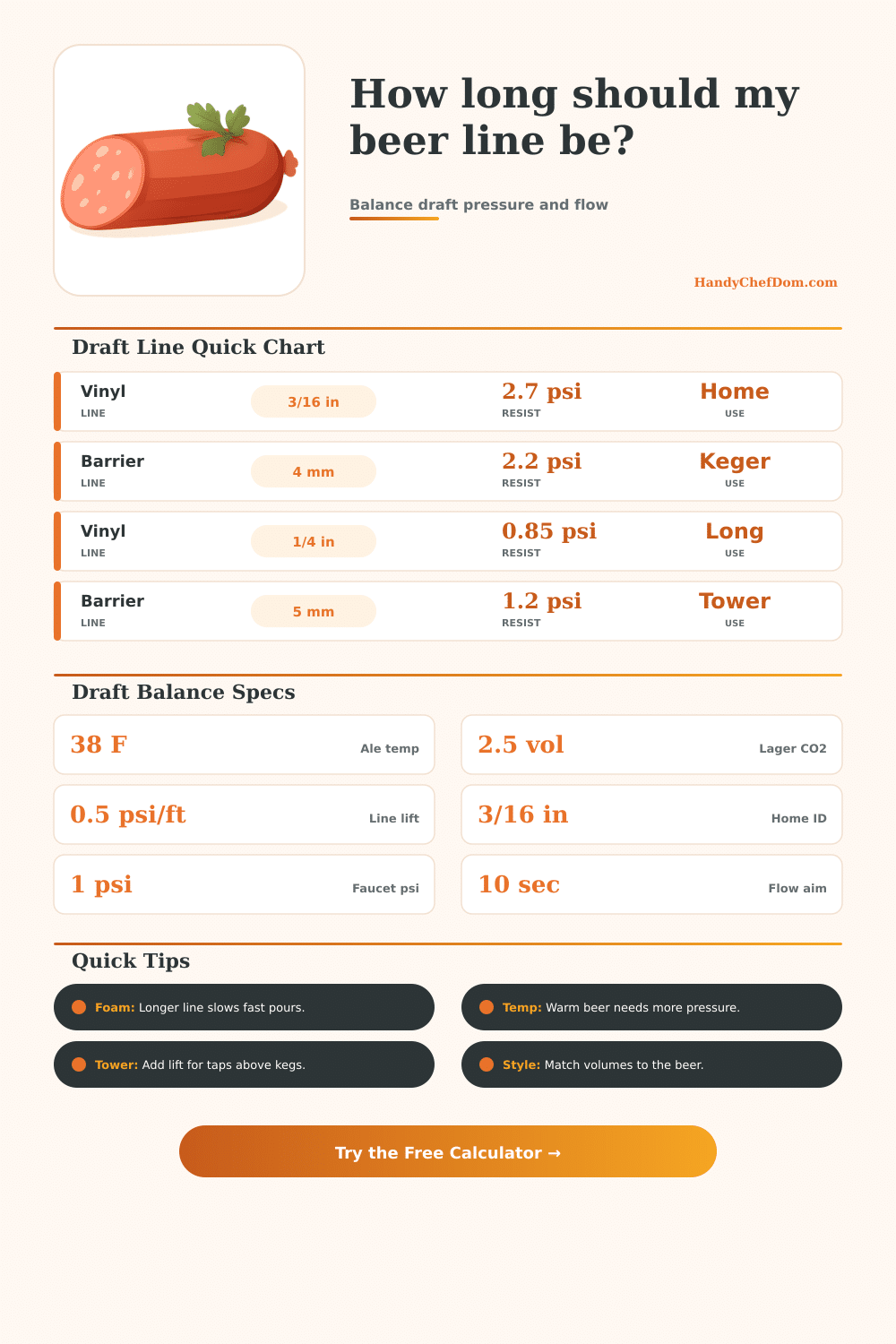
| Vinyl beer line | 3/16 in | 2.7 psi/ft | Home taps | Short runs |
| Barrier tubing | 4 mm | 2.2 psi/ft | Kegerators | Compact coils |
| Barrier tubing | 5 mm | 1.2 psi/ft | Towers | Medium runs |
| Vinyl beer line | 1/4 in | 0.85 psi/ft | Longer runs | Needs length |
| Barrier tubing | 6.3 mm | 0.50 psi/ft | Remote taps | Low drag |
| Vinyl beer line | 5/16 in | 0.40 psi/ft | Long draw | Longer line |
| Vinyl beer line | 3/8 in | 0.20 psi/ft | Transfer | Not short taps |
| Temperature | 2.2 vol | 2.5 vol | 2.8 vol | 3.2 vol |
|---|---|---|---|---|
| 34 F | 6.7 psi | 10.1 psi | 13.8 psi | 19.1 psi |
| 36 F | 7.3 psi | 10.8 psi | 14.7 psi | 20.2 psi |
| 38 F | 7.9 psi | 11.6 psi | 15.6 psi | 21.3 psi |
| 40 F | 8.5 psi | 12.3 psi | 16.5 psi | 22.5 psi |
| 42 F | 9.2 psi | 13.1 psi | 17.4 psi | 23.7 psi |
| 45 F | 10.1 psi | 14.3 psi | 18.7 psi | 25.4 psi |
| Draft factor | Rule of thumb | Adds pressure | Removes pressure | Why it matters |
|---|---|---|---|---|
| Faucet above keg | 0.5 psi/ft | No | Yes | Beer lifts upward |
| Faucet below keg | 0.5 psi/ft | Yes | No | Gravity assists |
| Elevation | 0.5 psi/1000 ft | Yes | No | Gauge target shifts |
| Faucet residual | 0.5-1.5 psi | No | Yes | Keeps pour stable |
| Warm tower | 1-5 F | Yes | No | CO2 breaks out |
| Large ID line | Lower psi/ft | No | No | Requires length |
Draft line values are practical planning estimates. Confirm the final pour with chilled hardware, steady regulator pressure, and the actual tubing used in your system.
When the pressure in the keg matches the resistances in the line, the system will accept the pour from the keg. A balance must exist between the pressure in the keg and the resistance in the line for the draft system to work correctly. If the two variables are balanced, the beer will maintain its carbonation and form the correct amount of head in the glass.
However, if the variables are not balanced, the outcome will be either a slow trickle of the beer from the faucet or the beer will fill the glass with foam. Other than the balance between the pressure and the resistance, the amount of tubing and the materials from which the tubing is made will affect the draft systems outcome. Many people attempt to determine the appropriate draft systems for there beer based off the type of beer brewed.
How to Set Up a Draft Beer System
For instance, different types of beer require different amounts of carbon dioxide in the pour. Dry stout requires a different draft system than that which is required for wheat beer. Another factor that influences the pressure requirement for the draft system is the temperature of the beer.
Cold liquid contain more gas than warmer liquid. The third determinant of the appropriate draft system is the elevation at which the beer will be poured. The same gauge reading of pressure at sea level will not show the same reading at higher elevation.
These three variables will allow a customer to determine the target pressure requirement of the draft system. The tubing of the draft system is the component in which the pressure can be adjusted. The diameter of the tubing and the material that the tubing is made of will determine the loss of pressure of the beer as it travels from the keg through the tubing to the beer consumer.
Stiff tubing with a narrow diameter will allow for more resistance to the movement of the beer, and thus, create a slower rate of the beer leaving the faucet. If the draft system is to be used over a greater distance from the keg to the tap, then the tubing should be wider and smooth to the touch. A calculator can be used to determine the length of the tubing that should be used in the draft system.
Such a calculator will take into account the variables of the beer type, the temperature of the beer, the type of tubing, and the height at which the beer will be poured into the consumers glass. The most common draft system for home use utilizes 3/16-inch vinyl tubing because of the high resistance to the flow of the beer through such tubing. However, commercial draft systems are often equipped with larger diameter barrier tubing that allows the beer to travel several feet from the keg to the consumer without losing much of it’s carbonation.
The tubing that can be used in the draft system is dependent on the relationship between the resistance of the tubing and the pressure that is required to pour the beer at the proper rate, which is related to the type of beer and its temperature. The height of the draft beer faucet is another variable that should be taken into account when setting up a draft system. For every foot that the beer faucet is elevated above the keg, there will be a loss of roughly half a psi of pressure in the system.
If the beer faucet is positioned higher than the keg, a longer line of tubing between the keg and the beer pour will reduce the pressure of the draft system. In this case, shortening the line will ensure that the draft system maintain the proper amount of pressure to maintain the beers carbonation. Conversely, if the draft system’s faucet is positioned lower than the keg, the force of gravity will assist in moving the beer through the line; therefore, using a longer line or lower pressure will achieve the same outcome.
A calculator will take into account the height of the faucet so that customers wouldnt have to calculate the lift loss caused by the height of the faucet themselves. Elevation is another variable that will have an impact on the pressure requirements of the draft system. Higher altitudes will require a higher gauge pressure reading because the pressure measurement will be lower at higher elevations.
The difference between sea level and the elevation at which the draft system will be used will have a small impact at sea level but will be noticeable at high elevations. If customers choose to ignore there elevation, they may find that their draft system is dispensing a beer with too much carbonation and it foam at the surface of the beer as it is poured into the glass. The temperature of the beer may change along the draft system.
Even if the keg has the correct temperature, the beer may warm between the tower and the beer consumer. The warmer the temperature, the more carbon dioxide the beer will release. This could potentially result in the beer foaming at the mouth of the consumer’s glass.
A solution to this problem is to use a longer line for the beer to travel or to allow the first pour of the beer to settle before drinking it. Many people make mistakes with draft systems by treating the length of the line as a number that cannot change. Using the length of tubing that another person has designed for their draft system is a mistake because the diameter of the tubing, the height of the faucet, and the style of the beer may not be the same in your system as it is in another individuals draft system.
Using a round number for the psi setting on the regulator of the draft system will also lead to errors. A proper system will begin with the carbonation level of the type of beer desired. Then, the variables of the temperature and elevation will help to determine the psi that should be set on the regulator.
The flow rate of the beer when poured from the draft system is an essential variable to consider. If it takes ten seconds for the faucet to release the beer for a standard serving of beer, the beer will maintain its carbonation. Pouring the beer at a faster rate then ten seconds will cause the beer to become over-carbonated.
Conversely, if the draft system pours the beer too slow, the beer will lose most of its carbonation before it reaches the beer consumer. A calculator will help to estimate the timing of the pour of the beer to ensure that the line that is used has the appropriate length for your system. There are a few small variables that can impact the outcome of a draft system.
The placement of the tubing can create a kink that will impact the rate of the pour. The faucet can become dirty and prevent proper dispensing of the beer. Additionally, the psi on the regulator may drift away from the setting that the draft system calculator created.
Despite these potential problems, it is essential to perform a few test pours of the beer using a cold glass. This will allow the system and the outcome of the draft system to become better understood. Based off the outcome of the test pours, adjustments will have to be made to the line or the tubing in order to achieve the best possible outcome with the draft system.
The goal of any properly constructed draft system will be to achieve a consistent pour of beer with the proper amount of head to match the type of beer poured.