🍌 Banana Calorie Calculator
Estimate banana calories, carbs, fiber, and potassium from size, edible weight, sliced cups, mashed cups, ripeness, and recipe portions.
Pick the measurement style you actually have. Count mode uses USDA-style edible banana weights, while cup modes use common kitchen weights for sliced and mashed banana.
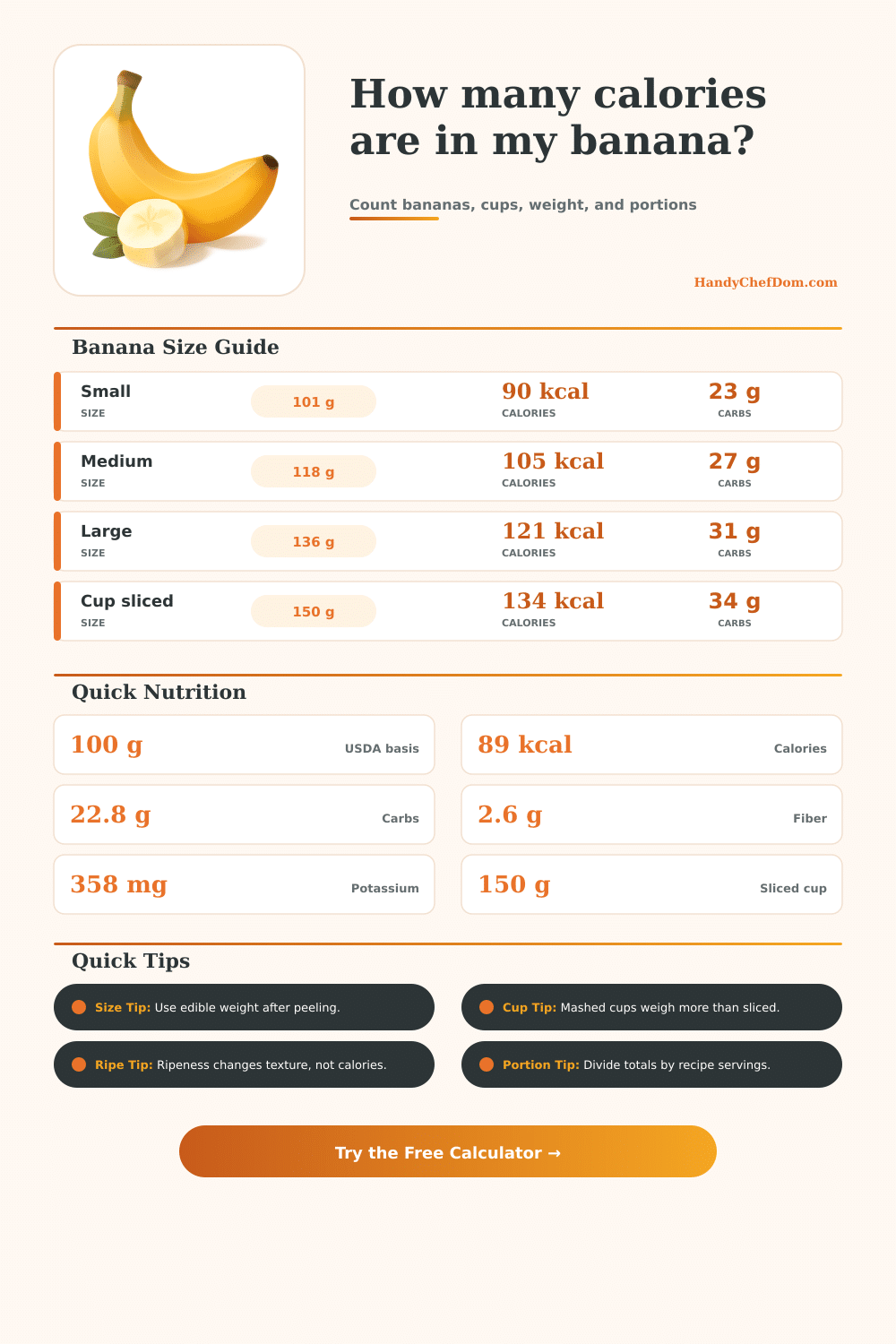
| Banana size | Edible weight | Calories | Carbs | Fiber |
|---|---|---|---|---|
| Extra small, under 6 inches | 81 g | 72 kcal | 18.5 g | 2.1 g |
| Small, 6 to 7 inches | 101 g | 90 kcal | 23.1 g | 2.6 g |
| Medium, 7 to 8 inches | 118 g | 105 kcal | 27.0 g | 3.1 g |
| Large, 8 to 9 inches | 136 g | 121 kcal | 31.1 g | 3.5 g |
| Extra large, 9 inches plus | 152 g | 135 kcal | 34.7 g | 4.0 g |
| Kitchen measure | Edible weight | Calories | Carbs | Best use |
|---|---|---|---|---|
| 1/2 cup sliced banana | 75 g | 67 kcal | 17.1 g | Oatmeal topping |
| 1 cup sliced banana | 150 g | 134 kcal | 34.3 g | Fruit bowls |
| 1/2 cup mashed banana | 113 g | 101 kcal | 25.8 g | Pancakes |
| 1 cup mashed banana | 225 g | 200 kcal | 51.4 g | Banana bread |
| 1 ounce edible banana | 28.35 g | 25 kcal | 6.5 g | Small garnish |
| Ripeness | Texture | Cup weight use | Sugar feel | Calculator note |
|---|---|---|---|---|
| Green or firm | Dense slices | +5% | Less sweet | Best for count or weight |
| Yellow, just ripe | Clean slices | +2% | Mild sweet | Good all-purpose estimate |
| Ripe yellow | Standard | Base | Sweet | Default USDA-style estimate |
| Spotted sweet | Soft slices | -2% | Very sweet | Useful for smoothies |
| Very ripe, baking soft | Mashes tight | -4% | Deep sweet | Use mashed mode for baking |
| Reference amount | Calories | Carbs | Fiber | Potassium |
|---|---|---|---|---|
| 100 g edible banana | 89 kcal | 22.8 g | 2.6 g | 358 mg |
| 1 medium banana | 105 kcal | 27.0 g | 3.1 g | 422 mg |
| 1 cup sliced | 134 kcal | 34.3 g | 3.9 g | 537 mg |
| 1 cup mashed | 200 kcal | 51.4 g | 5.9 g | 806 mg |
A banana seems simple, just a banana. But it’s actualy more complex than that. Depending on how ripe it is, how big it is, or how it was prepared, a banana can has different amounts of nutrients. More often than not, we think that any given banana have a set number of calories. And that leads us to make mistakes when keeping track of our diet.
When you input your own information, the calculator take care of it for you. No need to guess if a large banana is worth double what a small one would be. Nope. Be careful to separate out the actual fruit from the peel. Bananas are sold with their peels still attached (you’re paying for the peel, which also contributes weight). In fact, it may account for fifteen percent or more of the overall weight! When you enter the “weight” for a banana, log that into your tracker, but don’t include the peel, since you won’t actualy eat that. If you weighed a whole banana and entered its weight without peeling it first, you’re artificialy inflating the calories listed.
Why Banana Calories Are Hard to Count
Fortunately, the app allow you to specify whether you want to enter the weight once peeled, or count by size. The reason this makes a difference is that USDA data include only the weight of flesh. But that’s like measuring calories for what you aren’t eating. That skin doesn’t get digested, right? So why include those calories in your tally? If you set the app to count instead of entering a weight, you can specify small, medium, or large. The calculator will then adjust based off standard weights and account for the peel weight.
They also fails to account for ripeness. A green banana is starchy and firm. A ripe banana (brown spots) is sweet and soft. So did the banana get sweeter? Nope. Not really. Total carbohydrate load doesn’t vary much. But it DOES digest the sugars differently. Resistant starch make up a lot of what you see in green bananas, similar to fiber. Simple sugars make up more of what you see in ripe bananas, since the starch has been broken down. That’s not to say that green bananas are lower-calorie. They’re just going to impact your stomach different. The ripeness selector in the tool is accounting for texture, not a huge shift in caloric value. It still keeps the math correct but acknowledges that a ripe banana FEELS different, even though there may be no difference in its energy content.
Then there’s the question of cups. One recipe says “one cup of mashed banana” while another says “slice one medium banana“. You can’t simply cut up a banana that fits into a one-cup container. When you mash something, you compact it and take out all the air pockets. That means a cup of mashed banana weigh significantly more than a cup of sliced banana. Because they aren’t the same ingredients when cooked, the tool falls somewhere between those two states. If you weigh with slices for your bread, it won’t be moist enough. If you weigh with mashed for your smoothie, it will be too dense. Depending on how you define what you’re weighing, it alter the density math. That small difference matter and changes result.
And that’s not all: There is also potassium and fiber in the mix. A medium banana are a major source of the potassium you need each day; this mineral helps muscle function and regulates blood pressure. Fiber supports digestion. Like calories, these nutrient are scaled by weight. If you’re tracking macros for either performance or health reasons, accuracy trumps guesswork. You don’t want to be eating fuel without knowing the exact quantity. That’s why potassium and fiber levels increases with banana size, as shown in reference tables.
Make it accurate, but not perfect Don’t weigh out your snacks on a lab scale. But if the big banana is different than the little banana, know it (eat with intention). That’s why this becomes about knowing instead of guessing. Next time you peel a banana, realize that there’s a certain amount of potassium and carbs in your hand. It change how you think about each bite, making it valuable for what it truly is.