🌴 Protein in Dates Calculator
Estimate total protein from Medjool, Deglet Noor, and other date varieties by count, grams, or cups, then divide the result by servings.
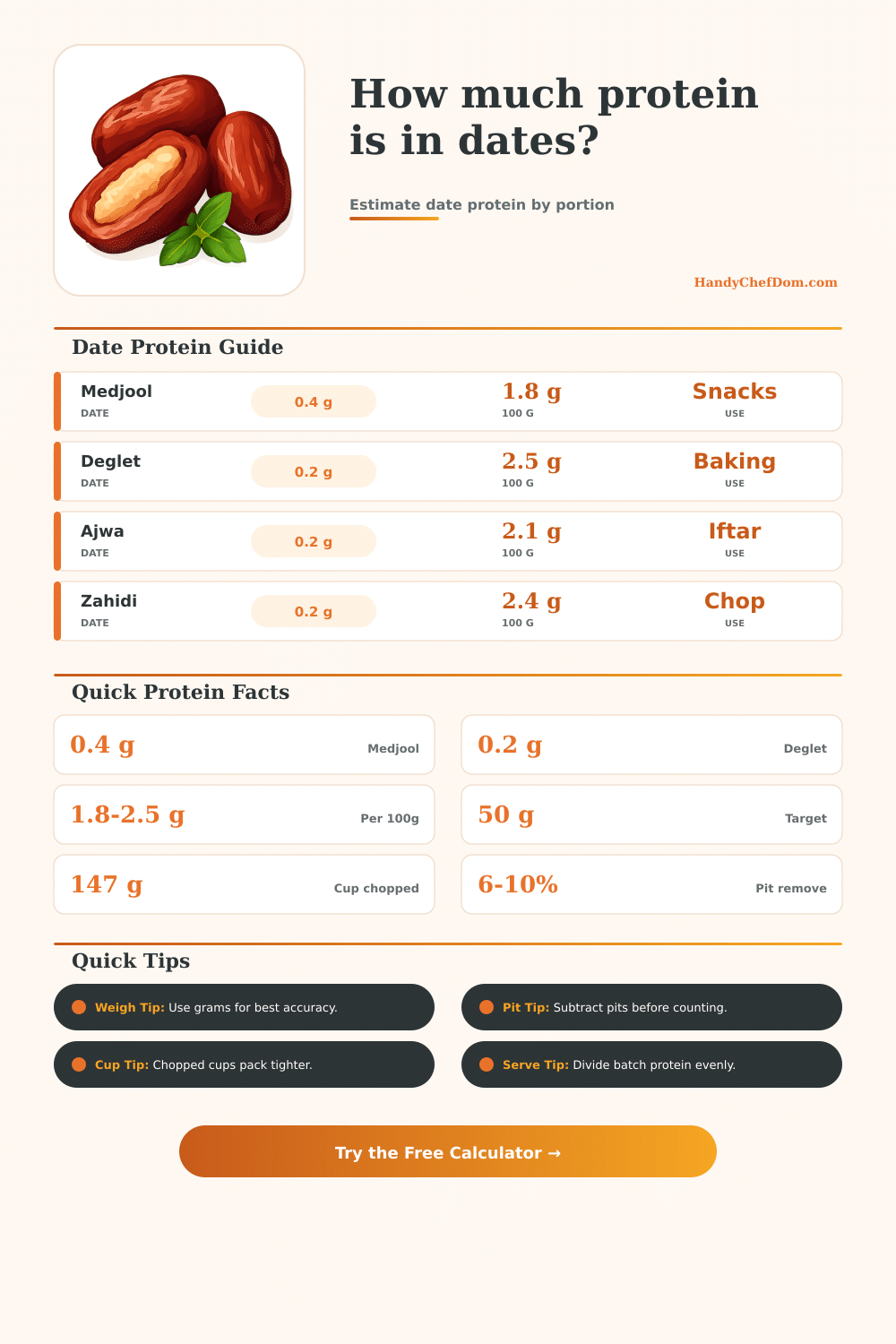
Dates are a carbohydrate-rich fruit with modest protein, usually about 1.8 to 2.5 g protein per 100 g depending on variety and moisture. A large Medjool date is about 0.4 g protein.
| Date Variety | Protein per 100 g | Typical Pitted Weight | Protein per Date | Calculator Note |
|---|---|---|---|---|
| Medjool dates | 1.8 g | 22 g each | 0.4 g | Large date snack and stuffing reference |
| Deglet Noor dates | 2.5 g | 6.8 g each | 0.2 g | Smaller baking and chopped-date reference |
| Ajwa dates | 2.1 g | 7.5 g each | 0.2 g | Small to medium serving dates |
| Zahidi dates | 2.4 g | 8 g each | 0.2 g | Firm date often chopped for mixes |
| Barhi dates | 1.9 g | 12 g each | 0.2 g | Softer date with more moisture variation |
| Sukkari dates | 2.0 g | 10 g each | 0.2 g | Sweet dessert date, use count or grams |
| Dried Fruit | Protein per 100 g | Protein per Oz | Common Portion | Protein Context |
|---|---|---|---|---|
| Dates | 1.8-2.5 g | 0.5-0.7 g | 2 Medjool or 4 Deglet | Modest fruit protein |
| Dried figs | 3.3 g | 0.9 g | 3 to 4 figs | Higher dried fruit protein |
| Raisins | 3.1 g | 0.9 g | Small box or 1/4 cup | Similar snack comparison |
| Prunes | 2.2 g | 0.6 g | 4 to 5 prunes | Close to date range |
| Dried apricots | 3.4 g | 1.0 g | 5 to 6 halves | Higher per 100 g |
| Dried cranberries | 0.1 g | 0.0 g | 1/4 cup | Very low protein |
| Serving Measure | Approx Pitted Weight | Medjool Protein | Deglet Protein | Use Case |
|---|---|---|---|---|
| 1 Medjool date | 22 g | 0.4 g | Use date type | Single snack date |
| 2 Medjool dates | 44 g | 0.8 g | Use date type | Snack plate serving |
| 4 Deglet dates | 27 g | Use date type | 0.7 g | Small handful serving |
| 1/4 cup chopped | 37 g | 0.7 g | 0.9 g | Oatmeal or yogurt topping |
| 1/2 cup chopped | 74 g | 1.3 g | 1.9 g | Bars or baking mix |
| 1 cup chopped | 147 g | 2.6 g | 3.7 g | Batch or date paste |
| Recipe Use | Typical Date Amount | Best Measure | Protein Range | Calculator Setting |
|---|---|---|---|---|
| Snack plate | 2 to 3 Medjool | Count | 0.8-1.2 g | Whole or loose dates |
| Smoothie | 2 Medjool or 4 Deglet | Count or grams | 0.7-0.8 g | Pitted before blending |
| Energy bites | 1 cup chopped | Cups | 2.6-3.7 g | Chopped or packed dates |
| Baking batter | 1/2 to 1 cup | Cups or grams | 1.3-3.7 g | Divide by finished servings |
| Stuffed dates | 12 Medjool | Count | 4.8 g | Use pitted weight estimate |
| Date paste | 250 g pitted | Grams | 4.5-6.3 g | Use grams for batch accuracy |
Dates are a fruit that contains a small amount of protein, yet dates are also often used as a sweetener or as a snack. Many people do use dates in various recipes, but few people are aware of the protein content of dates. Dates contain a consistent amount of protein; however, the total amount of protein in dates depend on the variety of dates that are used and the moisture level of the dates.
By using a calculator, individuals can determine the amount of protein contained in dates to allow them to know the exact amount of protein that they are consuming from the fruit. The variety of dates that is used will alter the amount of protein that is consumed. Medjool dates contain more water than other varieties of dates and, consequently, contain a lower protein density per gram of dates.
How to Measure Protein in Dates
Deglet Noor dates are smaller and contain more protein per gram than other varieties of dates. Thus, a cup of Deglet Noor dates will contain more protein than a cup of Medjool dates. To calculate the amount of protein in dates by weight, the user must chose the variety of dates in the calculator to obtain the correct measurement of protein content.
The way that the dates are measured will change the protein calculation. If individuals choose to count the dates, they will count the number of whole dates. However, if individuals choose to measure the dates by the cup, then the weight of the dates change based on how the dates are packed.
Individuals could choose to use a cup of loosely pack dates, or they could use a cup of dates that are tightly packed together. A cup of tightly packed dates will contain more protein than loosely packed dates. Date calculators often allow individuals to choose the weight of the dates in cups so that individuals dont have to guess the weight of the dates that they are measuring in cups.
Dates contain water, which will change the protein concentration of dates. Dates that are plumper and softer contain more water than dates that is dry. The more water that is contained in dates, the less concentrated the protein within those dates.
Dry dates contain less water and, therefore, the protein in dates is more concentrated. Date calculators often allow individuals to adjust the moisture levels of the dates so that the protein content is calculated in a way that accurate reflects the protein content of dates that have different moisture levels. Individuals should consider the way in which they use dates in the recipe in which they are employed.
If an individual uses dates in a recipe that uses a certain portion size of dates, they will contain a certain amount of protein. If an individual eats two or three whole dates as a snack, they are consuming a small amount of protein. However, if an individual chops dates into a batch of a certain size, such as energy bites, they are dividing that protein into various serving.
Date calculators allow individuals to see how much protein is contained in a single serving of dates. Thus, individuals can keep track of the protein content of dates that they consume throughout the day. Dates can be compared to other dried fruits to see how the protein content of dates compares to other foods.
Figs and apricots have more protein than dates. Raisins have a similar amount of protein as dates. Cranberries contain almost no protein, so they are not comparable to dates in regard to protein content.
While none of these dried fruits are primary sources of protein, they can be compared to dates to allow individuals to understand whether dates may be the best source of protein among these fruits. When calculating the protein content of dates, many people make various mistakes. For instance, people often forget to remove the pits of the dates.
The pits of dates do not contain any protein; however, they add to the weight of the dates. The best way to avoid this mistake is to use a kitchen scale to weigh the dates after removing the pits. Date calculators allow individuals to enter the weight of the dates in grams, which ensures that individuals can obtain an accurate measurement of the protein content of the dates.
Using a kitchen scale is the most accurate way to measure the weight of dates compared to using a cup to measure dates. Using a kitchen scale will ensure that the measurement of the protein content of dates is correct. Dates can not be used as a replacement for protein-containing foods such as chicken or Greek yogurt.
However, dates do contain protein, and the protein from dates does add up throughout the day if an individual eats many dates. By using a date protein calculator, individuals can ensure that the protein content of dates is visible and easily tracktable throughout the day.