🍪 Cookie Recipe Calculator
Scale a cookie recipe by target batch size, scoop size, flour, butter, sugar, eggs, chill time, pan count, and bake time.
Enter your original recipe yield and ingredients, then choose a target count and scoop size. The calculator scales the dough and estimates chilling, pans, and bake time.
| Scoop Size | Tablespoons | Dough Weight | Typical Cookie |
|---|---|---|---|
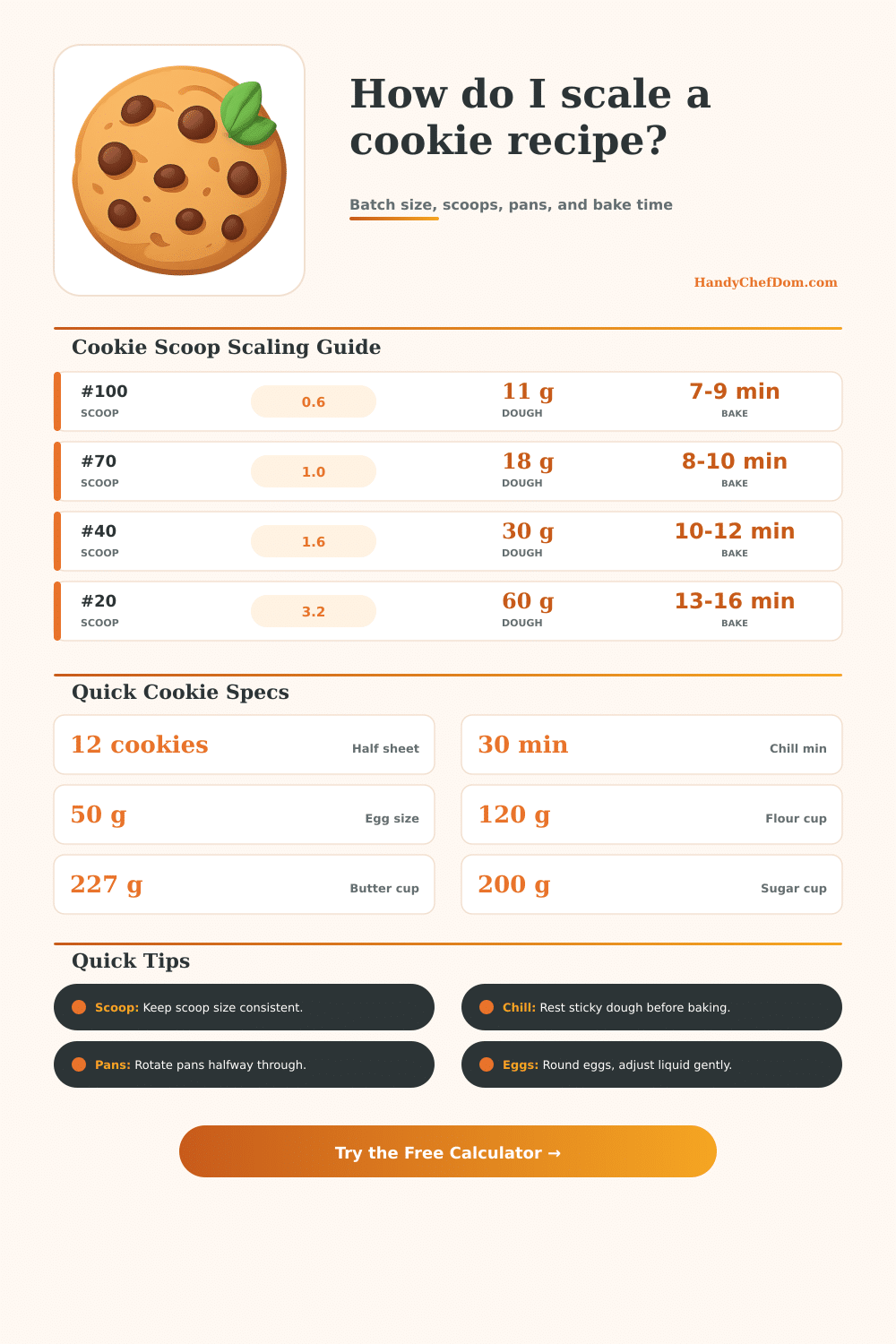
| #100 mini scoop | 0.6 tbsp | 10 to 12 g | 1.5 inch bite cookies |
| #70 small scoop | 1 tbsp | 16 to 20 g | 2 inch lunchbox cookies |
| #60 scoop | 1.25 tbsp | 22 to 25 g | 2.25 inch cookies |
| #50 scoop | 1.4 tbsp | 25 to 28 g | 2.5 inch cookies |
| #40 medium scoop | 1.6 tbsp | 28 to 32 g | 2.75 inch cookies |
| #30 large scoop | 2.1 tbsp | 38 to 45 g | 3.25 inch cookies |
| #24 jumbo scoop | 2.7 tbsp | 48 to 55 g | 3.75 inch cookies |
| #20 bakery scoop | 3.2 tbsp | 58 to 65 g | 4 inch bakery cookies |
| Cookie Style | Base Chill | Base Bake | Scaling Note |
|---|---|---|---|
| Chocolate chip drop | 30 to 60 min | 10 to 12 min | Chill for thicker centers |
| Sugar cutout | 45 to 90 min | 8 to 11 min | Roll evenly before cutting |
| Oatmeal raisin | 20 to 45 min | 10 to 13 min | Oats hydrate during rest |
| Peanut butter | 20 to 40 min | 9 to 12 min | Fork marks flatten dough |
| Shortbread | 60 to 120 min | 12 to 16 min | High butter needs chill |
| Double chocolate | 35 to 70 min | 10 to 13 min | Cocoa dough firms slowly |
| Pan Setup | Small Cookies | Medium Cookies | Large Cookies |
|---|---|---|---|
| Quarter sheet | 9 to 12 | 6 to 8 | 4 to 6 |
| Half sheet | 18 to 24 | 12 to 15 | 8 to 10 |
| Full sheet | 30 to 36 | 20 to 24 | 12 to 16 |
| Round pizza pan | 10 to 12 | 7 to 9 | 5 to 6 |
| Toaster tray | 4 to 6 | 3 to 4 | 2 to 3 |
| Ingredient | Imperial Reference | Metric Reference | Scaling Tip |
|---|---|---|---|
| All-purpose flour | 1 cup | 120 g | Weigh if scaling above 2x |
| Butter | 1 cup | 227 g | Keep softness consistent |
| Granulated sugar | 1 cup | 200 g | Brown sugar may pack tighter |
| Large egg | 1 egg | 50 g | Beat and weigh partial eggs |
| Dough ball | 1 tbsp | 18 g | Round for even spreading |
| Vanilla or extract | 1 tsp | 5 ml | Scale with the recipe ratio |
This calculator estimates cookie scaling from common bakery weights, scoop sizes, and pan spacing. Actual spread varies by flour measuring, butter temperature, and dough hydration.
The cookie recipe calculator are a tool that will help you to scale cookie recipes to the numbers of cookies that you would like to make. Many cookie recipes start with instructions for making a small number of cookies, but many peoples will require larger batches of cookies to prepare for a party or to store for later. However, guessing at the amount of ingredients that would be required for a larger number of cookies could waste ingredients like butter and sugar.
The cookie recipe calculator will help to avoid these issues by providing specific amount of ingredients, chill times, and the number of cookie pans that the baker will require to make the desired number of cookies. To use the cookie recipe calculator, you will need to enter the number of cookies that the original recipe will make, as well as the number of cookies that you would like to make. Simply multiplying each ingredient by the same number to increase the number of cookies will not work, as increasing the number of cookies will also increase the amount of dough that will need to be managed, as well as the number of times that the baking pans will need to be placed in the oven.
How to Use a Cookie Recipe Calculator
Thus, the cookie recipe calculator will help to determine the amount of dough that will be made, as well as the number of rounds that the cookies will need to be baked. The scoop size that the baker will use in baking the cookies is another of the factors that will influence the recipe. Scoop size will impact the number of cookies that is made, as well as the baking time of those cookies.
For instance, using smaller scoops to measure out the cookie dough will lead to the baking of more individual cookies. Additionally, smaller scoops will allow for the cookies to bake to the surface in less time. Conversely, using larger scoops will result in fewer individual cookies being baked, but each cookie will have deep centers that will require baking in longer periods of time.
Additionally, larger scoops will require more space between each of the cookies that are being baked on the baking pan to ensure that they do not all merge together into one large cookie. Thus, the cookie recipe calculator will allow for the selection of scoop size to determine the other variables related to scoop size. The ingredients for the cookies include flour, butter, and sugar.
The ratios of these ingredients will determine the texture of the baked cookies. Thus, these ingredients need to be scaled to appropriately adjust for the number of cookies that will be baked. The cookie recipe calculator will allow for scaling of the amount of flour, butter, and sugar to ensure that the cookies have the same texture as the recipe that originally made the dough.
Additionally, it is often useful to add a buffer percentage of each ingredient to account for the scoops of dough not being evenly sized, as well as for the desire to eat a few of the baked cookies while they are being cooked. The eggs for the cookies are another ingredient that must be carefully measured. Changing the number of cookies can lead to fractions of an egg being required.
Fraction of an egg can impact the amount of moisture in the cookies. Thus, the cookie recipe calculator provides suggested amount of eggs for the recipe. For instance, the recipe may use a gram weight of beaten egg rather than a fraction of an egg.
The chill time for the cookie dough is another of the variables that will impact the baking recipe. Chill time will depend on a variety of factors, such as scoop size, amount of butter that is used in the cookies, and the temperature of the kitchen in which the dough is to be chilled. Additionally, deep chill times will be required for baking larger cookies.
Thus, the cookie recipe calculator will allow users to adjust for these different variables in the recipe. However, the cookie recipe calculator may override the chill time if the baker knows that the dough will soften quickly during the chilling period, or if the oven reaches hot temperatures. The pan count and spacing of the baked cookies will impact the number of rounds of baking the cookies will require.
The number of cookies that may be baked on each baking pan, and the space that is required between each cookie on each pan will impact how many baking rounds will be required. Thus, the cookie recipe calculator will indicate the number of baking pans and rounds that will be required for baking the number of cookies that are desired. The cookie recipe calculator also includes reference tables for the cookies.
These reference tables will indicate the weight of the dough for different scoop sizes, the number of cookies that will bake on a quarter sheet pan or full sheet pan, and how long the cookies will take to chill based off scoop size and amount of butter. These reference tables will help to users to understand the baking recipe in the context of their kitchen range and baking pans. Thus, if a user has a toaster oven, for instance, they can use the reference tables to determine if the toaster oven is large enough for baking the number of cookies that is desired.
Finally, the cookie recipe calculator cannot control some of the variables in baking the cookies. For instance, how firmly the brown sugar is packed into the cookie dough, how warm the butter is, and the temperature of the oven cannot be controlled. Thus, the cookie recipe calculator will remove some of the mathematical elements of baking the cookies, allowing the baker to focus upon these other variables.
If the baked cookies spread too much during baking, for instance, the baker can adjust the recipe variables to ensure that the dough does not spread too much during baking. Thus, the cookie recipe calculator will allow the baker to focus upon baking the cookies of high quality.