🍞 Flour Protein Calculator
Blend cake flour, pastry flour, all-purpose flour, bread flour, high-gluten flour, and vital wheat gluten to hit a target protein percentage with hydration notes.
Choose two flour sources, set the target protein, then pick whether you want a pure flour blend, a fixed blend report, or a vital wheat gluten adjustment.
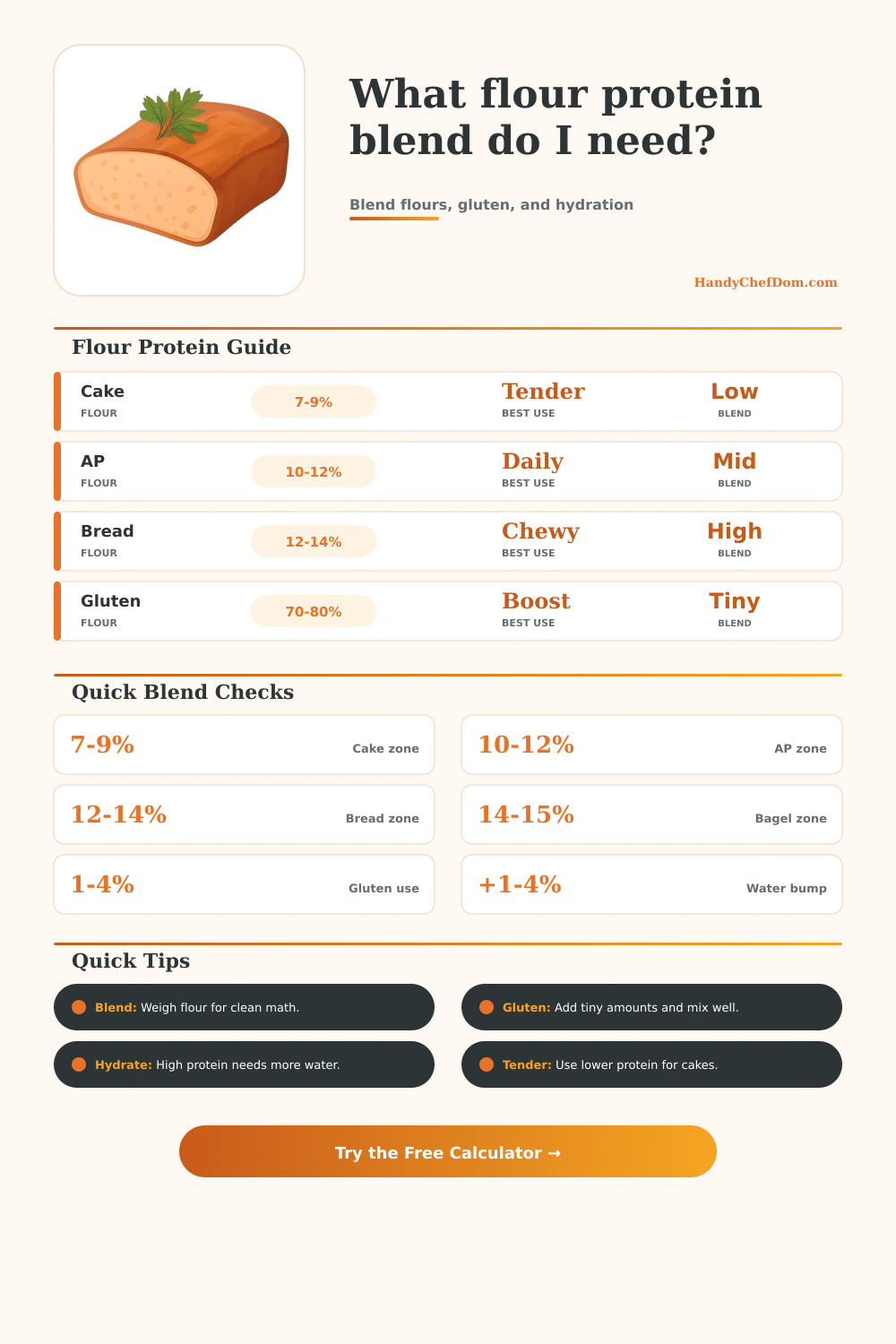
| Flour Type | Typical Protein | Best Use | Blend Direction |
|---|---|---|---|
| Cake flour | 7.0% to 9.0% | Layer cakes, chiffon, delicate crumb | Lowers AP or bread flour |
| Pastry flour | 8.0% to 10.0% | Pie crust, biscuits, scones | Softer than all-purpose |
| Italian 00 flour | 9.0% to 12.5% | Pizza, pasta, tender dough | Depends on label protein |
| All-purpose flour | 10.0% to 12.0% | Everyday baking and mixed use | Middle anchor flour |
| Bread flour | 12.0% to 14.0% | Loaves, rolls, pizza dough | Raises soft flour blends |
| High-gluten flour | 14.0% to 15.5% | Bagels, pretzels, chewy crust | Raises bread strength |
| Target Bake | Useful Protein Target | Common Blend | Hydration Cue |
|---|---|---|---|
| Tender cake | 7.5% to 8.5% | Cake flour or AP plus starch | Follow batter recipe |
| Pie pastry | 8.5% to 10.0% | Pastry flour plus AP | Keep water low |
| Cookies | 9.5% to 11.5% | Soft AP and standard AP | Hydration from eggs and fat |
| Sandwich bread | 11.5% to 12.8% | AP plus bread flour | 60% to 68% water |
| Pizza dough | 12.0% to 13.5% | Bread flour plus 00 flour | 62% to 72% water |
| Bagels | 13.5% to 15.0% | Bread flour plus gluten | 52% to 58% water |
| Vital Wheat Gluten Move | Formula Idea | When It Helps | Watch For |
|---|---|---|---|
| Add gluten | Add gluten to existing flour | When total flour can grow | Dough may need more water |
| Replace flour | Swap flour weight for gluten | When final flour weight is fixed | Use precise small weights |
| Blend high flour | Use bread or high-gluten flour | When flavor should stay flour-like | May still be under target |
| Lower protein | Blend with cake or pastry flour | When dough feels tough | Do not overmix tender batters |
| Whole grain support | Add gluten or bread flour | When bran weakens structure | Rest dough for absorption |
| Fixed blend check | Report achieved percentage | When using exact pantry amounts | Target may not be reachable |
| Blend Example | Protein Goal | Flour Weights For 500 g | Practical Note |
|---|---|---|---|
| Cake from AP and cake flour | 8.5% | 350 g cake, 150 g AP | Soft crumb target |
| AP from cake and bread flour | 11.0% | 227 g cake, 273 g bread | Middle protein blend |
| Bread from AP and bread flour | 12.5% | 188 g AP, 312 g bread | Good loaf strength |
| Pizza from 00 and bread flour | 12.7% | 167 g 00, 333 g bread | Balanced chew |
| Bagel with gluten boost | 14.2% | AP plus about 20 g gluten | Use water bump |
| Whole wheat support | 13.0% | Whole wheat plus gluten | Rest after mixing |
Protein percentages vary by mill and batch. For best results, use the protein value printed on your flour label and weigh vital wheat gluten accurately.
The protein percentage in flours indicates the amount of gluten that can form in dough. Furthermore, the protein percentage will determine the texture of the baked good that are produced. The protein percentage in flours dictate the structure of the flour.
For instance, cake flour have a very low protein percentage so that the baked goods has a delicate structure. In contrast, bread flour has a high protein percentage to set the structure of the baked products to be strong. Flour protein percentages differs between flour type.
Flour Protein and How to Use a Protein Calculator
Thus, an flour protein calculator can help bakers to determine the best flour to use for a given recipe. A flour protein calculator will calculate the ratio of two different flour. To use the calculator, the baker need to select the two types of flour, the total weight that will be used for baking, and the target protein percentage.
The calculator will indicate the amount of each flour that must be used in a recipe. Additionally, the flour protein calculator is also equipped to calculate the protein percentage of a mixture of flour of specific weight. This calculator will eliminate the guesswork in baking.
Another use of flour protein calculators is to add vital wheat gluten to flours with a lower protein percentage to increase the protein percentage of the flour. The calculator will calculate the amount of vital wheat gluten necessary to reach the desired protein percentage. Furthermore, flour protein calculators will alert the baker if the amount of vital wheat gluten that is necessary for that recipe are too much.
In this case, the recipe will require more water to knead the flour. Flour protein percentage and hydration is correlated. Hydration is the amount of water in the dough.
Flour with a higher protein percentage require more water to absorb all of the water that is necessary for kneading the flour. Adding vital wheat gluten will also increase the amount of water that must be added. The flour protein calculator indicate the higher percentage of water that should be used when the protein percentage of flour is increasing.
However, the baker must adjust the amount of water manualy to feel the dough to ensure that the hydration level is correct. Different types of baked goods will require different protein percentage. For instance, cakes and biscuits will have a protein percentage of below ten percent to ensure that they are tender to the touch.
Sandwich loaves has a protein percentage that is between the low and mid-teens. Bagels and pretzels will require a very high protein percentage of flour to provide the structure necessary to these baked goods when they are boiled in water. The flour protein calculator can indicate the protein percentage that a flour should have to achieve the baked good that a baker desire.
Individuals should of weigh the flour that is to be used in gram rather than using volume to measure the flour. This is because the weight of the flour will be the most accurate figure for the calculation of the flour protein calculator. The weight of a cup of flour can vary from bag to bag depending on how the flour settle in the bag.
When weighing the flour in grams, the flour protein calculator will calculate the amount of flour that is necessary to the recipe with accuracy. If the weight of the flour is not correct, then the percentage will also be incorrect. The protein percentage of the flour should also be checked on every bag of flour that is purchased.
Flour manufacturers may change the protein percentage in there flour. With changing protein percentages, dough will behave differently. Thus, the flour protein calculator will help bakers to adjust their recipes to the changed flour.
If the protein percentage of the flour decrease, the recipe can use the flour protein calculator to determine how much bread flour or vital wheat gluten to add to the recipe for the protein percentage to return to the target percentage for the recipe. Because of the bran and the germ in whole grain flour, the effectiveness of the gluten in the flour may decrease. The bran and germ may cut the gluten strands that is necessary for kneading the flour.
Furthermore, the bran and germ will absorb more water than the gluten in the flour. Thus, even if the protein percentage of whole grain flour is high, the protein percentage that is effective in the dough can be lower. In this case, when using flour protein calculators, bakers should aim for a higher protein percentage when using whole grain flours.
Additionally, the baker will have to add more water when using whole grain flour because the bran will absorb the water. However, with the flour protein calculator, bakers can plan for these variables to have the best outcome with their baked goods.