🦃 Turkey Defrost Time Calculator Room Temperature
Estimate how much danger-zone exposure a turkey has already had at room temperature, then compare that risk with safer refrigerator and cold-water thawing alternatives.
Safety-first note: this calculator does not approve counter thawing. It treats room-temperature time as risk exposure, not as a thawing method, and points you toward refrigerator or cold-water thawing when the turkey is still within safe handling limits.
Outer meat can sit in the danger zone while the center is still frozen, so this is exposure to assess, not a method to plan.
Slow, controlled thawing at 40 F or below. Plan about one day per 4 to 5 lb and use a tray for drips.
Keep the wrapped bird submerged in cold water, change water every 30 minutes, and cook immediately after thawing.
A frozen or partly frozen turkey can be cooked safely if handled cold, but cooking takes longer and stuffing needs extra caution.
| Situation | Time to count | Safety interpretation | Calculator action |
|---|---|---|---|
| Turkey on counter at 40 to 90 F | All time outside cold holding counts toward the 2-hour total. | Counter thawing is not a safe planned method, even if the bird is still icy. | Move to refrigerator or cold-water thaw if still within the limit. |
| Turkey in a room, car, porch, or picnic area above 90 F | All warm time counts toward the 1-hour hot-weather total. | Heat shortens the safe handling window and raises discard concern quickly. | Discard if exposure is at or above 1 hour, or if conditions are uncertain. |
| Turkey partly thawed with warm outer meat | Count room time plus any earlier exposure. | Soft outside meat can be unsafe while the center remains frozen. | Discard if over the limit or if the surface feels warm, sticky, or smells off. |
| Turkey below 40 F in a verified refrigerator | Cold holding time does not count as room exposure. | Refrigerator thawing is the preferred method when appliance temperature is 40 F or below. | Keep on a tray, allow about 24 hours per 4 to 5 lb, and cook within a short refrigerator window. |
| Unknown temperature or unverified garage | Use the warmest plausible exposure time. | Guessing low can hide danger-zone time, especially during weather swings. | Use the cautious result and discard if you cannot verify cold holding. |
| Turkey weight | Fridge thaw estimate | Cold-holding rule | Planning note |
|---|---|---|---|
| 4 to 8 lb | 1 to 2 days | Keep at 40 F or below. | Use a rimmed tray and place on a low shelf to protect other foods. |
| 8 to 12 lb | 2 to 3 days | Do not start on the counter to speed it up. | Small family birds still need more time than most counter-thaw guesses. |
| 12 to 16 lb | 3 to 4 days | Refrigerator time is controlled thawing, not danger-zone exposure. | Classic holiday size; reserve refrigerator space early. |
| 16 to 20 lb | 4 to 5 days | Check actual shelf temperature with a thermometer. | Large birds may need a full workweek in the refrigerator. |
| 20 to 24 lb | 5 to 6 days | Keep juices contained and away from ready-to-eat foods. | Start nearly a week ahead, especially if the freezer was very cold. |
| 24 to 30 lb | 6 to 7 days | Do not use a garage unless it is verified below 40 F. | Very large birds need extra refrigerator planning and shelf support. |
| Turkey weight | Cold-water time | Water changes | Safety condition |
|---|---|---|---|
| 4 to 8 lb | 2 to 4 hours | 4 to 8 changes | Use cold tap water, a leakproof wrapper, and cook immediately after thawing. |
| 8 to 12 lb | 4 to 6 hours | 8 to 12 changes | Keep fully submerged; do not leave the sink unattended for long periods. |
| 12 to 16 lb | 6 to 8 hours | 12 to 16 changes | A timer matters because water warming turns the rescue method into a risk. |
| 16 to 20 lb | 8 to 10 hours | 16 to 20 changes | Long rescue thaw; use only when someone can monitor the process. |
| 20 to 24 lb | 10 to 12 hours | 20 to 24 changes | Very large birds may be hard to keep fully submerged and cold. |
| 24 to 30 lb | 12 to 15 hours | 24 to 30 changes | If monitoring is unrealistic, cook from frozen or choose a smaller bird. |
| Red flag | Why it matters | Conservative guidance | Calculator trigger |
|---|---|---|---|
| More than 2 hours at 40 to 90 F | Bacteria can multiply on outer surfaces while the turkey still feels frozen inside. | Discard; do not taste, rinse, refreeze, or rely on cooking to make the history safe. | Exposure exceeds the room-temperature limit. |
| 1 hour or more above 90 F | Hot rooms, cars, and outdoor areas shorten the safe time window. | Discard if the hot exposure reached the limit or if timing is uncertain. | Room temperature input is over 90 F. |
| Odor, slime, sticky juices, torn package | Visible and sensory warning signs can signal mishandling or spoilage. | Discard rather than trying to salvage parts of the bird. | Surface condition selected as odor, warm, leaking, or torn. |
| Home-stuffed then frozen or pre-stuffed left out | Stuffing slows heat transfer and can hold risky juices inside the cavity. | Follow the package label for commercial pre-stuffed birds; discard if warm exposure exceeds limits. | Stuffing status adds a caution note. |
| Unknown temperature history | Unverified garages, coolers, porches, or delivery delays may hide danger-zone time. | Use the warmest plausible estimate; discard when the safe history cannot be reconstructed. | Temperature confidence selected as unknown. |
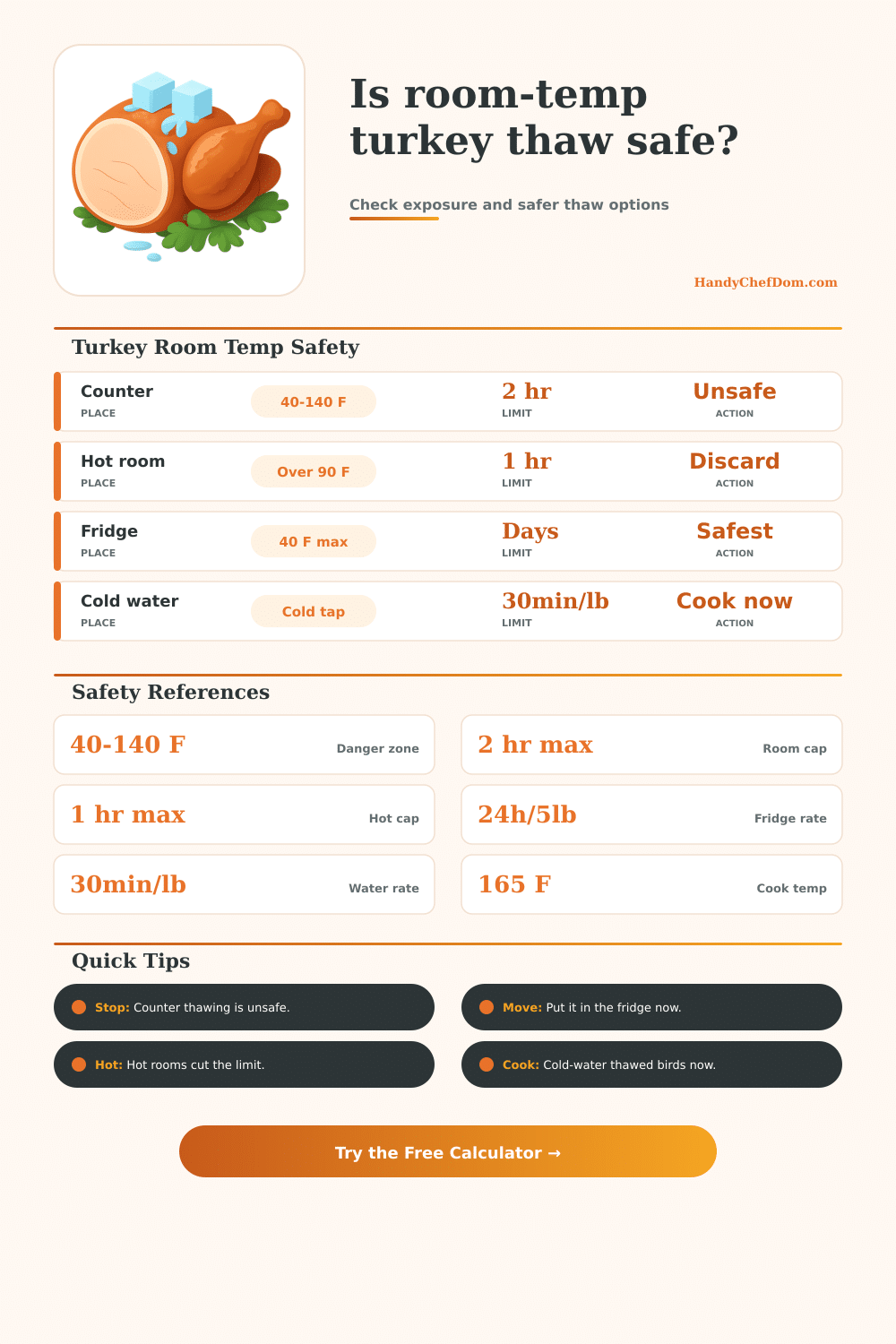
Thawing a turkey at room temperature can pose a safety risk to the turkey because the outer layer of the turkey can enter the danger zone while the center of the turkey is still frozen. The danger zone is the temperature between forty degrees and one hundred forty degrees, and the bacteria can multiply quick in turkeys within this range. It is important to ensure that you monitor the turkey while defrosting because the outer layers of the turkey can reach the danger zone even when the turkey feels cold to the touch.
The calculator include on this page is meant to calculate the amount of time that the turkey spent within the danger zone so that you can determine if the turkey is safe or not safe to consume. The calculator requires the input of certain information to calculate the time that the turkey was in the danger zone. This is because there are many ways in which the turkey could have been exposed to warmth.
Is My Thawed Turkey Safe to Eat?
For instance, the turkey may have been left in a warm car, on a warm counter top, or within a garage that is warmer than forty degrees. The calculator allows for the input of the time that the turkey spent on the counter as well as any other time that it was exposed to warmth, so that the calculator can provide an accurate time for how long the turkey was in the danger zone. The temperature of the environment that the turkey was defrosting in can affect the time that it takes for the turkey to enter the danger zone.
For instance, if the turkey was defrosted in a room that is seventy-two degrees, there is a certain amount of time that could be allotted for the turkey to defrost. However, if the turkey was defrosted in a room that is ninety degrees, there would be less time before the turkey enter the danger zone. Thus, the calculator also requires the input of the room temperature in which the turkey was defrosted, as well as whether or not the turkey was stuffed.
If the turkey has been sitting in the danger zone for too long to be safe to eat, there is a few option for how to prepare the turkey. One method is to defrost the turkey in the refrigerator, which is a safe method because the turkey will remain below forty degrees. However, refrigerator thawing require planning several days in advance.
Cold water thawing is another method of defrosting the turkey, but you must change the water every thirty minutes to ensure that it remains safe for the turkey. The calculator can determine how the time that remains to prepare the turkey compare to these thawing methods. It isnt recommended to thaw the turkey on the counter and then place the turkey into the refrigerator to complete the thawing process.
If you place the turkey into the refrigerator, that time that the turkey spent on the counter is still counted in relation to the turkeys safety. Thus, it is best to prepare the turkey using one thawing method only. The calculator also allows for the turkey’s temperature during defrosting to be a little uncertain.
For instance, it is possible that the turkey was not thawed in a room with a steady temperature. To account for this, the calculator incorporates a penalty that can account for such an issue. This penalty is included to account for the chance that someone guessed the temperature of the room to be lower than the actualy temperature of that room.
Additionally, if the turkey was previously thawed and refrozen, the time it spent in the danger zone before freezing again must be entered into the calculator to reflect the safety of the turkey. If the turkey has been defrosted in the refrigerator, it can be cooked from a frozen state. When cooking from a frozen state, the turkey will require extra time to ensure that the center of the turkey reach one hundred sixty-five degrees.
The calculator will allow an individual to determine if the turkey is safe to cook from a frozen state. Thus, the calculator allows the cooks or those preparing the turkey to make a decision about how to best cook the turkey. Whether through refrigerator thawing, cold water thawing, or cooking from a frozen state.