🐖 Fresh Ham Cooking Time Calculator
Estimate roasting time for uncured raw fresh ham by weight, bone style, oven temperature, pork target, skin plan, resting time, and carryover.
Use this for fresh ham that is raw and uncured. It is not for spiral ham, city ham, country ham, cured gammon, or fully cooked ham reheating.
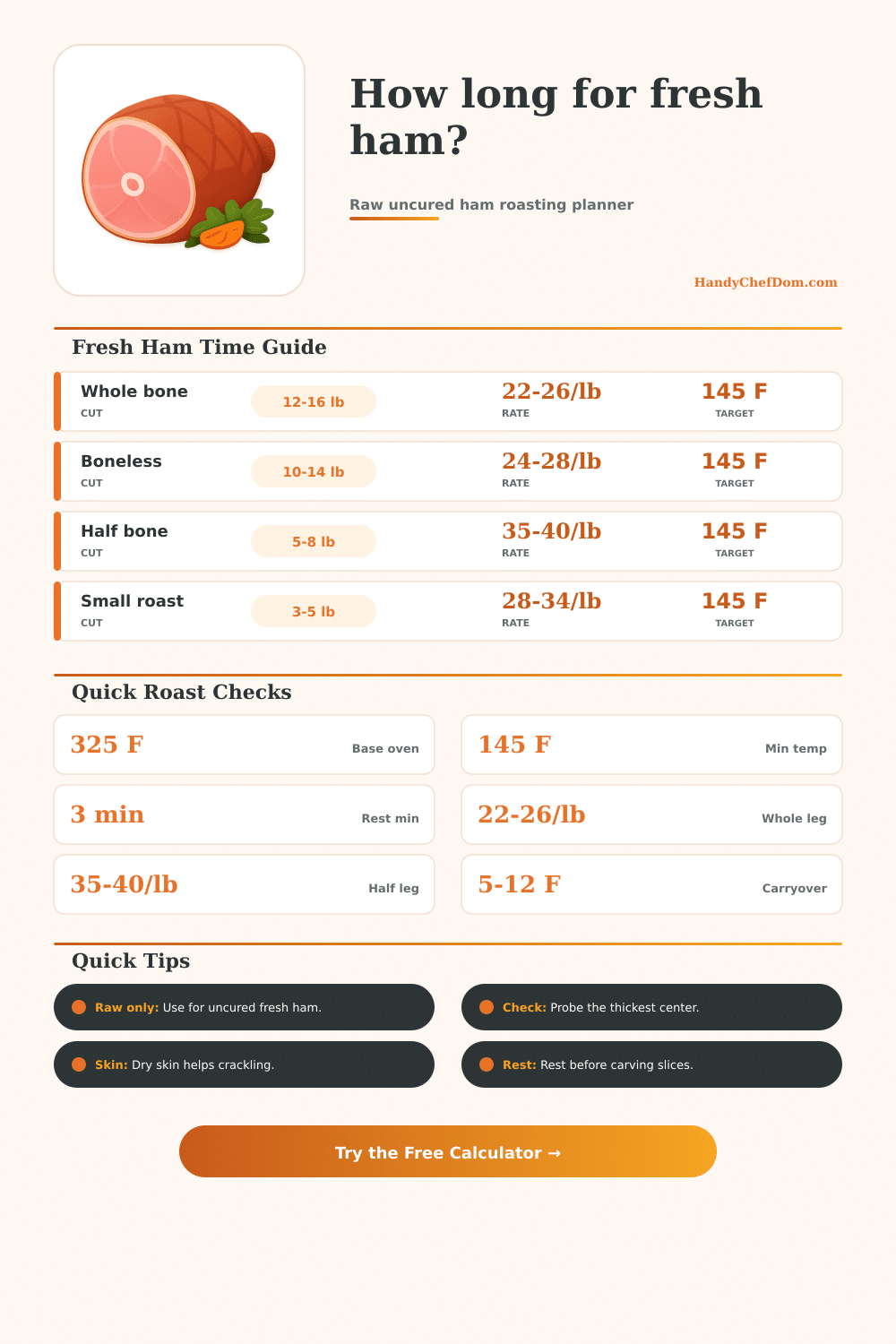
| Fresh ham cut | Typical weight | 325°F timing band | Minimum pull and rest |
|---|---|---|---|
| Whole leg, bone-in | 12 to 16 lb | 22 to 26 min/lb | 145°F with at least 3 min rest |
| Whole leg, boneless | 10 to 14 lb | 24 to 28 min/lb | 145°F with at least 3 min rest |
| Half fresh ham, bone-in | 5 to 8 lb | 35 to 40 min/lb | 145°F with at least 3 min rest |
| Shank or butt portion | 4 to 8 lb | 32 to 40 min/lb | 145°F with at least 3 min rest |
| Small boneless fresh roast | 3 to 5 lb | 28 to 34 min/lb | 145°F with at least 3 min rest |
| Main oven setting | Calculator effect | Best use | Watch point |
|---|---|---|---|
| 275°F | About 18% longer | Gentler large leg roasting | Skin may need a separate crackle phase |
| 300°F | About 8% longer | Large ham with moderate browning | Start checking after the first estimate |
| 325°F | Base reference | Most fresh ham planning | Use thermometer in the thickest center |
| 350°F | About 8% shorter | Smaller hams and boneless joints | Edges brown sooner |
| 375°F | About 16% shorter | Small roasts with skin removed | Check early to avoid overshooting |
| Pull target | Carryover range | Predicted final | Result style |
|---|---|---|---|
| 145°F | 5 to 10°F | 150 to 155°F | Juicy fresh pork roast |
| 150°F | 5 to 10°F | 155 to 160°F | Moderately firm slices |
| 155°F | 6 to 11°F | 161 to 166°F | Firmer traditional roast |
| 160°F | 6 to 12°F | 166 to 172°F | Well-done carving texture |
| Skin plan | Added high heat | Time effect | Calculator use |
|---|---|---|---|
| Skin removed | 0 min | Slightly quicker surface heating | Choose no crackling |
| Skin-on, no crackle | 0 min | Base roast time | Use for soft rind or covered roasts |
| Scored skin | 20 min | Adds a short browning phase | Use when skin is scored and dry |
| Dry crackling skin | 25 min | Longest surface phase | Use when crackling is a priority |
Timing uses fresh ham roasting bands and a minimum raw pork pull target of 145°F with rest. Use the estimate for planning and confirm doneness with a food thermometer.
Fresh ham are raw pork from the hind leg of a pig. Before it is safe to eat, the cook must cook the fresh ham. Raw ham is different than cured ham because cured ham is processed to make it safe to eat, but fresh ham must be roasted until it is safe to eat.
If you dont plan the cooking time of your fresh ham, it is possible that the outer meat of the ham will be dry due to overcooking, or the ham might cook too early and you will have to sit it out on the counter while you await your guests. The weight of the ham and the style of the bone in the ham will impact the cooking time of the ham. Bone in ham will cook differently from boneless ham because the meat near the bone will cook at a different rate from the rest of the ham.
How to Cook Fresh Ham: Time and Rest
Therefore, you must choose the correct style of ham in the calculator. Furthermore, the temperature of the oven will also impact the cooking time. If you set the oven to a lower temperature, the fat on the ham will render at a slower rate.
At higher temperatures, the ham will brown on the outside more quickly then the ham cooks on the inside. The target temperature that you cook the ham to is also important because the ham will continue to cook after you remove it from the oven. This is known as carryover cooking and will add several degree to the hams temperature while resting.
During the resting period, the juices will have a chance to settle so that the ham will not leak juices when it is sliced. If you do not allow the ham to rest, the ham will be dry due to the release of its juices onto the cutting board. If you cook the ham to produce crackling, the ham will need to be cooked to high heat for a period of time.
This high heat will increase the internal temperature of the ham. To avoid this effect on the cooking time of the ham, the ham calculator can separate this cooking phase from the main cooking time. If you are to remove the skin on the ham, it will be exposed to the heat for a different amount of time than the ham with intact skin.
The starting temperature of the ham and the way it is placed in the pan will change the way it cooks. If the ham starts from refrigerator temperatures, it will take longer to cook than if the ham was allowed to reach room temperature. Furthermore, if you place the ham on a rack in the pan instead of a deep pan, the ham will cook differently due to the circulation of air around the ham.
These factor will change the cooking time of the ham. Therefore, the calculator also considers these factors to ensure the cooking time is accurate. Due to fluctuations in the oven temperatures and the dropping temperatures of the oven when the door is opened, it is a good idea to plan for additional cooking time for the ham.
This extra time will allow for the oven temperatures to even out so that you do not cook the ham too late. It is also important to check the temperature of the ham every fifteen minute as it approaches the target temperature. If the ham is a smaller cut than another ham, it will heat to the target temperature more quickly.
Depending on the size of the cut of ham, the cooking time will change. Large cuts of ham will retain heat longer than small cuts. Therefore, small cuts may require more time than larger cuts of ham.
To account for this, the calculator will ask for the size of the ham as well as the style of the bones. By inputting these factors into the calculator, you can determine the amount of time required to roast the ham to the target temperature without having to memorize various cooking times for different-sized cuts of ham. Finally, ensure that you use fresh ham rather than cured ham because fresh ham is raw pork while cured ham is pre-cooked.
Another important mistake to avoid is skipping the resting period of the ham. During the resting period, the muscle even out the internal temperature of the ham so that the outside of the ham doesnt appear dry. By following these steps and using a calculator to determine the time necessary to cook the ham based off the weight, style of the bones, the internal starting temperature, the skin status of the ham, and any other factors mentioned, you can ensure that your ham will be cooked to the proper doneness to enjoy with your guests.