🥩 Meat to Fat Ratio Calculator
Build a precise sausage, burger, or meatball blend from lean meat weight, existing fat percentage, target ratio, added fat type, trim loss, batch target, and seasoning scale.
Choose a real blend preset or enter your own values. The calculator solves the added fat needed, final batch size, lean-to-fat split, and seasoning amount.
Lean beef starting point for burgers that need added fat to reach 80:20.
Often close to classic burger balance before extra trim adjustments.
Useful sausage base when the target is moderately rich.
Very lean pork that usually needs back fat for sausage ratios.
Wild game blends often need a high-fat add-in to reach burger texture.
Poultry blend estimate for lighter meatballs or patties.
Dense added-fat option for sausage, venison, and lean pork blends.
Adds less pure fat per pound, so the calculator uses a larger amount.
| Target ratio | Fat percent | Common blend use | Texture effect | Calculator note |
|---|---|---|---|---|
| 95:5 | 5% | Very lean patties | Firmest blend | Add fat only when lean meat is below target. |
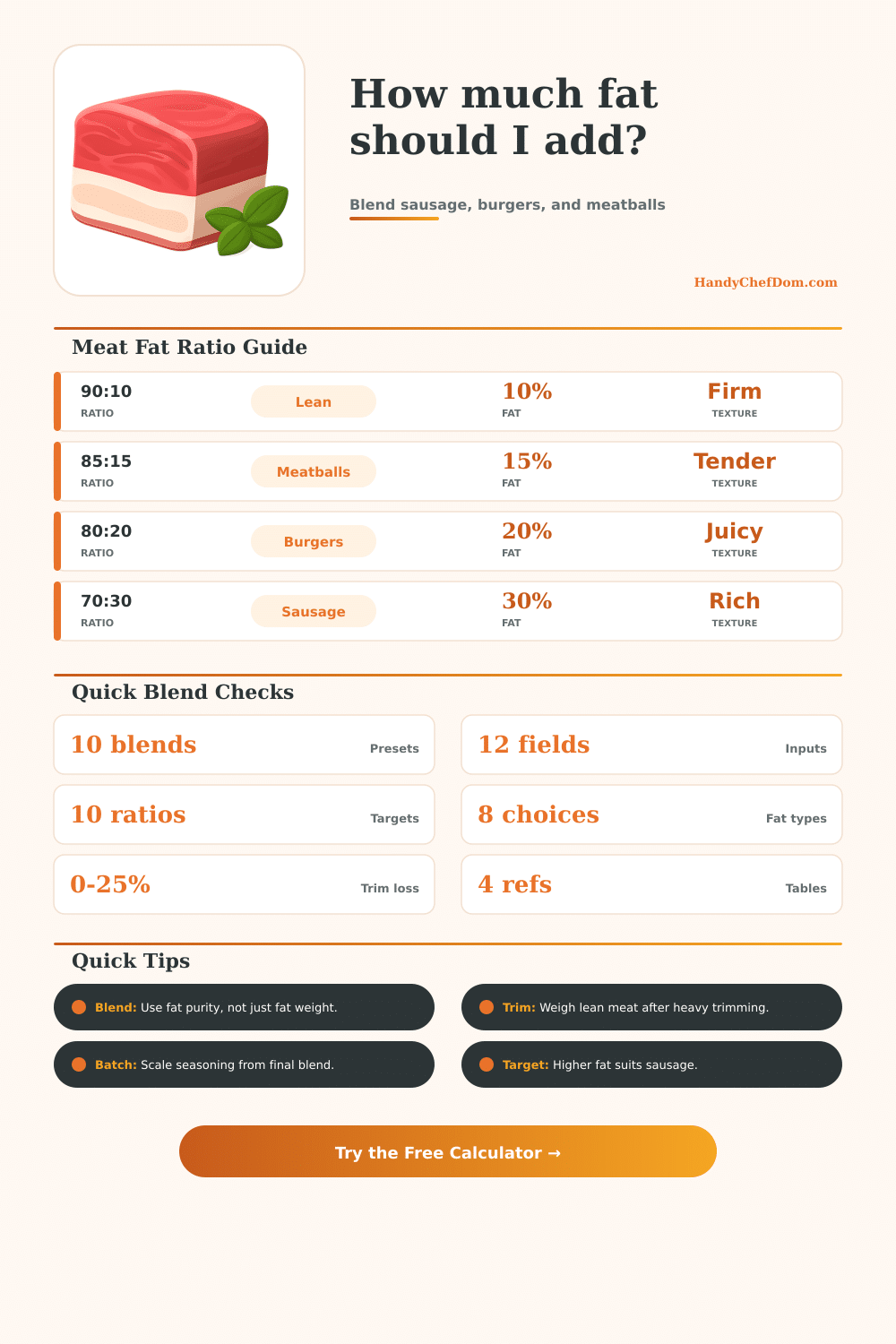
| 90:10 | 10% | Lean burgers or meatballs | Light and tidy | Works with 90% lean meat without extra fat. |
| 85:15 | 15% | Meatballs and balanced patties | Tender but not heavy | Common target for lean beef plus modest fat. |
| 80:20 | 20% | Classic burgers | Juicy and balanced | Default target for many home grinds. |
| 75:25 | 25% | Rich burgers and patties | Looser, richer bite | Needs higher-fat trim or added fat. |
| 70:30 | 30% | Fresh sausage | Rich and cohesive | Best solved with high-purity added fat. |
| Added fat type | Estimated fat purity | Best blend role | Why amount changes | Example target |
|---|---|---|---|---|
| Pork back fat | 90% | Sausage and wild game | Most of its weight counts as fat. | 70:30 or 80:20 |
| Beef suet | 92% | Beef burgers | High fat purity means less add-in weight. | 80:20 |
| Beef fat trim | 80% | Beef blends | Some lean tissue comes along with the fat. | 75:25 |
| Pork belly trim | 45% | Moderate pork blends | Lower purity requires more add-in weight. | 75:25 |
| Bacon ends | 50% | Flavorful blends | Only about half the weight is fat. | 80:20 or 75:25 |
| Chicken skin | 65% | Poultry patties | Middle purity changes batch size more. | 88:12 to 80:20 |
| Starting lean meat | Lean fat percent | Target ratio | Added fat purity | Added fat per 5 lb lean |
|---|---|---|---|---|
| 90% lean beef | 10% | 80:20 | 90% | 0.71 lb |
| 85% lean beef | 15% | 80:20 | 90% | 0.36 lb |
| 97% lean venison | 3% | 80:20 | 90% | 1.21 lb |
| 96% pork loin | 4% | 70:30 | 90% | 2.17 lb |
| 75% pork shoulder | 25% | 70:30 | 90% | 0.42 lb |
| 93% turkey mix | 7% | 85:15 | 65% | 0.77 lb |
| Final batch size | 1.2% burger seasoning | 1.8% meatball seasoning | 2.2% sausage seasoning | 2.8% bold seasoning |
|---|---|---|---|---|
| 2 lb | 0.38 oz / 11 g | 0.58 oz / 16 g | 0.70 oz / 20 g | 0.90 oz / 25 g |
| 5 lb | 0.96 oz / 27 g | 1.44 oz / 41 g | 1.76 oz / 50 g | 2.24 oz / 64 g |
| 10 lb | 1.92 oz / 54 g | 2.88 oz / 82 g | 3.52 oz / 100 g | 4.48 oz / 127 g |
| 15 lb | 2.88 oz / 82 g | 4.32 oz / 122 g | 5.28 oz / 150 g | 6.72 oz / 191 g |
| 25 lb | 4.80 oz / 136 g | 7.20 oz / 204 g | 8.80 oz / 249 g | 11.20 oz / 318 g |
When you grind meat at home, you must determine the fat content that will maintain an correct texture of the ground meat. If the fat content is too low, the ground meat will be dryly. If the fat content is too high, the ground meat will be greasy.
While many people can estimate the amount of fat that should be added to the meat, this process will lead to inconsistent result. In order to achieve the best results, you must understand how to measure the fat content of the meat and calculate the fat ratio that will keep the meat moist and of good texture. Lean meat is not completely free of fats.
How to Calculate the Right Fat for Ground Meat
The fat that naturaly exist in lean meat must be accounted for. For instance, if the meat contain ninety percent lean meat, it will have ten percent fat content. Additionally, if you trim lean meat of sinew or silver skin, some of the fat will also be removed from the lean meat.
This trimming process will reduce the weight of the lean meat. The meat fat-ratio calculator accounts for the weight of lean meat that can be utilized after trimming. The purity of the fat that you will use in the ground meat must also be accounted for.
For instance, pork back fat is ninety percent pure fat. However, pork belly trim is only forty-five percent pure fat. If you use the forty-five percent pure fat instead of the ninety percent pure fat, the fat ratio will be incorrect.
The meat fat-ratio calculator accounts for the purity of the fat that is to be utilized in the ground meat. The target fat ratio will depend upon the type of ground meat that is to be prepared. Burgers has a target fat ratio of twenty percent.
Meatballs contains fifteen percent fat. Sausage contains thirty percent fat. Each of these ratios can be altered in the meat fat-ratio calculator to determine the amount of fat that should be added to the lean meat to achieve the target fat ratio.
The weight of the meat will be reduced during the trimming process. If three percent of the total weight of the meat is lost during trimming, that three percent will have a significant impact upon the total weight of the ground meat. However, the meat fat-ratio calculator accounts for the usable weight of the lean meat prior to the calculation of the amount of fat that must be added to the lean meat.
The amount of seasonings that you will add to the ground meat must also be calculated based off the total weight of the ground meat after the fat has been added to the lean meat. If the amount of salt, for instance, is calculated based upon the lean meat alone, there will not be enough salt added to the ground meat to season the ground meat properly. The amount of seasonings will be applied to the total weight of the finished ground meat in the meat fat-ratio calculator.
The temperature at which you prepare and grind the meat will impact the texture of the meat. If the temperature of the meat is too high, the fat will smear. Smearing of the fat will result in poor texture of the ground meat.
To combat this issue, you may rest the ground meat in the refrigerator for a few hours to allow the ground meat to rebind. This is especially useful for sausages as the binding of the sausage will remain intact in its casing. The size of batch of ground meat that will be prepared will impact the way in which the meat and fat are mixed.
Small batches of two or three pounds can be mixed by hand. However, large batches of ten pounds or more can be more difficultly to mix. Some will mix the meat in stages.
Others will purchase a stand mixer to help mix the ground meat and fat. Additionally, large batches may have a slightly higher target fat percentage as the fat will help with the mixing of the lean meat and fat. The type of fat that will be used will impact the flavor of the ground meat.
Beef suet will impart a flavor to the ground meat that is suitable for burgers. Pork back fat is more neutral in flavor and is suitable for ground sausage. Bacon ends will add salt and smoke to the ground meat, but may be too strong for ground meat recipes.
The fat calculator will indicate the weight of the fat that must be added to the lean meat. However, the choice of fat will impact the flavor of the prepared ground meat. Purchased pre-ground meat can be used in place of grinding the meat at home.
However, it does not offer as much control over the fat percentage of the ground meat. Pre-ground meat will have a specific fat percentage. However, that percentage may not be accurate.
For small batch ground meats, purchasing pre-ground meat can save time. For ground meat that will be frozen or served to guests, however, grinding the meat at home is preferable. Understanding the fat ratio will allow cooks to stop guessing at the amount of fat that should be added to lean meat.
The target fat percentage should be measured against the total weight of the finished ground meat. The weight of the lean meat after trimming must also be accounted for. Finally, the purity of the fat that is added to the lean meat will impact the amount of fat that must be added to the lean meat.
The meat fat-ratio calculator will account for and calculate each of these factors so that cooks can focus upon selecting the type of meat, fat and seasonings for the recipe. You should of used a calculator to make sure the meat tastes good.