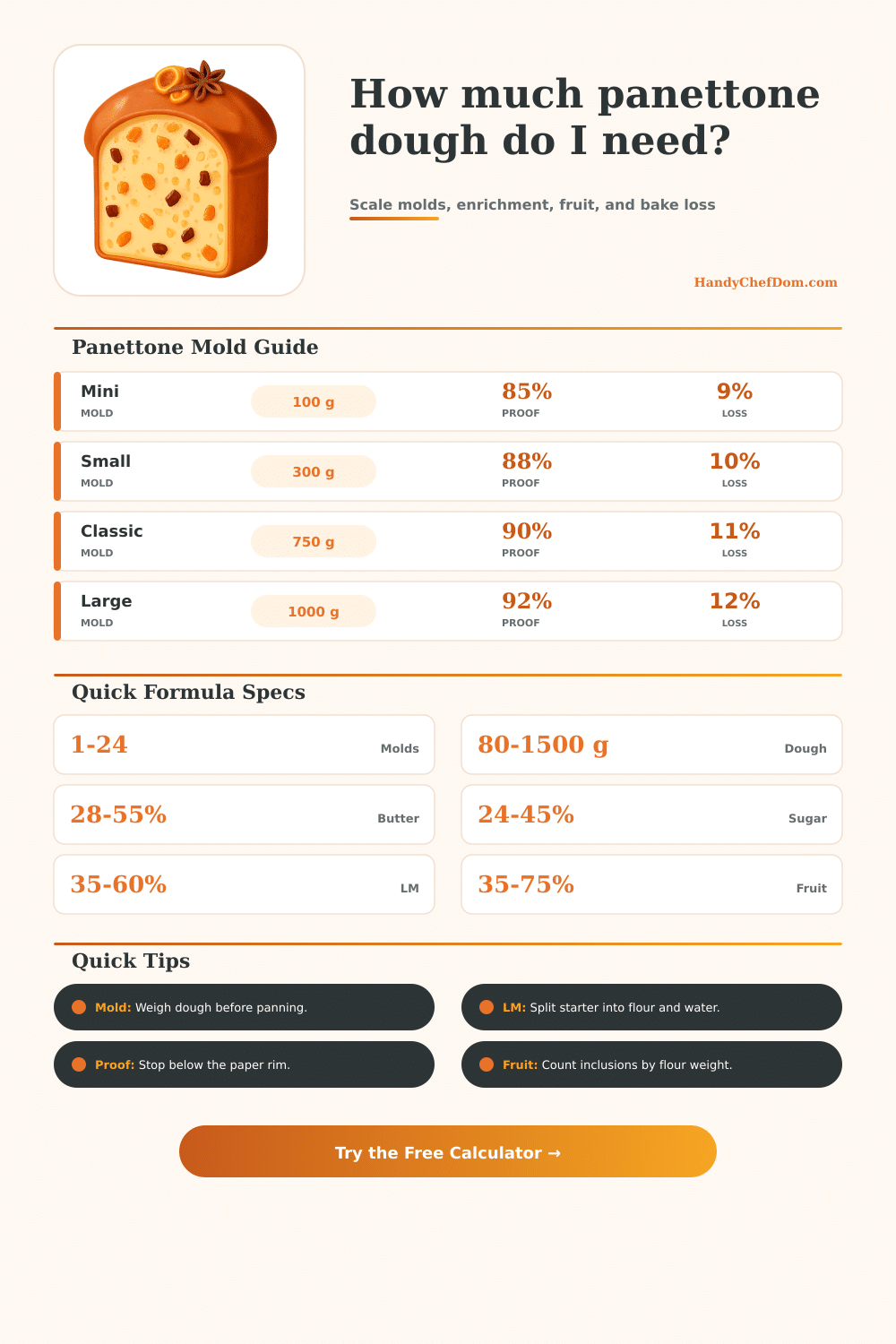
🍞 Panettone Dough Calculator
Scale panettone dough by mold size, dough weight, enrichment percentage, butter, sugar, egg, yolk, lievito madre, fruit load, proof height, handling buffer, and baked yield.
Choose a mold size or enter a custom dough weight. The calculator solves total flour from the final panned dough, splits stiff lievito madre into flour and water, then reports ingredient weights, proof height target, and baked yield.
0% of flour.
0% of flour.
0% of flour.
0% of flour.
0% of flour.
0% of flour.
Outside egg and starter water.
Based on enrichment and fruit.
| Mold type | Typical dough weight | Diameter and height | Proof target | Baked yield cue |
|---|---|---|---|---|
| Mini paper mold | 80 to 120 g | About 7 cm by 5 cm | 80 to 86% of height | Small molds lose moisture quickly |
| Small panettone mold | 250 to 330 g | About 10 cm by 7 cm | 84 to 88% of height | Good for gift portions |
| Classic 500 g mold | 480 to 540 g | About 13 cm by 9.5 cm | 88 to 91% of height | Common home bakery size |
| Tall 750 g mold | 720 to 790 g | About 15.5 cm by 10.5 cm | 89 to 92% of height | Taller proof before doming |
| Classic 1 kg mold | 950 to 1050 g | About 17 cm by 11.5 cm | 90 to 93% of height | Traditional full-size panettone |
| Large paper mold | 1350 to 1550 g | About 20 cm by 12.5 cm | 90 to 93% of height | Use a longer bake loss estimate |
| Formula style | Butter | Sugar | Egg and yolk | Fruit load |
|---|---|---|---|---|
| Light panettone dough | 28 to 34% | 24 to 30% | 22 to 30% | 35 to 50% |
| Balanced classic dough | 35 to 45% | 30 to 38% | 30 to 42% | 50 to 65% |
| Rich holiday dough | 45 to 55% | 35 to 45% | 38 to 55% | 60 to 75% |
| Chocolate panettone | 38 to 50% | 30 to 42% | 28 to 45% | 35 to 60% |
| Low fruit or crema style | 35 to 48% | 30 to 42% | 32 to 50% | 0 to 35% |
| Lievito madre hydration | Flour in 100 g LM | Water in 100 g LM | Formula effect | Use in calculator |
|---|---|---|---|---|
| 40% stiff madre | 71.4 g flour | 28.6 g water | High prefermented flour for its weight | Firm, traditional builds |
| 45% stiff madre | 69.0 g flour | 31.0 g water | Balanced stiff starter split | Default panettone setting |
| 50% stiff starter | 66.7 g flour | 33.3 g water | Slightly more water contribution | Common home adaptation |
| 60% firm levain | 62.5 g flour | 37.5 g water | Lower flour share by weight | Adjust water downward |
| Mold size | Proof height cue | Typical bake loss | Cooling yield | Calculator note |
|---|---|---|---|---|
| 100 g mini mold | 80 to 86% of rim | 8 to 10% | 90 to 92 g from 100 g dough | Shorter bake, faster moisture loss |
| 300 g small mold | 84 to 88% of rim | 9 to 11% | 267 to 273 g from 300 g dough | Good for proof comparison tests |
| 500 g classic mold | 88 to 91% of rim | 10 to 12% | 440 to 450 g from 500 g dough | Default home panettone range |
| 750 g tall mold | 89 to 92% of rim | 10 to 12% | 660 to 675 g from 750 g dough | Watch center structure |
| 1 kg classic mold | 90 to 93% of rim | 11 to 13% | 870 to 890 g from 1 kg dough | Longer bake and cooling time |
This calculator is a formula planning tool. Panettone structure still depends on flour strength, lievito madre condition, mixing development, dough temperature, fruit moisture, and final proof timing.
The panettone calculator is a tool that will helps you calculate the ingredients that are necesary to make panettone. Because the dough for panettone is very sensitively to the ingredients that are used, you must use the panettone calculator to determine the amount of flour, lievito madre, and enrichment ingredients that you will need for your panettone recipe. The panettone calculator utilize percentages of the total amount of flour that will be used to ensure that the recipe remains the same no matter how many mold of panettone you are baking.
Panettone contain several different ingredients, each of which can play a role in the setting of the panettones structure. Butter add flavor and tenderness to the panettone, but if added in excess amounts will interfere with the development of the gluten structure of the panettone. Sugar is used to provide food for the yeast that will rise the panettone, but if added in excess amounts will cause the structure of the panettone to tighten due to it’s competitive relationship with the flour for the water in the dough.
How to Use the Panettone Calculator
Eggs and egg yolks provides color to the panettone as well as contribute to the structure of the panettone, as well as the type of fruit that is added to the panettone can affect the way in which the dough set during proofing. Because lievito madre is a sourdough starter that contains flour and water, the panettone calculator must account for the amount of flour and water that will be contained in the lievito madre by subtracting that amount from the amount of flour and water that is contained in the main recipe for the panettone. This ensure that the enrichment ingredients that are contained in the panettone will not be altered if you alter the amount of lievito madre that is used in the recipe.
If you increase the amount of lievito madre that is used, the panettone calculator will automatically decrease the amount of main flour that should be used, as well as indicate the amount of liquid that the lievito madre will provide. Using lievito madre in excess of the amount that is suggested by the panettone calculator may lead to difficulty in baking the panettone, as the dough may become too wet. In addition to the ingredients that must be accounted for, the size of the mold in which the panettone will be baked is another important variable.
A mold that is filled with 500 grams of dough will not hold 500 gram of panettone dough, as the panettone must rise within the mold while it is proofing and baking. The panettone calculator accounts for the percentage in which the mold will be filled with panettone dough as well as the height of the paper mold that will be used to contain the panettone. This allow for the panettone maker to accurately calculate the height that the panettone dough will rise prior to baking.
It is important for the rise proofing process to be stopped prior to the panettone dough reaches the rim of the mold, otherwise the panettone may dome outside of the paper mold. Finally, the weight of the panettone after baking will always be less then the weight of the dough prior to baking. This is due to the loss of the moisture from the panettone during baking and while it is cooling after baking.
A panettone will lose between 9 and 13 percent of its weight during the baking and cooling process. The amount of weight that a panettone loses is due to the size of the mold, the duration of baking, and the amount of surface area that the panettone have in contact with the air. The panettone calculator uses the percentage for bake loss to calculate the weight of the panettone that will come out of each mold and the total weight of the batch of panzettoni.
Knowing the cooled weight of the panettone will help you determine how to package the panettone and how many loaf will fit on a cooling rack. The enrichment grid allows you to separate the ingredients of the panettone such as butter, sugar, whole eggs, and egg yolks. Each ingredient contribute to the richness of the panettone.
For example, a chocolate panettone will require less butter than a fruit panettone because the chocolate chips contains the fat and moisture that the panettone requires. Additionally, a panettone with light loads of fruit will require more liquid than a panettone that has a heavy load of fruit because the fruit will contain less water when it is added to the panettone. A small amount of dough will be lost during the preparation of the panettone.
Dough can stick to the mixing hook and to the work table after the panettone dough is divided into each mold. A buffer for this lost dough is built into the panettone calculator. For example, a three percent buffer accounts for dough that may stick to the mixing hook.
Otherwise, the last mold will not have enough dough to fill the mold. The proof-height target for the panettone allow you to account for the oven spring of the panettone. If you set the proof height to 90 percent of the mold height, the panettone will allow for oven spring during the first ten minutes of baking.
A wide and short mold will produce a gentle dome with a 90 percent proof height target. A tall and narrow mold will have fewer options for oven spring so the reference values for proof height will increase with the size of the mold. The panettone calculator allows you to view the effect that changing one variable will have upon the other variables in the panettone formula.
For instance, if you increase the amount of butter in the panettone, the calculator will allow you to determine if you need to increase the amount of egg yolk to maintain the structure of the panettone. Additionally, if you increase the amount of fruit in the panettone, the calculator can help you to determine if you need to increase the amount of dough allotted for handling loss. Using the panettone calculator allow cooks to understand the relationship between the ingredients and the baking process for the panettone.