🍺 Yeast Pitching Rate Calculator
Estimate beer, lager, wine, cider, or mead yeast pitching by batch volume, gravity, pitching profile, target cells per mL per Plato, pack cells, viability, and starter growth.
Use the profile selector to load a typical pitch rate, or enter a custom rate directly. The calculator converts SG, Brix, or Plato into degrees Plato, then multiplies batch mL by Plato by the target rate in million cells per mL per Plato.
The volume multiplier used in the cell requirement formula.
Gravity converted to extract strength for pitching math.
Million cells per milliliter per degree Plato.
Viable cells compared with the buffered target.
Convenient for moderate ales but viability changes with age.
Often enough for average ale batches when fresh.
Use must volume, sugar strength, and pack size together.
Estimate density and viability before repitching.
| Fermentation style | Common rate | Typical gravity | Best use | Calculator cue |
|---|---|---|---|---|
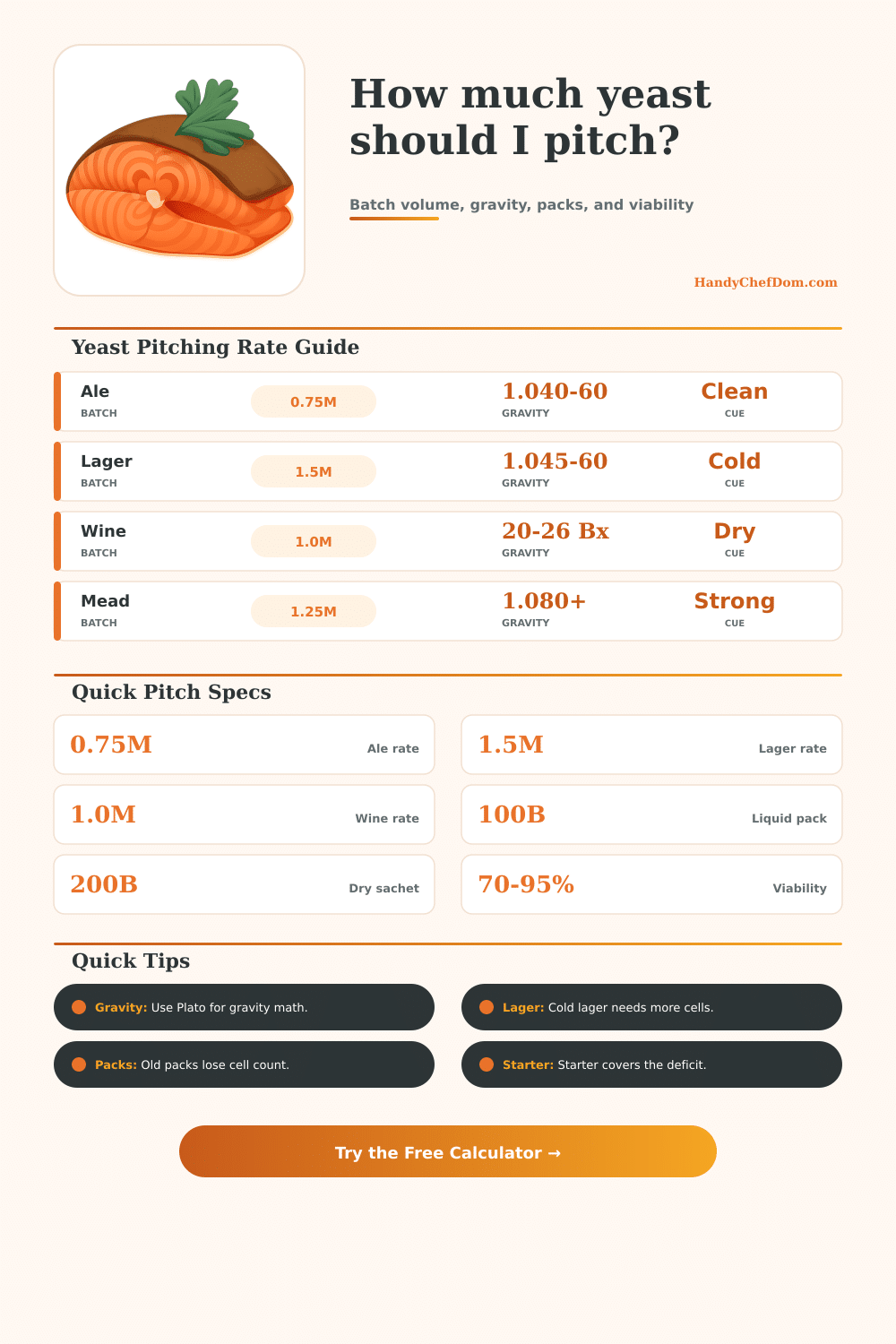
| Ale - clean standard | 0.75 million/mL/Plato | 1.040 to 1.065 | Pale ale, porter, amber, stout | Good default for neutral ale character |
| Ale - expressive or wheat | 0.50 to 0.65 million/mL/Plato | 1.040 to 1.060 | Wheat beer, saison, expressive ale | Lower pitch can leave more yeast character |
| Lager - cold fermentation | 1.50 million/mL/Plato | 1.040 to 1.065 | Pilsner, helles, bock, cold lager | Cold wort needs a larger pitch |
| High gravity beer | 1.00 to 1.25 million/mL/Plato | 1.070 and higher | Imperial stout, barleywine, strong ale | Use extra oxygen and a healthy culture |
| Wine, cider, and mead | 0.75 to 1.25 million/mL/Plato | 12 to 30 Brix or Plato | Musts and juice fermentations | Use the Brix or Plato input when available |
| Yeast source | Typical listed cells | Fresh viability | Planning caution | Starter fit |
|---|---|---|---|---|
| Liquid beer pack or pouch | About 100 billion cells | 70 to 95% | Age has a strong effect on available cells | Often benefits from a starter |
| Dry beer sachet | 150 to 220 billion cells | 85 to 98% | Use the maker count when printed | Usually pitched direct for average ales |
| Dry wine yeast pack | 50 to 100 billion cells | 80 to 95% | Hydration and must stress change performance | Usually rehydrated rather than built up |
| Measured slurry | Density dependent | 40 to 85% | Trub content can inflate the estimate | Use lower viability if stored |
| Fresh yeast cake | Very high | 50 to 90% | Overpitching is possible on small batches | Measure or dilute for repeatability |
| Starter method | Growth estimate | Useful range | DME at 100 g/L | Planning note |
|---|---|---|---|---|
| Stir plate starter | 100 to 180 billion cells/L | 1 to 5 L | 100 g per liter | Best growth for a single pack |
| Shaken or swirl starter | 70 to 120 billion cells/L | 1 to 3 L | 100 g per liter | Simple and useful for moderate deficits |
| Simple still starter | 40 to 80 billion cells/L | 0.5 to 2 L | 100 g per liter | Lower growth, but useful for waking yeast |
| Step starter | Use several stages | Large deficits | 100 g per liter per step | Split big needs into manageable steps |
| Batch example | Volume | Gravity | Rate target | Approx cells |
|---|---|---|---|---|
| Standard ale | 5 gal | 1.052 | 0.75 million/mL/Plato | About 185 billion cells |
| Cold lager | 5 gal | 1.050 | 1.50 million/mL/Plato | About 350 billion cells |
| Table wine | 23 L | 24 Brix | 1.00 million/mL/Plato | About 552 billion cells |
| Strong mead | 19 L | 1.100 | 1.25 million/mL/Plato | About 560 billion cells |
| Cider batch | 5 gal | 1.055 | 0.75 million/mL/Plato | About 196 billion cells |
Pitching calculations are planning estimates. Manufacturer cell counts, storage age, oxygen, nutrient level, must composition, starter gravity, and fermentation temperature can change real yeast performance.
Yeast pitching is the process of adding yeast to the liquid wort. This process is critical to the brewing process because the number of yeast cells that are added will determine how well the fermentation process will work. Adding too few yeast cell will make it difficult for the yeast to complete the fermentation process.
Adding too many yeast cells can change the flavors of the beer in ways that is undesirable to the brewer. It is important to add a sufficient number of living yeast cells to the wort to allow the yeast to perform it’s function. The rate at which the yeast is pitched is measured in yeast cells per milliliter of wort times degree Plato.
How Much Yeast to Add
The rate at which the yeast is pitched will vary depending on the type of beverage that the brewer produces. For instance, for clean ales, the pitching rate is 750,000 yeast cells per milliliter of wort per degree Plato. Cold lagers, however, require twice that rate of yeast pitching.
Cold lagers require higher rate of yeast pitching because the yeast activity is slower at lower temperatures. Lower temperatures also allow off-flavors to remain in the beer. Products like wine, cider, and mead require different rates of pitching of the yeast due to the different level of sugar found in these products.
Factors such as the batch volume and the gravity of the product will impact the amount of yeast that is required. With higher batch volume, there will be a higher total amount of yeast that is required, even though the pitching rate of the yeast per milliliter of wort will be the same. Higher gravity wort contains more sugar, which the yeast must ferment.
High gravity worts also place more stress on the yeast. More yeast pitching may be required if the gravity of the wort is higher then 1.070. The source of the yeast will impact the number of living yeast cells that is available to perform the fermentation process.
If using liquid yeast, the count will be listed on the package. The viability of the yeast may decline with the age of the yeast or if it was stored at vary temperatures. Dry yeast contains more yeast cells than liquid yeast and is more shelf-stable.
However, proper yeast rehydration is required to ensure that there is an adequate number of living yeast cells to initiate fermentation. The yeast slurry from previous batch could be used in place of dry yeast. However, the brewer will have to estimate the density of the slurry and the brewer will have to account for the trub that is mixed in with the yeast cells.
If there are insufficient yeast cells relative to the amount of wort, a yeast starter can be used to increase the number of yeast cells. A stir plate will allow for the growth of more yeast cells per liter of wort than a shaken yeast starter. More yeast cells will grow with more wort and more running time for the yeast starter.
It is also up to the brewer to decide whether to purchase additional yeast pack or to build a larger yeast starter. This decision must be made prior to pitching the yeast. The temperature at which the yeast is pitched will affect the functioning of the yeast after pitching.
If lager yeast is to be pitched into the batch, the brewer will pitch it at a colder temperature. For this reason, a higher pitching rate will be used for lager yeast so that enough active yeast cells are present to begin the fermentation process. Oxygen will help the yeast cells to multiply.
The more oxygen that is added to the wort, the more active the yeast will be. However, this only will be effective if the yeast cells have high viability. If the yeast has low viability and there is low levels of oxygen in the wort, the yeast will be sluggishly in its fermentations.
One of the mistakes that many brewers make is not accounting for the age and viability of the yeast. Many people simply use the number of yeast cells per milliliter that is stated on the package of yeast. They dont account for the age of the yeast.
Many also fail to account for the viability of the yeast, which can cause the fermentation process to end at a higher gravity than that which the brewer intended. To account for these variables, many brewers use a yeast pitching calculator to make the variables visible to the brewer to allow for proper adjustment to the pitching rate of the yeast before the brewing day. It is important for brewers to always consider the yeast as a population of living cells.
Each yeast cell has a certain time frame to reproduce and metabolize the sugars in the wort. Using enough yeast cells will allow the yeast to reach the necessary amount when the wort is fresh. Not using enough yeast will cause the yeast to take longer to reach the necessary amount of yeast cells to ferment the wort, which could lead to undesirable flavor in the finished product.