🍖 Boneless Ham Cooking Time Calculator
Estimate oven time for boneless ham, spiral sliced ham, mini ham, or fresh boneless ham from weight, oven temperature, cover style, glaze timing, reheat or cook mode, and target internal temperature.
Choose a ham style or enter your own numbers. The calculator separates covered heating time, glaze time, rest time, check time, and target temperature.
A steady reheating estimate for most fully cooked boneless hams at a moderate oven setting.
Pre-sliced ham can dry faster, so covered heat and late glaze timing matter more.
Small hams heat quickly, but they need an early temperature check because carryover is limited.
Fresh boneless ham uses a longer rate and a cook-to-temperature target instead of a reheat target.
| Ham style | Calculator mode | Base oven rate | Typical target |
|---|---|---|---|
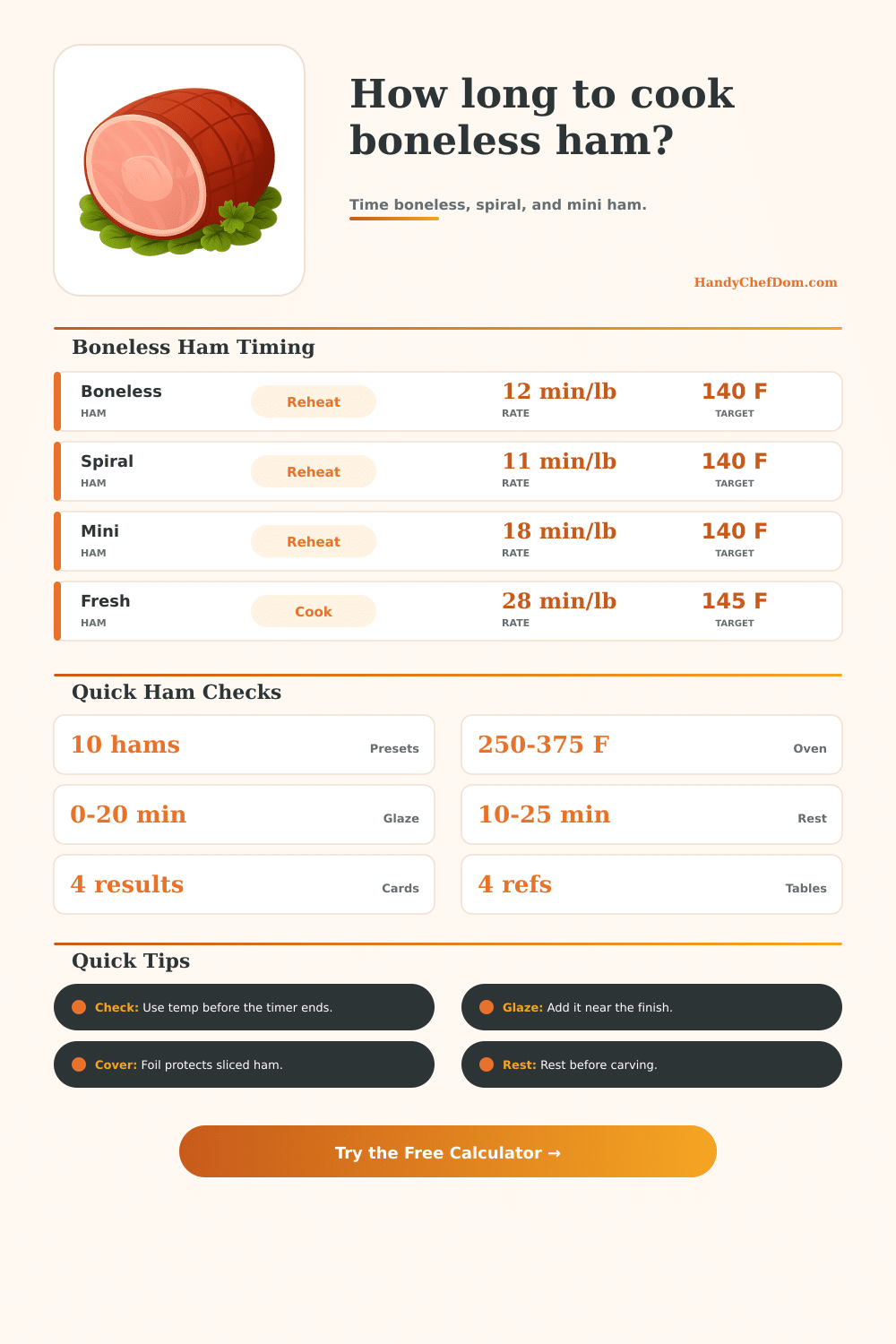
| Boneless fully cooked ham | Reheat | 12 minutes per pound at 325 F | 140 F center for many labeled fully cooked hams. |
| Spiral sliced fully cooked ham | Reheat | 11 minutes per pound at 325 F | 140 F center, with foil protecting the slices. |
| Mini boneless ham | Reheat | 18 minutes per pound at 325 F | 140 F center, checked earlier because the piece is small. |
| Whole boneless ham | Reheat | 13 minutes per pound at 325 F | 140 F center, then rest before carving. |
| Fresh boneless ham roast | Cook | 28 minutes per pound at 325 F | 145 F center with a rest before slicing. |
| Boneless picnic ham | Cook or reheat by label | 24 to 30 minutes per pound | Use the label and target temperature field. |
| Oven setting | Best use | Timing effect | Calculator adjustment |
|---|---|---|---|
| 250 F to 275 F | Gentle reheat for spiral or sliced ham | Longer but moist | Adds about 18% to 32% time. |
| 300 F | Slow covered heating | Slightly longer | Adds about 8% time from the 325 F base. |
| 325 F | Default ham timing | Baseline | Uses the listed minutes per pound. |
| 350 F | Faster reheat or glaze finish | Slightly shorter | Reduces time around 7% from baseline. |
| 375 F | Short finish for glaze setting | Faster browning | Caps the reduction to avoid overestimating speed. |
| Glaze or cover choice | When it happens | Timing role | Planning note |
|---|---|---|---|
| No glaze | Entire oven time covered or uncovered | No separate finish | Best when a sauce is served on the side. |
| Final 10 minute glaze | Last 10 minutes uncovered | Replaces the end of heating time | Good for thin honey, mustard, or fruit glazes. |
| Final 15 minute glaze | Last 15 minutes uncovered | Creates a tacky finish | Use when the glaze needs one brush and one set. |
| Final 20 minute glaze | Last 20 minutes uncovered | Thick glaze finish | Watch closely so sugar does not over-darken. |
| Two-stage glaze | Brush, set, brush again | Adds a short finishing cushion | Use for a glossy holiday ham finish. |
| Tightly covered | Most of reheating time | Slightly faster and moister | Especially useful for spiral sliced ham. |
| Ham weight | Boneless cooked | Spiral cooked | Mini or fresh note |
|---|---|---|---|
| 2 lb mini ham | About 24 to 32 min | About 22 to 30 min | Mini hams often need 30 to 40 min total. |
| 4 lb boneless ham | About 48 to 64 min | About 44 to 56 min | Start checking before the final glaze window. |
| 6 lb dinner ham | About 72 to 96 min | About 66 to 84 min | Good size for a family meal with leftovers. |
| 8 lb holiday ham | About 96 to 128 min | About 88 to 112 min | Plan a covered phase and a glaze phase. |
| 10 lb buffet ham | About 2 to 2.7 hours | About 1.8 to 2.3 hours | Fresh ham takes much longer than reheating. |
| 12 lb large ham | About 2.4 to 3.2 hours | About 2.2 to 2.8 hours | Rest and carving time become more important. |
Use the label on the ham package when it gives a different target. The calculator is a timing planner and assumes the final decision is made with an internal temperature check.
A cooking time calculator will helps you determine how long to cook your ham. Cooking time calculators is useful because they take all of the different variable of cooking a ham and turn them into one window of time for cooking the ham. If you dont use a cooking time calculator prior to cooking your ham, you may find yourself with a ham that is either too cold in the center or too dry on the edges.
To use a cooking time calculator, you will first need to enter the style of the ham. There are different cooking method for different styles of ham. For instance, spiral sliced hams require a different method of cooking than mini ham or fresh roast ham.
How to Use a Ham Cooking Time Calculator
Due to the fact that spiral sliced hams often lose moisture during the slicing process, they require a gentle cooking method. Mini ham recipes often require you to cook the ham quick but also will cool quickly after cooking, so you must pay close attention to the check time for a mini ham. Lastly, fresh roast ham will take more time to heat to the proper internal temperature then a fully cooked ham.
After selecting the ham style, you will need to enter the weight of the ham. However, the cooking time calculator will also ask for your oven temperature and the type of cover on the pan. A 325 degree oven is the standard cooking temperature for boneless ham.
If you choose to cook your ham at a lower temperature than 325 degrees, the cooking time will take longer. If you cook your ham at a higher temperature, the cooking time will be less. Another variable for cooking time is the cover for the ham.
If you cook the ham in an oven bag or seal it with foil, the cooking time will be shorter. If you cook the ham in an uncovered pan, the cooking time will take longer. Another factor that the cooking time calculator will ask for is the glaze phase of cooking the ham.
The glaze on hams contains sugar. Sugar requires direct heat to caramelize. However, direct heat will dry out the ham if you apply the glaze at the start of cooking the ham.
Cooking time calculators separate the glaze phase from the cooking of the ham and ask that you cook the glaze during the last ten to twenty minutes of cooking the ham. During this phase, the ham should be uncovered. Another variable that the cooking time calculator will ask for is the starting and the target internal temperature of the ham.
If the ham started at the refrigeration temperature, it will take longer to heat than a ham that started at room temperature on the counter. The target internal temperature depends upon the type of ham. For instance, fully cooked hams will have a target internal temperature of 140 degrees.
Fresh hams will have a target internal temperature of 145 degrees. The cooking time calculator will provide you with the time required for the ham to heat to the target internal temperature. The cooking time calculator will ask for the time required for covered heating, glaze phase, check time, and rest period.
The check time allow you to test the internal temperature of the ham before the cooking time is complete due to the various thicknesses of ham. During the rest period the hams length will be more easier to carve. Using a cooking time calculator will assist you in planning your meal.
Knowing the cooking time for the ham will allow you to plan the other component of your meal. For instance, if you know that the ham will be cooked at a certain time, you can make sure that it will not be cooked too long or that it will not cook too late in the meal. Although cooking time calculators account for most variables, there are a few that cannot be accounted for.
One of them is the actual temperature of the oven. One oven may be hotter than another. Another variable is the density of the ham.
One ham may be more dense than another ham. To account for these variables, it is always a good idea to use a thermometer to check the internal temperature of the ham before you serve it. Although the cooking time calculator may allow you to plan your meal efficient, the meat thermometer will give you the final confirmation of doneness.