🍰 Sheet Cake Calculator
Estimate sheet cake servings, batter cups, frosting amount, leftovers, and bake time from your pan dimensions and serving cut size.
Use inches and cups in imperial mode or centimeters and liters in metric mode. Layer count means stacked cake layers, so servings stay based on the top cutting grid while batter and frosting scale up.
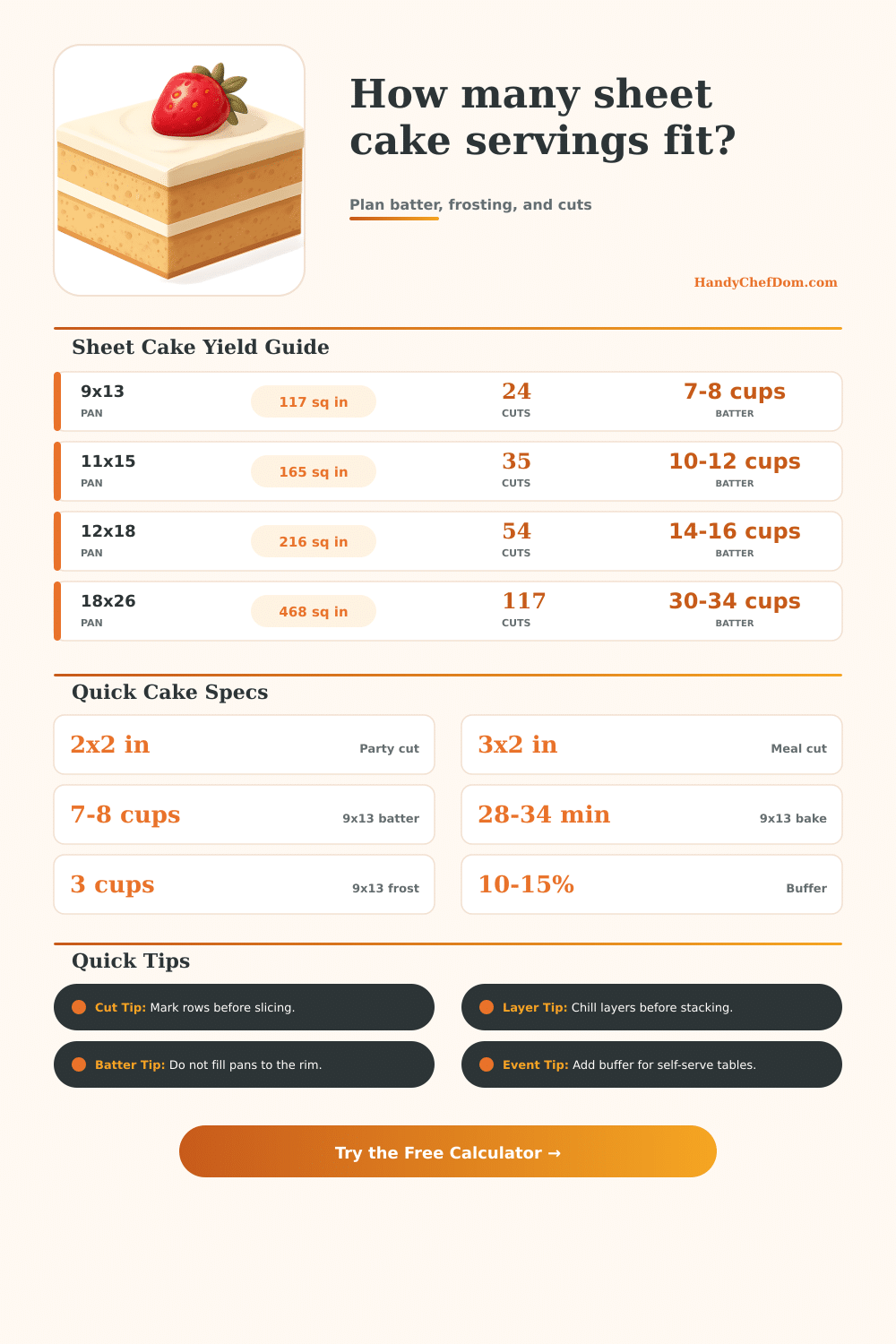
| Pan | Dimensions | 2 x 2 Cuts | 3 x 2 Cuts | Batter Per Layer |
|---|---|---|---|---|
| Small sheet | 8 x 12 in | 24 servings | 16 servings | 6 to 7 cups |
| Quarter sheet | 9 x 13 in | 24 servings | 18 servings | 7 to 8 cups |
| Jelly roll | 11 x 15 in | 35 servings | 25 servings | 10 to 12 cups |
| Half sheet | 12 x 18 in | 54 servings | 36 servings | 14 to 16 cups |
| Full sheet | 18 x 26 in | 117 servings | 78 servings | 30 to 34 cups |
| Event Style | Typical Cut | Serving Factor | Best Use |
|---|---|---|---|
| Wedding or catered | 1.5 x 2 in | Exact to light | Plated dessert service |
| Birthday party | 2 x 2 in | Standard | Cake is the main dessert |
| Casual family dessert | 2.5 x 2 in | Comfortable | Relaxed home service |
| Buffet dessert table | 2 x 2 in | Lower demand | Several dessert choices |
| Generous celebration | 3 x 2 in | Higher demand | Large slices expected |
| Cake Batter | Batter Factor | Bake Effect | Frosting Note |
|---|---|---|---|
| Light sponge | 0.90x | Faster bake | Pairs with light finish |
| Butter or vanilla | 1.00x | Baseline bake | Classic buttercream amount |
| Chocolate | 1.05x | Slightly slower | Accepts thick frosting |
| Carrot or spice | 1.10x | Slower bake | Often needs thicker coat |
| Dense pound cake | 1.15x | Slowest bake | Works with thinner finish |
| Gluten-free batter | 1.00x | Check early | Keep crumb supported |
| Frosting Finish | 9 x 13 Single | 12 x 18 Single | Layer Fill | Use Case |
|---|---|---|---|---|
| Top-only sheet | 1.5 to 2 cups | 3 to 4 cups | No | Simple pan cake |
| Light top and sides | 2.25 to 3 cups | 4 to 5 cups | Optional | Casual party cake |
| Classic frosted cake | 3 to 3.5 cups | 5 to 6 cups | Yes | Birthday sheet cake |
| Thick celebration | 4 to 5 cups | 7 to 8 cups | Yes | Piped borders and decor |
| Thin naked finish | 1 to 1.5 cups | 2 to 3 cups | Optional | Stacked rustic sheet |
| Bake Change | Typical Adjustment | Why It Changes | Calculator Use |
|---|---|---|---|
| Fill depth below 0.8 in | Subtract 3 to 6 min | Thin batter heats faster | Reduces bake window |
| Fill depth above 1.2 in | Add 3 to 10 min | Center needs more time | Adds depth adjustment |
| Dense batter | Add 4 to 8 min | Moist crumb sets slower | Uses batter style factor |
| Lower oven temp | Add 3 to 8 min | Gentler heat extends bake | Compares with 350F |
| Multiple layers | Same per pan | Layers bake separately | Shows total pan batches |
When planning a sheet cake, many variables needs to be considered. Sheet cakes involve volumes and the surface area of the cake. Many variables to consider when planning a sheet cake include the dimensions of the pans, the size of the cake slices, the number of cake layers, and the amount of batter and frosting need.
The calculator show mathematical results after you enter the dimensions of the cake pan and the size of the cake slices. The calculator will help you avoid any mistakes in the mathematics involved in preparing a sheet cake. The width and length of the pan will determine the total surface areas of the pan.
How to Plan a Sheet Cake
The surface area of the pan will determine how many cake slice you can cut from the sheet cake. The depth of the pan will determine how much batter the pan can hold. A deeper pan will require the cake to bake more long than a pan with a smaller depth.
A shallow pan may cause the batter to overflow from the pan when baking the sheet cake. The number of layers of cake will determine how much batter you will need to prepare the cake. You will also need to take into account how many layer of frosting you will need to coat the cake.
The number of layers will not impact the total surface area of the cake. Therefore, the number of layers will not impact the number of cake slices you can cut from the sheet cake. The style of the event will impact the size of the cake slices.
For birthday parties, cake slices will need to be larger because cake is the primary dessert served at these events. For buffet events, cake slices will have to be smaller because guests will have many different dessert option. The calculator will allow for an adjusted target number of cake slices for each guest.
This will account for extra servings in case guests take a second portion of cake. Providing extra servings will ensure that you do not run out of cake for new guest that may come to the event. The type of batter for the cake will impact the bake time for the cake.
Light sponge cakes will settle more differently than dense pound cakes. Therefore, depending on the type of cake selected, the amount of batter needed will be different. The calculator will use a factor to account for the type of cake batter selected for the sheet cake.
However, you will also need to take the bake time of the cake into account. If the cake bakes quick, you will need to check the cake after the bake time listed in the recipe. For sheet cakes, lower oven temperatures will require a longer bake time.
Higher oven temperatures may result in a domed center for the cake that will make it difficult to slice the cake into even piece. The amount of frosting that you use will also change the amount of cake required to serve the number of guests. If you decide to frost the cake on top only, you will need less frosting than if you choose to frost the sides and the top of the cake.
If you choose to use multiple layer of cake, there will be frosting in between each layer of cake. You may need more frosting in between each layer of cake if you want to avoid the cake layers from sliding past each other. The calculator will separate the requirements for the cake from the frosting so that you can see how the type of frosting selected will impact the total amount of ingredient needed to prepare the sheet cake.
Many people make mistakes when preparing a sheet cake. One common mistake is treating the sheet cake as if it is a flat object. People often choose a pan size based on the size of the oven instead of the amount of cake slice it will produce.
Another mistake is measuring the amount of batter based on the recipe instead of the area of the pan in which the cake will be baked. Using the calculator, you can see the raw serving count and the adjusted target count for the sheet cake. These numbers will help you to decide whether to change the size of the cake slices or to add another layer of cake to the sheet cake.
The percentage of the sheet cake that will be allowed for the guests who do not eat cake is another important number produced by the cake calculator. Some guests will not have an appetite for cake. Others may eat more than one slice of cake.
This percentage will ensure that there is enough cake for each guest so that no one goes without eating cake at the party. You should run the cake calculator twice to ensure that the sheet cake plan that you have created is accurate. First, calculate the number of cake slices using the size of the slices that you would like to provide for each guest.
Second, calculate the number of cake slices using a smaller size for the cake slices. The difference between these two numbers will show you how flexible your sheet cake plan is. If the numbers are similar, your sheet cake plan is successful and does not need to be changed.
If the numbers are very different, then you will need to change the size of the pan or the number of layers of cake before purchasing the ingredient for your sheet cake. A successful sheet cake will require you to find the perfect balance between the dimensions of the pan for the cake and the number of guests who will attend the party. Furthermore, preparing a sheet cake that is successful in its planning will require you to prepare more cake than the minimum amount required for the guests to consume.