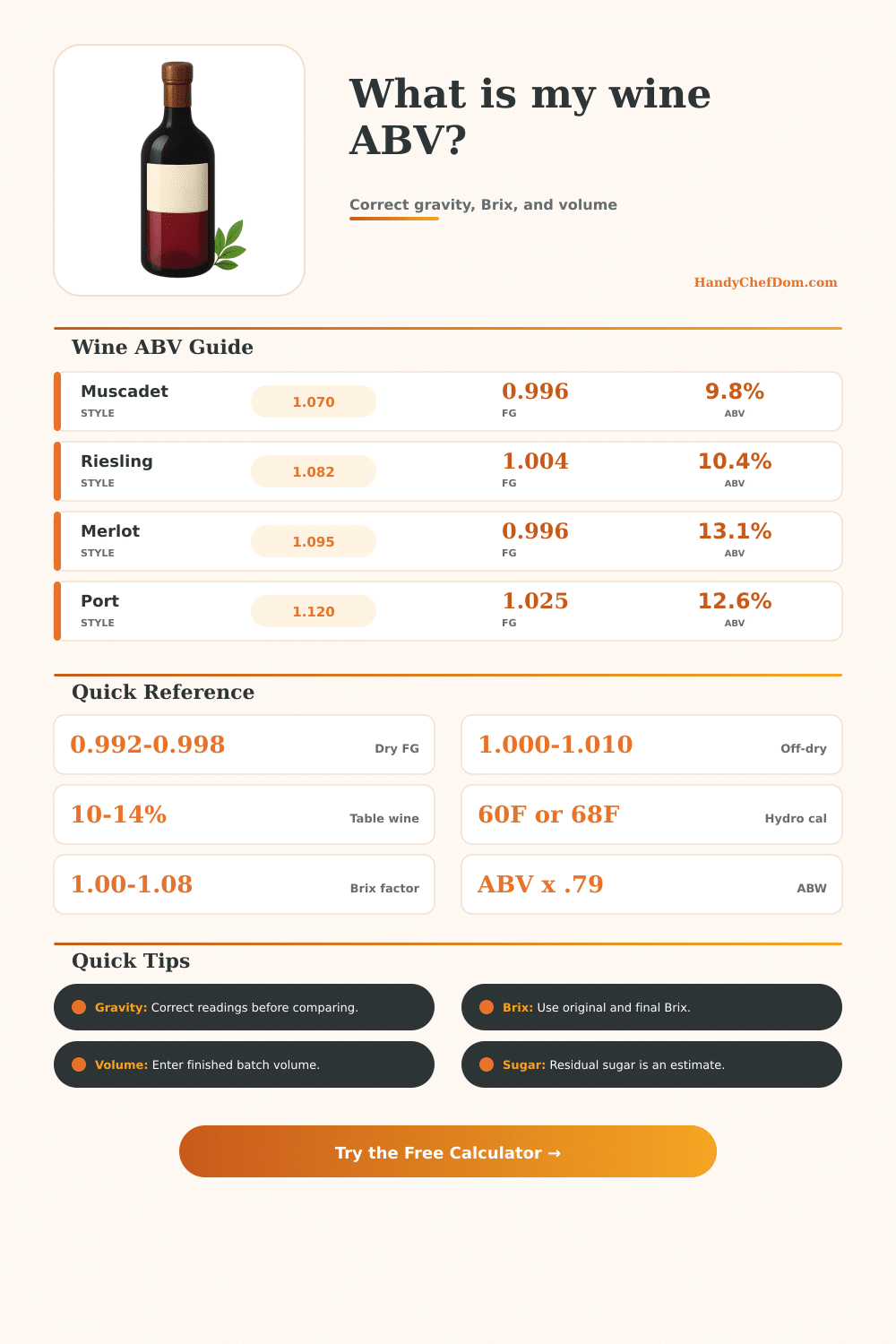
🍷 Wine ABV Calculator
Calculate alcohol by volume, alcohol by weight, corrected gravity, residual sugar estimate, and finished batch alcohol from gravity or Brix readings.
Use gravity readings when you have hydrometer values. Choose Brix correction when the final reading came from a refractometer after fermentation began.
| Wine type | Typical OG | Typical FG | Common ABV | Residual sugar |
|---|---|---|---|---|
| Dry white | 1.070 to 1.090 | 0.990 to 0.998 | 9.5% to 12.5% | 0 to 9 g/L |
| Rose | 1.075 to 1.092 | 0.992 to 1.002 | 10.0% to 12.8% | 2 to 12 g/L |
| Light red | 1.085 to 1.098 | 0.992 to 1.000 | 11.5% to 13.5% | 0 to 8 g/L |
| Full red | 1.095 to 1.112 | 0.994 to 1.004 | 12.8% to 15.0% | 0 to 10 g/L |
| Off-dry white | 1.080 to 1.100 | 1.000 to 1.012 | 10.0% to 13.0% | 10 to 35 g/L |
| Dessert wine | 1.105 to 1.160 | 1.020 to 1.060 | 11.0% to 16.0% | 45+ g/L |
| Brix reading | Approx SG | Potential ABV | Must impression | Calculator note |
|---|---|---|---|---|
| 18 Brix | 1.074 | 9.9% | Light table wine | Often crisp |
| 20 Brix | 1.083 | 11.1% | Classic white | Moderate body |
| 22 Brix | 1.092 | 12.4% | Rose or red | Common target |
| 24 Brix | 1.101 | 13.6% | Full red | Watch finish |
| 26 Brix | 1.111 | 15.0% | Big red | Advanced formula helps |
| 28 Brix | 1.120 | 16.2% | Dessert base | May finish sweet |
| Residual sugar class | g/L range | Final gravity clue | Common wine feel | Use in results |
|---|---|---|---|---|
| Dry | 0 to 9 | 0.990 to 0.998 | Crisp, clean finish | Low sweetness |
| Off-dry | 10 to 18 | 0.999 to 1.006 | Soft fruit edge | Light sweetness |
| Medium | 19 to 45 | 1.007 to 1.020 | Rounded palate | Noticeable sugar |
| Sweet | 46 to 90 | 1.021 to 1.040 | Rich finish | Dessert leaning |
| Very sweet | 90+ | 1.041+ | Lush and heavy | High sugar estimate |
| Hydrometer sample | 60F correction | 68F correction | Reading effect | Why it matters |
|---|---|---|---|---|
| 50F sample | About -0.001 | About -0.002 | Cooler reads high | Corrects OG and FG |
| 60F sample | About 0.000 | About -0.001 | Near baseline | Use calibration temp |
| 68F sample | About +0.001 | About 0.000 | Common room sample | Small but useful |
| 80F sample | About +0.003 | About +0.002 | Warmer reads low | Add SG correction |
| 95F sample | About +0.006 | About +0.005 | Hot must shifts more | Cool sample if possible |
Alcohol by Volume, or ABV, allow a winemaker to make decisions after fermentation begin. ABV measurements can tell a winemaker how much sugar has been converted into alcohol, indicate whether the wine will taste balanced, and help winemakers to determine the total volume of wine that will be bottled. The measurements of ABV, however, are often inconsistent due to the possibility of taking a hydrometer sample at the wrong temperature or because a refractometer may still show the presence of sugar even when alcohol is already present in the wine.
As such, a reliable calculation of ABV is necessary to account to these different measurements to determine the strength of the wine. Using such a calculation allows the winemaker to adjust the wine prior to blending or aging the wine. One of the first step in calculating ABV is performing a temperature correction of the hydrometer measurements.
How to Measure Alcohol and Leftover Sugar in Wine
Most hydrometer are calibrated to measure at one specific temperature, usually 60 or 68 degrees Farenheight. If the sample is taken at a higher temperature, the strength of the liquid will be less, and the hydrometer’s reading will be less as well. In order to account for this, corrections to the reading must be made.
If the winemaker choose to skip the temperature correction, the winemaker may find that the ABV appears to be higher than it will actualy be. Using temperature correction before calculating ABV will ensure accurate measurements and prevent errors that may be compounded in the winemaker’s several-gallon batch. Another of the complications in calculating ABV is the issue of Brix readings.
Brix measurements are taken with a refractometer, which measure the amount of light bending in the wine. Because the light bending properties of alcohol are different than those of sugar, the winemaker records the original Brix readings but the winemaker must adjust the final Brix reading for the amount of alcohol produced. The factor that is applied to the Brix reading vary from winery to winery and must be based upon the composition of the must, the amount of sugar that was present in the must, and the type of yeast that was used in the fermentation process.
Most winemakers use a factor that ranges between 1.00 and 1.08. A Brix reading calculator allow the winemaker to account for these variables and provides an accurate estimate as to the amount of sugar that remains in the wine after the winemaking process. Another of the most important calculations for a winemaker to learn is that of the ABV formula.
For ordinary wines, the most common formula to calculate ABV is the use of the 131.25 formula. This formula work well for wines that have ABVs between 10% and 14%. More concentrated musts, however, like those wines that are produced as dessert wines or big red wines, contain more non-fermentable solids.
For these wines, an alternative formula can be used to adjust for the differing ABV. Averaging these two formulas will produce an ABV that is the closest to the measurement that can be obtained by a laboratory assay. The difference between the two formulas can be as much as half a percent for wines that have high amount of alcohol.
This half of a percent difference can have an impact upon the tax bracket of the wine or upon the flavor that the wine is thought to have when paired with food. The measurement of the residual sugar in the wine is another decision that a winemaker must make. The final gravity of the wine can reveal to a winemaker the amount of residual sugar that is present in the wine.
The actual amount of grams of sugar per liter of wine, however, is another decision that the winemaker must make. If the winemaker plan to produce a dry wine, the goal will be for the wine to have a final gravity of around 0.996; off-dry wines will have a final gravity of around 1.006. A calculator can help the winemaker estimate the amount of grams of sugar per liter of wine, though this value will only be an estimation, not an assay of the wine.
If the amount of residual sugar is higher than the winemaker had planned, it is an indication of possible stalled fermentation or the reaching of the yeast’ tolerance for alcohol. Volume measurements as they relate to the amount of pure alcohol that is produced by the winemaking process is another of the critical variable in winemaking. For example, a winemaster may want to know if five gallons of wine at 13% ABV will contain the same amount of alcohol as six gallons of wine at 11% ABV.
This measurement of total alcohol can also help the winemaster when performing blending decisions regarding the different lots of wine that may be produced. Furthermore, knowing the total volume can help the winemaker to estimate in how many bottle the wine can be bottled, and how many milliliters of ethanol are contained in each of those bottles. These calculations allow winemakers to have a general idea of the ABV strength of the wine prior to undergoing the winemaking process.
Common mistakes in winemaking may involve the inaccuracies of ABV measurements. For example, some winemakers may forget to record the temperature of the wine sample. Others may use the same Brix reading factor for each type of grape variety.
Others may even compare the original gravity reading of the wine to the final gravity reading of the wine. These inconsistencies in the winemaking process will affect the ABV measurements. Accuracy in winemaking, however, can be achieved by using consistent winemaking technique.
Wine style cannot be described in numbers, though. A light wine like Muscadet will have the same ABV as a full-bodied wine like Cabernet Franc. The wine will taste different, however, due to the different ABVs of each wine style.
Thus, the ABV measurement is just one part of the story of a wine; the flavor, mouthfeel, and aging potential of a wine are other measurements that can exist in addition to ABV measurements. Reference tables for wine recipes and components often use wine style as a means of categorizing wines with similar ABVs. Finally, when the winemaker has determined the ABV and residual sugar measurements for the batch of wine, the winemaker must make a decision as to what these measurements mean for the batch of wine.
If the ABV is lower than the winemaker had expected, he or she may wish to age the wine for a shorter period of time or use a different type of closure for the wine bottles. The measurement of residual sugar may reveal to the winemaker that the wine may undergo refermentation after it is bottled. These types of decisions are only possible after trusting the ABV and residual sugar measurements of the batch.
The calculations remove the guesswork in winemaking. The numbers allow for a winemaker to decide which processes are successful and which processes may need to be adjusted to create the desired batch of wine. By using a consistent set of techniques with each batch of wine, winemakers can develop an understanding of which methods work well together and create good wine batch.