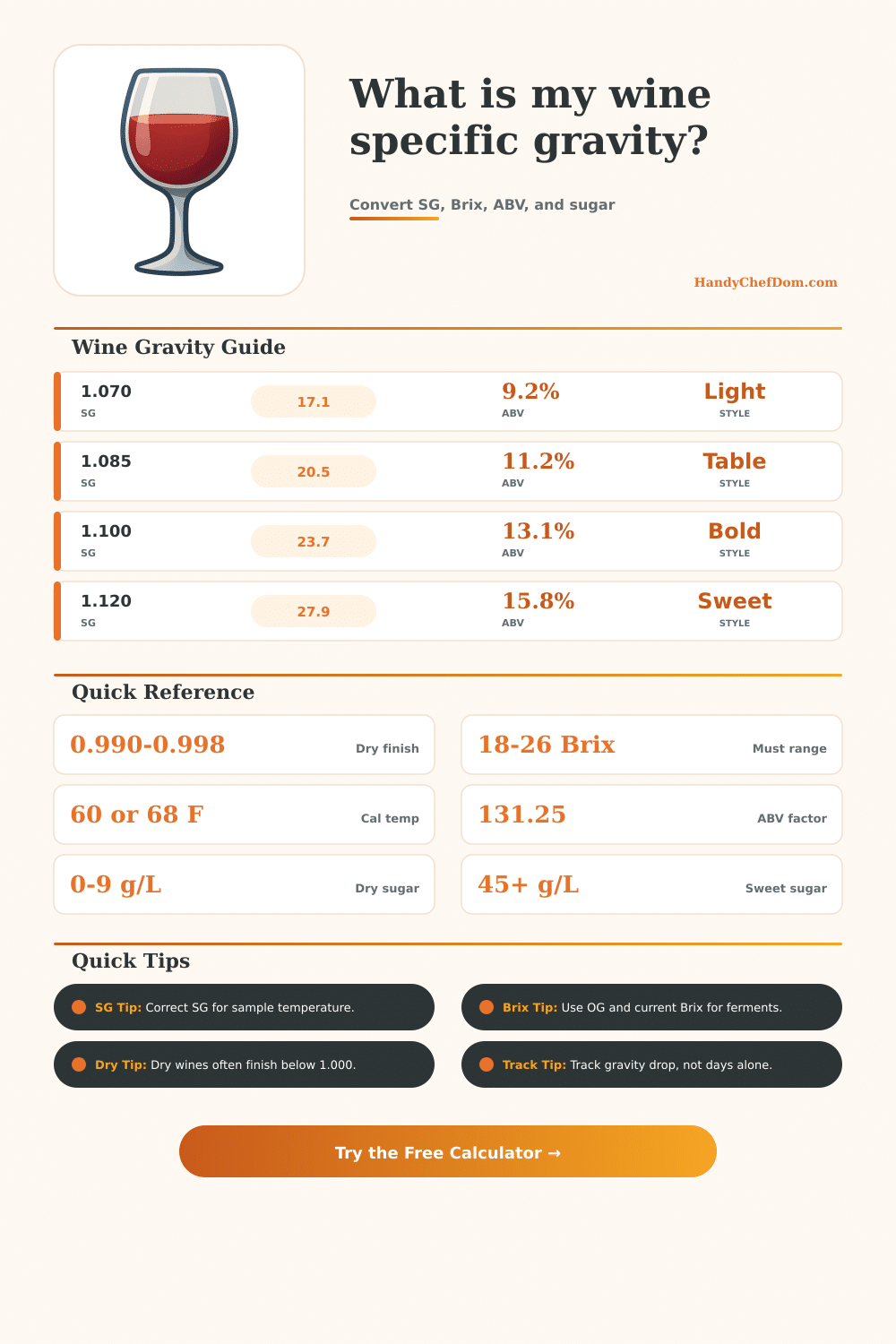
🍷 Wine Specific Gravity Calculator
Convert SG and Brix, correct sample temperature, and estimate gravity drop, potential ABV, residual sugar, and fermentation progress.
Enter original gravity plus your current hydrometer or refractometer reading. For fermenting wine, the refractometer option uses original Brix and current Brix to estimate true SG after alcohol is present.
| Starting SG | Brix | Potential ABV | Common Wine Use |
|---|---|---|---|
| 1.060 | 14.7 | 7.9% | Light fruit wine or low alcohol base |
| 1.075 | 18.2 | 9.8% | Light white, rose, or sparkling base |
| 1.090 | 21.6 | 11.8% | Standard dry table wine must |
| 1.100 | 23.7 | 13.1% | Fuller red or richer white must |
| 1.115 | 26.8 | 15.1% | Dessert or high-gravity must |
| 1.130 | 29.9 | 17.1% | Very high sugar must, hard ferment |
| Sample Temp | 60 F Hydrometer | 68 F Hydrometer | Correction Note |
|---|---|---|---|
| 50 F | Subtract about 0.001 | Subtract about 0.002 | Cool samples read slightly high |
| 60 F | No correction | Subtract about 0.001 | Classic calibration point |
| 68 F | Add about 0.001 | No correction | Common modern calibration |
| 75 F | Add about 0.002 | Add about 0.001 | Warm room sample |
| 85 F | Add about 0.003 | Add about 0.002 | Cool the sample for accuracy |
| 95 F | Add about 0.005 | Add about 0.004 | Hot samples magnify error |
| Current SG | Ferment Stage | Sugar Clue | Measurement Focus |
|---|---|---|---|
| 1.080 and up | Early must | High sugar | OG, Brix, nutrient timing |
| 1.050 to 1.079 | Active drop | Still sweet | Daily gravity trend |
| 1.020 to 1.049 | Mid ferment | Noticeable sugar | Corrected SG or refractometer math |
| 1.000 to 1.019 | Late ferment | Off-dry zone | Stable readings over time |
| 0.990 to 0.999 | Dry finish | Low sugar | Final gravity and clarity |
| Below 0.990 | Very dry | Alcohol lowers density | Confirm instrument accuracy |
| Residual Sugar | Finish Label | Typical SG Clue | Palate Impression |
|---|---|---|---|
| 0 to 4 g/L | Bone dry | 0.990 to 0.996 | Crisp, lean, very low sweetness |
| 5 to 9 g/L | Dry | 0.994 to 0.999 | Balanced dry table finish |
| 10 to 17 g/L | Off-dry | 0.998 to 1.004 | Soft fruit and light sweetness |
| 18 to 45 g/L | Semi-sweet | 1.004 to 1.018 | Clear sweetness, round finish |
| 46 to 125 g/L | Sweet | 1.018 to 1.050 | Dessert-style sweetness |
| 125+ g/L | Very sweet | 1.050 and up | Late harvest or syrupy must |
A hydrometer is an tool that you use to measure density of a liquid. Specifically, a hydrometer is used to determine how much sugar is dissolve in a sample of must. The density of the liquid is expressed as a number called specific gravity.
Specific gravity tell you how much sugar is in the must. It also tells you what the potential alcohol level of the wine will be once fermentation is finish. You will use specific gravity measurement to make various decisions throughout the winemaking process.
How to Measure Sugar and Fermentation with a Hydrometer
Winemakers will begin the winemaking process by measuring specific gravity of the must before yeast are added to the must. This measurement is referred to as an original gravity of the must and can tell you the total amount of sugar that is contained within the must. If a must contains high original gravity, then there will be more potential alcohol levels within the wine.
However, high gravity must also mean that more care will be required when adding nutrients or when adding oxygen to the batch of must. Winemakers will take specific gravity measurements again after yeast have been added to the must to initiate the fermentation process. Specific gravity readings will show a dropping numbers each time the measurement is taken.
The dropping gravity levels is caused by the yeast consuming the sugar in the must and producing alcohol and carbon dioxide as a result of the fermentation process. Monitoring the drop in specific gravity can help you to determine the rate at which fermentation is occurring in the must. The specific gravity of the must will be affected if the liquid is measured at different temperature.
When the must is warm, the molecule in the must will begin to expand. Because the must expands when it is warm, the hydrometer will sit lower within the tube of the must than it would if the must was measured at its calibration temperature. Specific gravity measurements that are not corrected for the temperature at which the must is measured will lead to misjudged measurement for fermentation and dry wine levels within the must.
Specific gravity readings will need to be adjusted according to the temperature of the must sample and the calibration temperature of the hydrometer. A refractometer is another tool that can be used to measure Brix, which is a measurement of the amount of sugar dissolved in the must. Prior to the beginning of fermentation, Brix measurements will be easily convertible to specific gravity and specific gravity values will be easily convertible to Brix.
However, after the beginning of fermentation, the alcohol content of the must will refract the light differently than the sugar molecule, leading to Brix measurements that reflect more sugar than is actualy present in the must. A calculator that estimate specific gravity from original gravity and current Brix measurements can help winemakers more accurately determine the amount of sugar remaining in the must and the amount of alcohol that has been produced. Specific gravity measurements can be used to calculate the potential alcohol content of the wine.
Potential alcohol is calculated as the difference between the original gravity of the must and the gravity of the must after fermentation reaches its end. The target final gravity of the must can range widely depending upon the type of wine that is to be made. Dry table wine, for instance, will have a target final gravity of around 0.994, while dessert wines will have a more higher target gravity.
The difference between the original gravity and the target final gravity will inform winemakers of the way in which the winemaking process will need to be managed, particularly in regard to temperature and winemaking nutrient. Residual sugar is the amount of sugar that is left in the wine after fermentation has occurred and the wine has been aged. Residual sugar can impact the taste of the wine once it is consume.
If the amount of residual sugar is within the range of 0 to 9 grams per liter, the wine will taste dry. If the wine has a residual sugar level in the teens, it will taste soft. Finally, if the level of sugar in the wine is above 45 gram per liter, it will be considered a sweet wine.
A calculator will provide winemakers with an estimate of the amount of residual sugar in the wine by reviewing the final gravity and the amount of alcohol in the wine. The alcohol lowers the density of the wine and mask the sugar in the wine. Another way in which winemakers can use specific gravity measurements is in the determination of the progress of fermentation.
By dividing the gravity drop of the must between the gravity of the original must and the target final gravity, winemakers can determine if the fermentation process is in its initial stage, in the middle of the process, or nearly finished with the winemaking process. If the percentage of the drop of specific gravity is low, it indicate that the fermentation process has stalled. In cases like these, specific gravity measurements can alert winemakers to potential problem in the winemaking process, such as incorrect temperatures, the health of the yeast, or the potential for contamination.
Reference table can help winemakers to gain an overview of the process of winemaking. However, reference tables are not the same as specific gravity measurements. One reference table can help winemakers to understand how the starting gravity of the must relate to the type of wine that should be produced.
Another table can inform winemakers of the type of temperature correction that will be required with different must temperatures. Finally, a third reference table can map gravity measurement to different stages of fermentation. Reference tables should never be used to replace specific gravity measurements.
However, they can help winemakers to avoid the need to perform specific gravity calculation for estimated gravity. Many mistake are made by winemakers that use specific gravity measurements without understanding how the measurements can be misinterpreted. For instance, specific gravity measurements can be taken during periods of active foaming by the yeast or during pump-over procedure.
These type of measurements will lead to artificially high readings of specific gravity. A Brix measurement may also be taken without correcting for the gravity of the must at the start of fermentation. Finally, specific gravity measurements may be taken without adjusting for the temperature of the sample of must.
If the temperature is high, the specific gravity reading may indicate that the winemaker will produce a dry wine when the wine is drunk. Specific gravity measurements are only beneficial to winemakers if the winemakers maintain the proper condition for taking those measurements. Specific gravity measurements do not take into account every element of winemaking.
Specific gravity measurements do not take into account elements like the aroma of the winemaking process, the mouthfeel of the wine, and the stability of the wine. Furthermore, it is possible for the winemaking process to reach the gravity level that are targeted for a specific type of wine yet the wine can still taste harsh due to the acidity or the tannins within the wine. Specific gravity measurements are but one of many measurement that should be used to make decision within the winemaking process.
Specific gravity measurements can be made more reliable through the use of some consistency within the winemaking process. For instance, the same type of hydrometer should be used every time that specific gravity measurements are taken. The hydrometer should also be calibrated using distilled water.
Additionally, the raw specific gravity measurement should be recorded along with the temperature of the batch of must every time that specific gravity measurements are taken. The volume of the batch can also be recorded. Finally, by maintaining a record of the specific gravity of wine that are made, winemakers will be able to recognize pattern or trend in their winemaking process.
The continued use of specific gravity as a measurement tool will accumulate point that indicate whether the fermentation process is healthy or requires intervention.