🍷 BAC Wine Calculator
Estimate wine BAC from body weight, metabolism factor, pour size, wine ABV, glasses, sipping duration, food, and elimination rate.
Enter one person's drinking pattern. The formula uses wine standard drinks, a Widmark-style distribution factor, food absorption adjustment, and hourly alcohol elimination.
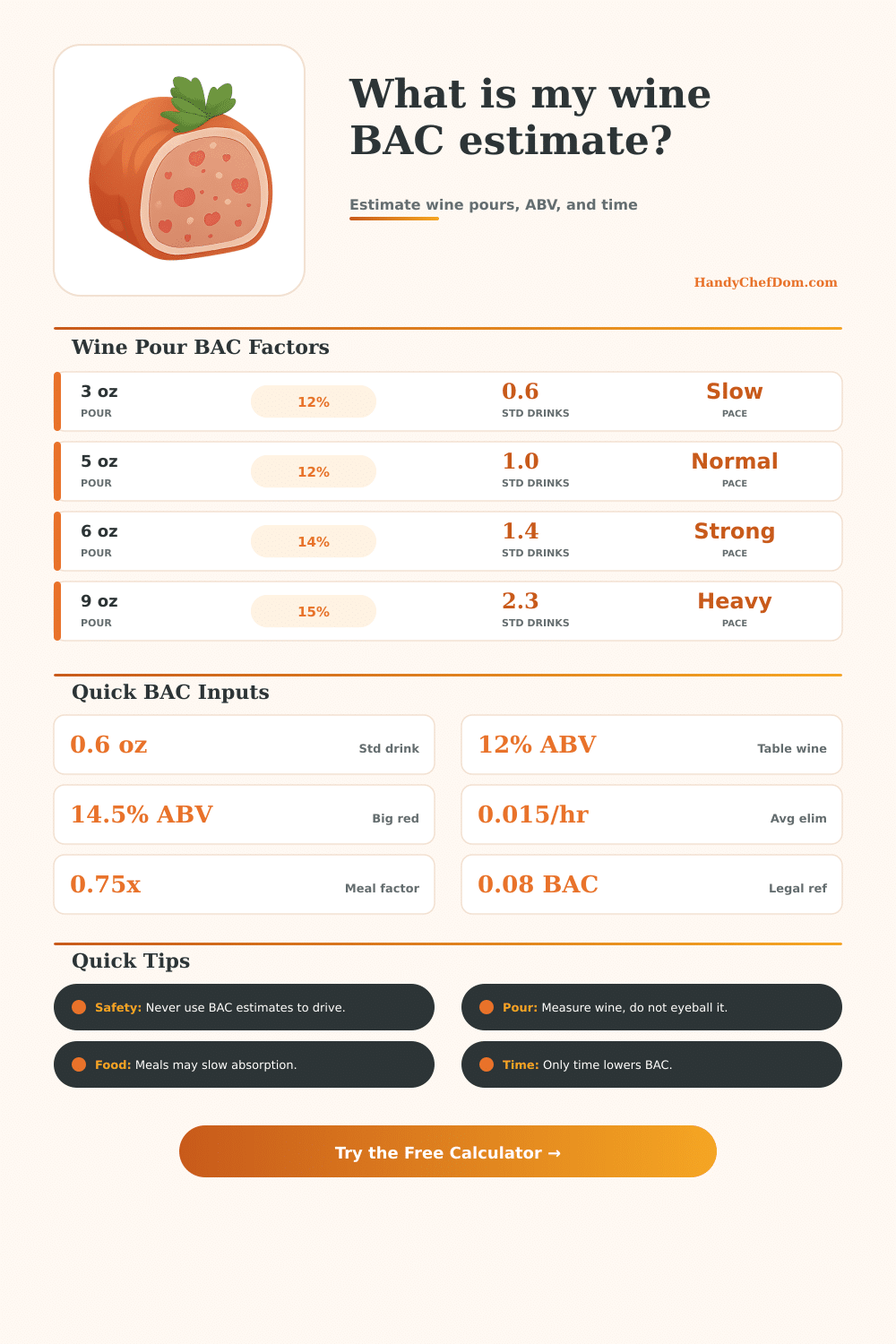
| Wine pour | Typical ABV | Pure alcohol | Standard drinks |
|---|---|---|---|
| 2 oz tasting pour | 12% | 0.24 fl oz | 0.4 drink |
| 3 oz dessert pour | 18% | 0.54 fl oz | 0.9 drink |
| 5 oz table wine | 12% | 0.60 fl oz | 1.0 drink |
| 6 oz larger glass | 14% | 0.84 fl oz | 1.4 drinks |
| 9 oz oversized pour | 14% | 1.26 fl oz | 2.1 drinks |
| Wine style | ABV range | Common pour | Calculator note |
|---|---|---|---|
| Light white | 10% to 12% | 5 fl oz | Lower alcohol per glass |
| Sparkling wine | 11% to 13% | 5 fl oz | Similar to table wine |
| Rose | 11.5% to 13.5% | 5 fl oz | Check bottle label |
| Big red wine | 13.5% to 15.5% | 5 fl oz | Higher standard drinks |
| Dessert wine | 16% to 20% | 3 fl oz | Smaller pour, stronger ABV |
| Fortified wine | 17% to 22% | 3 fl oz | Can add up quickly |
| Food factor | Multiplier | When to use | Important limit |
|---|---|---|---|
| Empty stomach | 1.00x | No food near drinking | Fastest estimate |
| Light snack | 0.92x | Small bite or appetizer | Still absorbs alcohol |
| Normal meal | 0.84x | Dinner with wine | Not a safety guarantee |
| Full meal | 0.76x | Substantial meal | May delay peak BAC |
| Heavy meal | 0.68x | Large, slow meal | Can extend absorption |
| BAC range | Calculator label | Common meaning | Safety framing |
|---|---|---|---|
| 0.000 to 0.019 | Low estimate | Alcohol may still affect some people | Do not rely on it for driving |
| 0.020 to 0.049 | Noticeable estimate | Attention and reaction may be affected | Use safer transportation |
| 0.050 to 0.079 | Elevated estimate | Impairment risk is significant | Do not drive |
| 0.080 and above | High estimate | At or above many legal limits | Do not drive or operate equipment |
Formula note: this calculator uses US standard drinks where 1 drink equals 0.6 fl oz pure alcohol, or about 14 grams of alcohol. It is not a breathalyzer or legal measurement.
A wine BAC calculator are a tool that will allow you to calculate your blood alcohol concentration (BAC). You can use this calculator if you want to know how much alcohol is in your blood after you have consumed wine. You can use the wine BAC calculator to estimate your blood alcohol concentration instead of guessing what your level is.
Using this calculator will allow you to understand how each of the following factor can affect your blood alcohol concentration level. The first of the factors that you must enter into a wine BAC calculator is your body weight. People who weigh more have more water in their body.
How to Use a Wine BAC Calculator
Because water in the body can dilute alcohol, the higher the body water level are in a person, the lower the blood alcohol concentration level will be for that individual. The opposite is true for individuals who are much lighter in body weight than others. Another factor that you must select when utilizing a wine BAC calculator is your sex.
Because men and women have different body compositions including the amount of water in their bodies, it is important for the wine BAC calculator to have a field for your sex so that it can calculate your blood alcohol concentration with the highest degree of accuracy. In addition to your body weight and your sex, the strength of the wine that you consumed and the total volume of the wine that you consumed are factor that must be entered into the calculator. The alcohol by volume percentage of the wine will need to be entered into the calculator as well as the number of ounces of wine that you consumed.
An example of how the strength of the wine can factor into the calculation is that a wine with 14.5 percent alcohol contain a higher amount alcohol per ounce than a wine with 11 percent alcohol. Similarly, if an individual drinks a seven ounce serving of wine but enters only five ounces into the calculator, the BAC levels that the calculator calculates will be lower than the individual’s actual blood alcohol concentration. The wine BAC calculator will also calculate another factor: the amount of time that has passed since you began drinking.
Your body will begin to eliminate the alcohol from your system while you are drinking the wine. The wine BAC calculator will allow you to enter the length of time between your first and last sip of wine. Additionally, you can also enter the length of time that has passed since you finished drinking the wine into the calculator.
These time measurements will allow the calculator to calculate your peak blood alcohol concentration and your current blood alcohol concentration after your body has begun to eliminate some of the alcohol from your system. The last factor is the amount of food that you consumed while drinking the wine. By consuming a full meal prior to drinking wine, you will slow the absorption of the alcohol from your system.
This will allow for the peak of your blood alcohol concentration to be delayed. However, the amount of food that you consume wont have any effect on the amount of alcohol that you have in your system. It will only slow the rate at which alcohol enter your bloodstream.
A wine BAC calculator will provide you with an estimate of your blood alcohol concentration but will not provide a precise measurement. A variety of factor can play a role in how fast your body metabolizes the alcohol from the wine. For instance, some medications, levels of fatigue, and hydration can all affect the rate at which your body processes the alcohol from the wine.
Additionally, not everyone metabolizes alcohol at the same rate. Some people are capable of processing the alcohol faster than others while other individuals take longer to process the alcohol from wine. Because of these differences in individuals’ bodies, you should not use the BAC levels calculated by the wine BAC calculator to permit an individual to drive.
The calculator is used as a tool to provide information but cannot be used as a means of replacing a breathalyzer or a designated driver. Some of the most common mistake made with wine BAC calculators are misunderstanding the information that the calculators provide. For instance, some individuals will see the BAC levels that the calculator calculates and believe that they are permitted to consume more alcohol.
However, if an individual consumes more alcohol, there BAC levels will rise. Another mistake is thinking that if they eat food they will cancel the effect of the alcohol. While eating food will slow the absorption of the alcohol from the wine, it will not cancel its effect.
Additionally, people often dont enter the correct amount of wine that they drank into the calculator. If they drank wine at a restaurant, the amount of wine that they consumed will be more than the five ounce serving that is often portrayed for wine. Finally, another use of the wine BAC calculator is to recognize any pattern in how you consume wine.
By using the calculator, you can determine your blood alcohol concentration after drinking a certain amount of wine during a week night. Additionally, the calculator can provide information about how the rate at which you drink wine can also impact your blood alcohol concentration. By playing with the variables in the wine BAC calculator, an individual can gain an understanding of how each of these factor can impact the amount of alcohol in their blood.