🧀 Salt in Parmesan Cheese Calculator
Estimate sodium milligrams, salt equivalent, sodium per serving, and percent daily sodium from grated, shredded, block, or shaved parmesan.
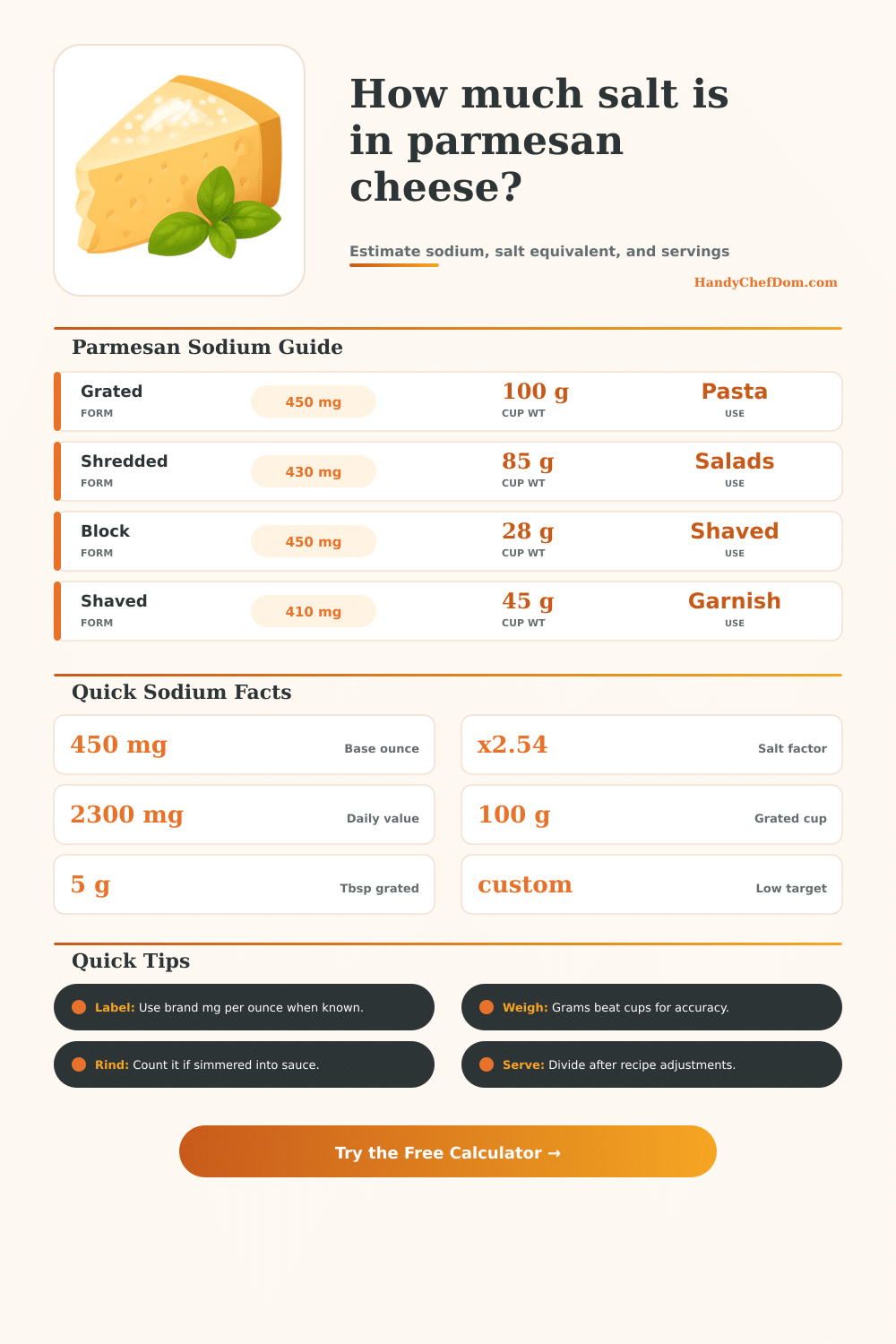
Parmesan often contains about 450 mg sodium per ounce. Use the brand override when your label lists sodium per ounce, and the calculator converts sodium to salt equivalent with sodium x 2.54.
| Parmesan Form | Approx Weight | Default Sodium | Calculator Note |
|---|---|---|---|
| Grated parmesan | 100 g per cup, 5 g per tbsp | 450 mg per oz | Most compact spoon and cup measure. |
| Shredded parmesan | 85 g per cup, 4.5 g per tbsp | 430 mg per oz | Looser than finely grated cheese. |
| Block or wedge parmesan | 28.35 g per ounce | 450 mg per oz | Best measured by scale or package weight. |
| Shaved parmesan | 45 g per cup, 2.5 g per tbsp | 410 mg per oz | Airy garnish with lower cup weight. |
| Cheese | Sodium Per Oz | Salt Equivalent | Relative Saltiness |
|---|---|---|---|
| Parmesan | About 450 mg | About 1.14 g salt | High, strong flavor in small amounts. |
| Pecorino Romano | About 520 mg | About 1.32 g salt | Often saltier than parmesan. |
| Cheddar | About 180 mg | About 0.46 g salt | Moderate compared with hard grating cheese. |
| Mozzarella | About 175 mg | About 0.44 g salt | Milder sodium load per ounce. |
| Feta | About 320 mg | About 0.81 g salt | Brined and noticeably salty. |
| Serving Size | Approx Weight | Parmesan Sodium | Best For |
|---|---|---|---|
| 1 teaspoon grated | 1.7 g | 27 mg | Light bowl garnish. |
| 1 tablespoon grated | 5 g | 79 mg | Pasta finish or salad sprinkle. |
| 2 tablespoons grated | 10 g | 159 mg | Noticeable parmesan flavor. |
| 1/4 cup grated | 25 g | 397 mg | Sauce, risotto, or shared recipe. |
| 1 ounce | 28.35 g | 450 mg | Package label comparison. |
| 1 cup grated | 100 g | 1587 mg | Large batch recipes. |
| Recipe Use | Calculator Factor | Why It Matters | Typical Amount |
|---|---|---|---|
| Garnish or finishing sprinkle | 1.00x | All cheese is usually eaten directly. | 1 tsp to 2 tbsp per serving. |
| Sauce or pasta mixed through | 1.00x | Sodium spreads through the whole recipe. | 1/4 to 1 cup per batch. |
| Baked topping or casserole | 0.98x | Small sticking losses can remain in the pan. | 2 tbsp to 1/2 cup. |
| Salad or dressing | 1.00x | Shreds and shavings stay in the bowl. | 1 to 4 tbsp. |
| Cheese board or snack | 1.00x | Portion weight is the main driver. | 1/2 to 1 oz per person. |
Parmesan cheese contains a significant amount of salts because of the way that the salt becomes concentrated within the cheese throughout the aging process. Many individual select Parmesan cheese due to the strong flavor that it provide in small amounts. However, the salt content of parmesan cheese can increase the sodium content of teh meal.
Therefore, care must be taken to measure the amount of parmesan cheese that is used in a recipe if the individual is following a low-sodium diet. The density of parmesan cheese change based off the way in which the parmesan cheese is prepared. Parmesan cheese that is grated will have a more higher density than parmesan cheese that is shredded.
Parmesan Cheese and Sodium in Recipes
Furthermore, large shavings of parmesan cheese will take up alot of visual space within a measuring spoon, but will weigh very littlely. Thus, large shavings of parmesan cheese will contain less sodium per volume than grated parmesan cheese. The user can select the form of the parmesan cheese within the calculator to allow for accurate estimations of the sodium content of a recipe that use parmesan cheese.
If the user selects the incorrect form of parmesan cheese, the sodium content of the recipe will be change by approximately ten percent. Therefore, it is important to select the correct form of parmesan cheese within the calculator for the sodium content to be accurate. The age of the parmesan cheese can impact the amount of sodium that is contained within the cheese.
Younger wheel of parmesan cheese contain more water than extra-aged parmesan cheese. Thus, a weight of younger parmesan cheese will contain less sodium than the same weight of extra-aged parmesan cheese. Parmesan cheese that is pre-shredded often contains anti-caking agent which can dilute the amount of parmesan cheese that is contained in each serving.
The way in which the parmesan cheese is to be used in a recipe will impact the distribution of the sodium content of the cheese. If the parmesan cheese is to be melted into a sauce, the sodium will be distributed throughout the entire sauce. However, if the person uses the parmesan cheese as a garnish for a dish, the sodium will remain on the top of the food.
The user can select the way in which the parmesan cheese is to be used in the calculator to provide accurate sodium measurements for each recipe. The rind that is left over from the parmesan cheese can also impact the sodium content of a recipe. If the person simmers the rind from the parmesan cheese in a pot of cooking liquid, only some of the sodium will dissolve into the cooking liquid.
However, if the person eats the rind of the parmesan cheese, they will consume the full amount of sodium that is contained in the rind. The calculator allow for the amount of sodium from the rind to be accounted for in both scenario so that the individual dont have to make an assumption as to how the parmesan cheese is to be consumed. The calculator displays the total sodium content of a recipe (per serving) and the percentage of the daily value of sodium that the recipe will provide side-by-side.
These two values allow the individual to understand the amount of sodium that will be provided by the recipe, and how that relates to their daily intake of sodium. The low-sodium target field allow the individual to compare the calculated amount of sodium to a target sodium goal. Thus, this field provides the individual with an understanding of whether or not the recipe will meet their established target for sodium consumption.
Although the weighing of parmesan cheese on a scale is often considered to be accurate, the weight measurements of parmesan cheese can be misleadingly. This is due to the fact that aged parmesan cheese contains more sodium per gram of cheese than younger parmesan cheese. Thus, 25 grams of aged parmesan cheese will contain more sodium than 25 grams of young parmesan cheese.
The override field for sodium content within the calculator allow for the exact amount of sodium from the label of the parmesan cheese to be entered. Thus, by entering the amount of sodium from the label, the individual eliminate the need to estimate the amount of sodium within the parmesan cheese. The reference tables provide information regarding how many gram of parmesan cheese are contained in a certain volume of parmesan cheese.
Additionally, the reference tables provide information regarding how the sodium content of parmesan cheese compares to other type of cheese, such as pecorino cheese or mozzarella cheese. The total amount of parmesan cheese that is to be used in a recipe is the most important factor in determining the total sodium content that will be consumed by those eating the recipe. For instance, if a recipe calls for one cup of parmesan cheese for eight individuals, each individual will consume a small amount of sodium.
However, if the same amount of parmesan cheese is divided among four individuals, each individual will consume a higher amount of sodium. Thus, calculating the amount of sodium that will be present in a recipe prior to beginning to cook the recipe allow the individual to control the amount of sodium that is consumed by those eating the recipe.