☕ Death by Coffee Calculator
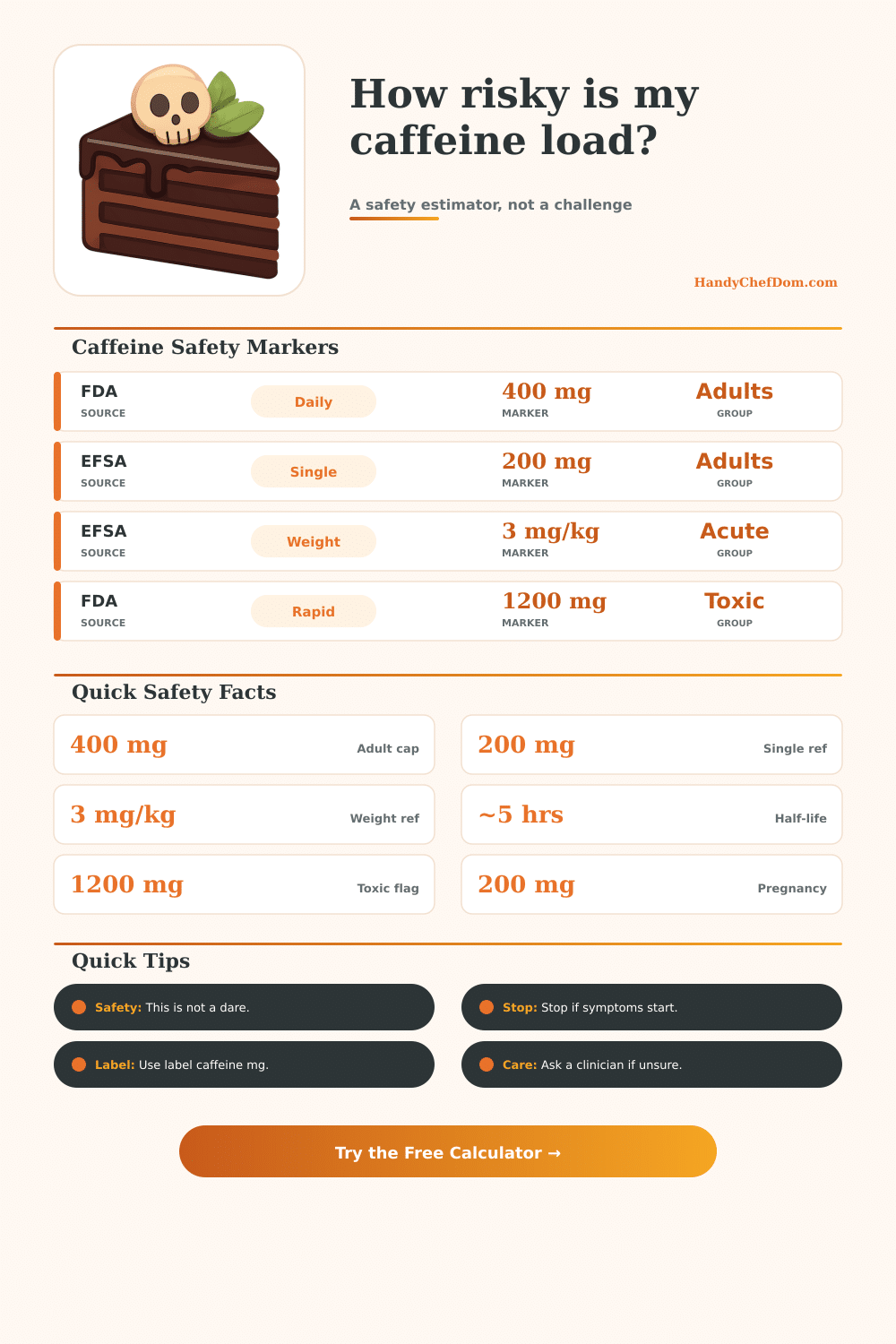
A caffeine safety estimator that compares body weight, cup strength, time window, sensitivity, and half-life. It is educational only and never a challenge to consume more caffeine.
Enter what was actually consumed or planned. The safest result is often a reason to stop, delay, switch to non-caffeinated drinks, or ask a clinician about personal limits.
| Reference point | Marker used | Who it is for | Calculator use |
|---|---|---|---|
| FDA adult daily comparison | 400 mg/day | Many healthy adults | Default daily limit field |
| EFSA single-dose reference | 200 mg or about 3 mg/kg | Healthy adults | Single-sitting flag |
| Pregnancy or lactation lower comparison | 200 mg/day | Use only as a conservative reference | Preset changes daily limit |
| FDA rapid-toxicity warning | Around 1200 mg rapidly | Not a target; danger flag | Shown in breakdown |
| Concentrated caffeine warning | Avoid powders or concentrates | Anyone using non-beverage caffeine | Not supported as a safe input |
| Adjusted load band | Approx marker | Result language | Safety action |
|---|---|---|---|
| Log range | Under 1.5 mg/kg | Lower entered load | Track total day and sleep timing |
| Review range | 1.5 to 3 mg/kg | Near common acute reference | Pause before adding more caffeine |
| Caution range | 3 to 6 mg/kg | Above conservative acute reference | Stop intake and monitor symptoms |
| High-alert range | Over 6 mg/kg | Personal acute alert marker reached | Do not add caffeine; seek advice if unwell |
| Emergency concern | Severe symptoms at any dose | Symptoms matter more than math | Seek urgent medical help |
| Half-life setting | After 5 hours | After 10 hours | What it means |
|---|---|---|---|
| 3 hours | About 31% remains | About 10% remains | Faster clearance estimate |
| 5 hours | About 50% remains | About 25% remains | Common adult estimate |
| 7 hours | About 61% remains | About 37% remains | Slower evening clearance |
| 9 hours | About 68% remains | About 46% remains | Very slow estimate |
| 12 hours | About 75% remains | About 56% remains | Extra cautious setting |
| Source | Typical serving | Approx caffeine | Tracking note |
|---|---|---|---|
| Brewed coffee | 8 oz | 95 mg | Use actual cafe label if known |
| Espresso | 1 oz shot | 63 mg | Count each shot separately |
| Large latte | 12 oz | 126 mg | Usually two espresso shots |
| Cold brew | 12 oz | 200 mg | Often stronger than drip coffee |
| Black tea | 8 oz | 47 mg | Steeping strength changes amount |
| Green tea | 8 oz | 28 mg | Lower but not caffeine-free |
| Energy drink | 16 oz | 160 mg | Check total caffeine from all sources |
| Decaf coffee | 8 oz | 7 mg | Helpful for late-day swaps |
Reference basis: FDA consumer caffeine guidance and EFSA caffeine safety opinion. This page summarizes public reference points for education only and cannot account for personal medical risk.
Caffeine take a long period of time to leave the body, and the caffeine from the drink do not dissapears from the body after the person finishes consuming the drink that contains caffeine. The body does, however, naturaly and gradually eliminate the caffeine from the system according to a decay curve, the parameters of which can differ from person to person. Some individuals naturally has a higher rate of eliminating caffeine from the body than others.
A calculator that estimate the amount of caffeine still in the body after consumption can help the individual to understand how much caffeine is still active within their system after several hours of consume the caffeinated drink. One of the variables that can be adjusted on the calculator is the half life of the caffeine in the system. The half-life of caffeine is the length of time required for the amount of caffeine within the body to reduce by half, and each individual have a different half-life for caffeine.
How to Track Caffeine in Your Body
By adjusting for an individual’s half-life for caffeine, the calculator can more accurately calculate the amount of caffeine that remains within the system. The amount of caffeine within the system can help an individual to understand whether or not they should consume additional caffeine-containing drink. The body weight of the individual can factor into the calculation of how much caffeine an individual consumes.
An individual often calculate the amount of caffeine that an individual consume in relation to the body mass of that individual. Therefore, an individual’s caffeine intake in milligrams may seem low, but if that amount is divided by the individual’s total body mass, that amount can have a much different impact on that individual. The calculator ask for the body weight of the individual in either pound or kilogram.
Additionally, the calculator use a sensitivity factor for caffeine for each individual because some individuals are more sensitive to the effects of caffeine than other individuals. An individual who is very sensitive to caffeine can adjust that setting on the calculator to reflect the sensitivity to caffeine of that individual. The time during which the caffeine is consumed is another factor in how the caffeine affect the individual’s body.
The rate at which an individual consumes caffeine can impact the effect that the caffeine has upon the body. For instance, if an individual consume a large amount of caffeine over a short time period, the caffeine will reach high level within the body. However, if the same amount of caffeine is consumed over a long time period, the levels of caffeine within the body will increase at a slower rate.
The time period during which the caffeine is consumed is a critical variable in the calculations of the caffeine’s effects on the body, as an amount of caffeine consumed slowly can have different effect upon an individual than rapidly-consumed amounts of caffeine. Health organization publish various limits to the amount of caffeine that an individual should consume each day. These limits are suggested limits for healthy adults, and they are not strict rule to be followed by those adults.
These limits can, however, help to an individual to understand their caffeine consumption in relation to health guidelines. An individual’s own limit for caffeine consumption can be programmed into the caffeine calculator, as there are different limits for caffeine consumption in different situation. For instance, individuals who is pregnant or who take certain medications may have limits to caffeine consumption that are lower than the limits for the general population.
The caffeine calculator provide an individual with the percentage of their limit that they have consumed in that day. The caffeine calculator can determine the estimated amount of caffeine that remain in the body beyond the amount consumed. The amount of caffeine that remains within the body will never fall to zero immediately after the individual consume the caffeine-containing product.
The body will eliminate the fraction of the consumed caffeine that remains within the body over time according to the half-life of the body. The caffeine calculator provides estimates of the amount of caffeine that will remain within the body after six hour of consumption. This amount of caffeine can help the individual to understand if the consumption of additional caffeinated drink will lead to excessive amount of caffeine within the system.
Although various factor can impact the effects of caffeine upon the body, they cannot be accounted for in the caffeine calculator. Factors like stress, sleep debt, and dehydration can all impact the effect of caffeine on an individual’s body. Additionally, if an individual feel symptoms like chest discomfort, heart palpitations, or panic attack, they should stop consuming caffeine and seek medical advice.
Although the caffeine calculator allow individuals to track their consumption of caffeine, it isnt a replacement for heeding the physical signal of their bodies. An individual can use the calculator over several day to recognize their bodys response to various amount of caffeine. An individual may discover that certain drink or amounts of caffeine lead to certain effect upon their body.
For instance, an individual may find that drinking tea is more beneficial to the body than drinking coffee. Additionally, because only one variable may be altered at a time with the caffeine calculator, the individual can observe each effect that each variable have upon the total amount of caffeine within the system of that individual. Through these step and observations, an individual can recognize what amount of caffeine best suit their body.