💧 Hydration Test Calculator
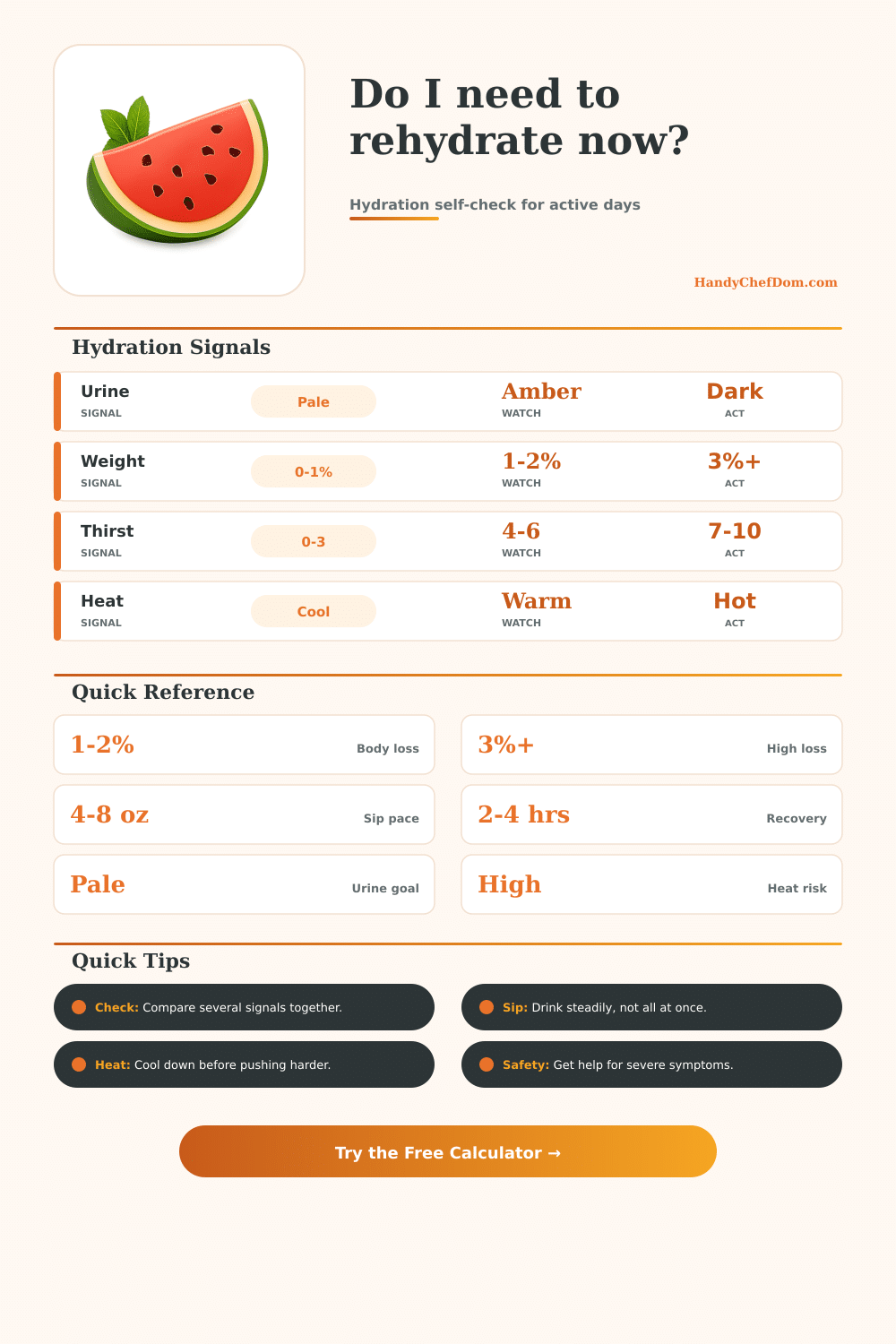
Compare urine color, body weight change, thirst, headache, training load, heat exposure, and fluid intake for a practical hydration self-check.
Use recent, honest observations. Body weight change is most useful when measured before and after the same workout or hot shift with similar clothing.
| Urine color | Common meaning | Self-check action | Caution |
|---|---|---|---|
| 1 - Very pale | High fluid intake or recent clear drinks | Keep normal sipping | Do not force extra water |
| 2 - Pale yellow | Often well hydrated | Maintain steady intake | Compare with thirst |
| 3 - Clear yellow | Generally acceptable | Drink with meals or breaks | Recheck after activity |
| 4 - Warm yellow | Watch zone | Add water gradually | Heat can raise need |
| 5 - Amber yellow | Possible fluid deficit | Sip and cool down | Check weight change |
| 6 - Honey amber | Likely under-recovered | Use fluids plus electrolytes | Pause hard effort |
| 7 - Dark tea | High concern signal | Rest, rehydrate, monitor | Seek advice if persistent |
| 8 - Brownish dark | Not a normal training target | Stop and get help if unwell | Medical review may be needed |
| Body weight change | Hydration signal | Typical response | Notes |
|---|---|---|---|
| Gain over 1% | Possible over-drinking | Pause forced fluids | Consider electrolytes and symptoms |
| 0 to 1% loss | Usually manageable | Drink to thirst | Recheck urine and energy |
| 1 to 2% loss | Watch zone | Plan recovery fluids | Performance may feel lower |
| 2 to 3% loss | Likely dehydration stress | Slow effort and rehydrate | Add sodium if sweating hard |
| Over 3% loss | High concern after effort | Stop hard work and recover | Seek care if symptoms are strong |
| Activity load | Baseline fluid pace | When to increase | Practical cue |
|---|---|---|---|
| Rest or desk pace | 4-8 fl oz per hour | Dry mouth or dark urine | Small glass with breaks |
| Light movement | 8-14 fl oz per hour | Warm room or long shift | Drink between tasks |
| Moderate effort | 14-22 fl oz per hour | Steady sweat | Bring a marked bottle |
| Hard sweating | 22-30 fl oz per hour | Clothes wet or salty skin | Add electrolytes |
| Race or peak service | 26-34 fl oz per hour | Heat, humidity, long duration | Schedule cooling breaks |
| Heat exposure | Risk effect | Fluid strategy | Cooling strategy |
|---|---|---|---|
| Cool room | Lower sweat loss | Drink to thirst | Normal breaks |
| Warm room | Moderate sweat loss | Keep bottle visible | Ventilation helps |
| Hot kitchen or sun | High sweat loss | Use electrolytes if long | Shade or cooler area |
| Extreme heat | Heat illness concern | Do not chase with water only | Stop, cool, and monitor |
| Humid heat | Sweat cools poorly | Plan earlier drinking | Lower intensity |
Reference values are practical planning ranges, not personalized medical targets. Medications, kidney or heart conditions, illness, alcohol, caffeine, altitude, and pregnancy can change hydration needs.
A hydration test calculator is a tool that you can use to determine how much fluid has left your body. Use a hydration test calculator if you would like to know if you have lost too much fluid as a result of working for long period or performing physical activities. To operate a hydration test calculator, provide the tool with data regarding your body, such as your change in body weight, the color of your urine, your level of thirst, and the temperature of an environment in which you are performing the activities.
Your body weight will decrease as a result of your body lose fluid to activities like exercising. To calculate your fluid loss using a hydration test calculator, you will need to determine your body weight before and after you perform your activities. The tool will take your current body weight and subtract your starting body weight to calculate the total weight that you have lost as a result of your activities.
How to Use a Hydration Test Calculator
Losing one percent of your body weight is a small amount of fluid loss, but it can still have an impact on your body; it can increase your heart rate and slow your reaction times. Losing two percent of your body weight indicates that you have lost a significant amount of fluid. Losing three percent of your body weight or more indicate that you have lost an amount of fluid that can be dangerous to your body.
Your body must be weighed under the same conditions each time that you utilize the hydration test calculator to ensure that your weight measurement is accurate. The color of your urine will change according to the amount of fluid that is in your body. If you have plenty of fluid in your body, your urine will be light in color.
If you do not have enough fluid in your body, your urine will be dark in color, possibly even to the color of honey. Another element that the hydration test calculator can consider is how often you use the restroom. If you go to the restroom less often, you are losing less fluid through your urine.
Small volume of urine can indicate that you are losing fluid because you are dehydrated. However, drink too much water, and your urine will be light in color, even if you dont have enough fluid in your body for your electrolytes to function proper in your body. Thirst and headaches are two symptoms that may indicate that your body is losing fluid rapid.
However, thirst and headaches do not occur at the same time. Thirst will develop quickly if the volume of plasma in your body decrease. However, if you experience headaches, these can take an hour or more to develop.
On a scale of zero to ten, the hydration test calculator will rate the level of thirst that you experience and the headaches that you develop. Use these two ratings to understand your hydration status. High level of thirst and weight loss indicate that dehydration is urgent.
High levels of thirst, but no loss of body weight, can indicate a different issue. The environmental heat and the amount of fluid that you sweat while performing an activity will change how much fluid that your body uses. The higher the environmental temperature, the more fluid that will be lost through sweating.
This value can be entered into the hydration test calculator, which will estimate the amount of fluid that your body use while performing the activities. Compare that number to the amount of fluid that you drank while performing those activities. The hydration test calculator will provide you with a number that indicates how much fluid that you need to consume to recover from your dehydration.
Do not drink all of the fluid that the hydration test calculator calculates at once. Instead, consume the amount of fluid gradualy over a period of time. Other external factor will influence the fluid that your body utilizes.
Fluid lost through caffeine and salty food will reduce the amount of fluid that you feel thirst for. Additionally, humidity will alter how much fluid evaporates from your body through sweating. Since the hydration test calculator cannot measure the amount of caffeine or salt that you consume, the hydration test calculator will provide an estimate of the amount of fluid that you need to consume to rehydrate your body.
Additionally, the amount of time that you have to recover from dehydration will change the amount of fluid that you consume. If you have a short period of time before you can perform another task, you should take small sips of fluid and eat salty snacks to replace the fluid and electrolytes that you lost while performing your tasks. If you have time to rest and recover from dehydration, such as during sleep, you can drink more fluid to rehydrate.
To get an accurate reading of your hydration status, you should check each of these indicators at the same time. Only using body weight to determine your dehydration can be affected by the food that you eat. Using only urine color to determine your hydration can be impacted by the food that you consume, such as coffee.
Using only thirst to monitor your dehydration can be affected by the environment in which you perform your tasks. By using the hydration test calculator, you can view all of these indicators at once to ensure that you do not miss any signal that your body sends to indicate that you are losing too much fluid. The goal in using this hydration test calculator is to ensure that you notice when your body has lost too much fluid so that you can provide your body time to replace that fluid.