🥚 Carbs in Eggs Calculator
Estimate total carbs, fiber-adjusted net carbs, and carbs per serving for whole eggs, whites, yolks, low carb add-ins, and cooking fat.
Choose the egg size, exact mix of whole eggs, whites, and yolks, then add low carb extras and a per-serving net carb target.
| Egg size | Weight | Net carbs | Calories | Protein | Fat |
|---|---|---|---|---|---|
| Small chicken egg | 38 g | 0.30 g | 54 | 4.8 g | 3.6 g |
| Medium chicken egg | 44 g | 0.34 g | 63 | 5.5 g | 4.2 g |
| Large chicken egg | 50 g | 0.36 g | 72 | 6.3 g | 4.8 g |
| Extra-large chicken egg | 56 g | 0.40 g | 80 | 7.0 g | 5.3 g |
| Jumbo chicken egg | 63 g | 0.45 g | 90 | 7.9 g | 6.0 g |
| Egg part | Large portion | Total carbs | Net carbs | Protein | Best carb use |
|---|---|---|---|---|---|
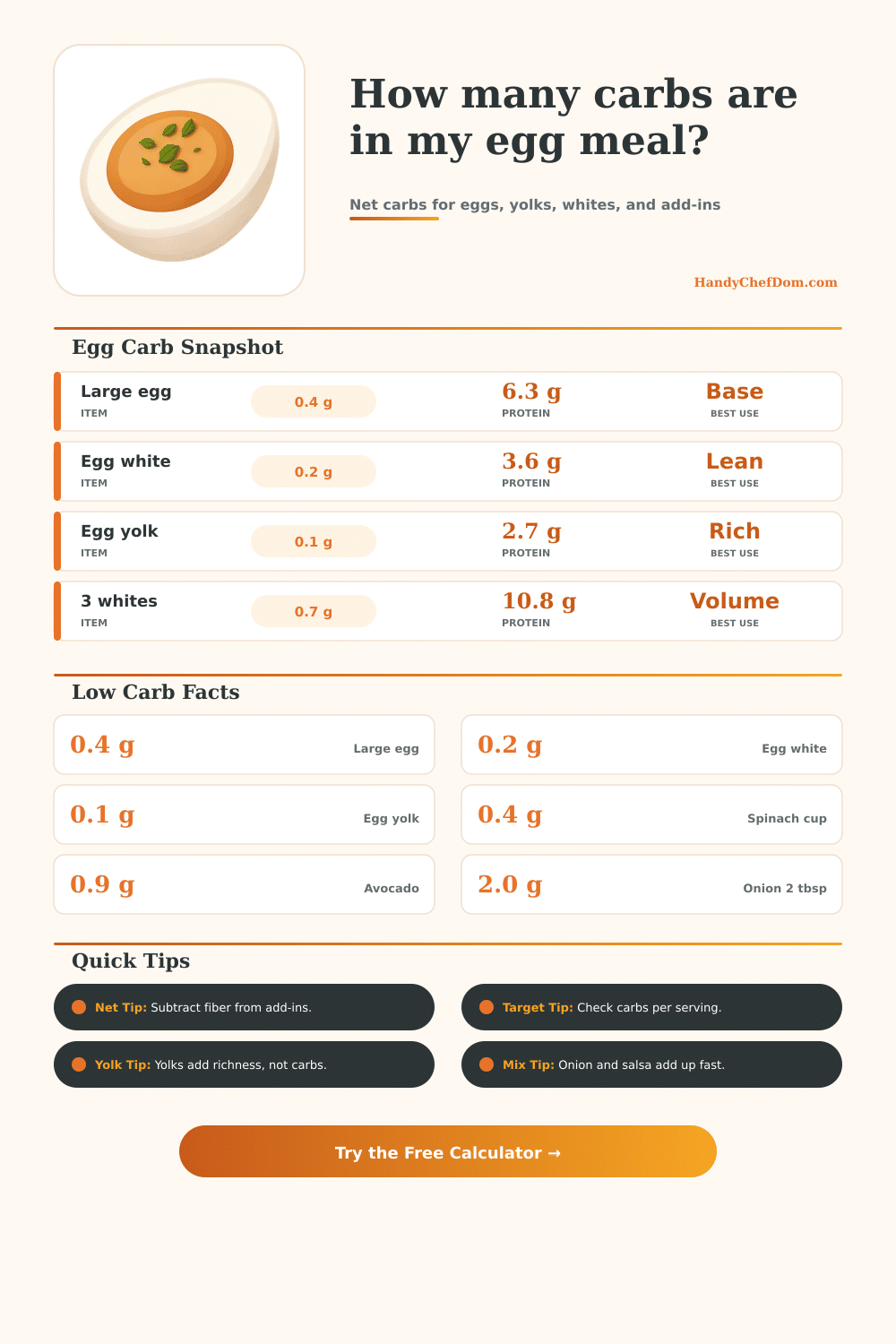
| Whole egg | 1 egg | 0.36 g | 0.36 g | 6.3 g | Balanced base |
| Egg white | 1 white | 0.24 g | 0.24 g | 3.6 g | Lean volume |
| Egg yolk | 1 yolk | 0.12 g | 0.12 g | 2.7 g | Richness |
| Two whole eggs | 100 g | 0.72 g | 0.72 g | 12.6 g | Breakfast plate |
| Three whites | 99 g | 0.72 g | 0.72 g | 10.8 g | Low fat bowl |
| Add-in portion | Total carbs | Fiber | Net carbs | Calories | Carb note |
|---|---|---|---|---|---|
| Raw spinach, 1 cup | 1.1 g | 0.7 g | 0.4 g | 7 | Very low net |
| Mushrooms, 1/2 cup | 1.1 g | 0.4 g | 0.7 g | 8 | Low carb bulk |
| Cheddar, 1/4 cup | 0.4 g | 0.0 g | 0.4 g | 110 | Low carb, dense |
| Avocado, 50 g | 4.3 g | 3.4 g | 0.9 g | 80 | Fiber offset |
| Tomato, 1/4 cup | 1.8 g | 0.5 g | 1.3 g | 8 | Moderate |
| Onion, 2 tbsp | 2.4 g | 0.4 g | 2.0 g | 12 | Measure closely |
| Bell pepper, 1/4 cup | 2.3 g | 0.8 g | 1.5 g | 12 | Colorful bump |
| Salsa, 2 tbsp | 2.0 g | 0.5 g | 1.5 g | 10 | Spoon count matters |
| Meal type | Typical net target | Egg-friendly mix | Add-in caution | Serving move |
|---|---|---|---|---|
| Breakfast | 6 g | 2 eggs with greens | Salsa and onion | Keep one plate |
| Brunch | 8 g | Omelet with avocado | Tomato portions | Split rich sides |
| Lunch | 10 g | Egg bowl with cheese | Double vegetables | Use two servings |
| Dinner | 12 g | Skillet eggs | Carby sauces | Spread add-ins |
| Snack | 4 g | Boiled eggs | Dips with sugar | Keep extras tiny |
| Meal prep | 7 g | Egg cups | Onion in batches | Divide evenly |
Eggs is a central food in a low-carb eating program because eggs provide protein and fats to the diet, and because eggs dont contain much sugar. Foods like toast, cereal, and fruit contain more sugar then eggs contains. However, adding various ingredient to the eggs will alter the total amount of sugar and carbohydrates that are contained in that dish.
These additions can make it difficult for an individual to maintain track of there nutritional targets. The calculator described in this article helps to avoid this problem by performing the mathematical calculation necessary to determine the nutritional content of the eggs based off the exact amount of the various ingredients that are added to the eggs. Thus, the calculator helps an individual to understand the exact nutritional content of the eggs that they prepares.
How to Calculate Carbs in Eggs
Before using the calculator to determine the nutritional content of the eggs, it is important for an individual to consider the portion of eggs that will be used. One large whole egg contains a small amount of carbohydrate. However, egg whites and egg yolks contains different amount of carbohydrates than do whole eggs.
Eggs yolks contain fat and a small amount of carbohydrates, but the egg whites contain no fat and very little carbohydrate content. Considering these difference allows an individual to prepare their eggs in a way that maximizes either the amount of volume of eggs that is cooked, or the protein content of the eggs without increase the carbohydrate intake. Additionally, various other ingredients that may be prepared with the eggs will alter the carbohydrate content of the eggs.
Spinach and mushrooms contains very little carbohydrate content. However, onions and salsa contain a higher carbohydrate content than most individuals would expect. Finally, avocado contains carbohydrates, but its high fiber content will alter the net carbohydrate count that is contained within the portion of avocado that is added to the eggs.
Each of these ingredient can be adjusted in the calculator to determine if an additional portion of an ingredient like salsa will fit within the carbohydrate target that is set for the individual, or if a different ingredient should be selected. The way that the eggs are prepared can also alter their carbohydrate and calorie count. For instance, using fat to cook the eggs will not add any carbohydrates to the eggs, but will alter the calorie count of those eggs.
Additionally, the amount of cooking fat that can be used will alter the amount of other ingredients that can be cooked in the same fat. For instance, scrambled eggs will contain more fat than fried eggs, and egg cups that are baked will allow for the even distribution of the ingredients to many servings of the eggs. The field for entering the number of servings in the calculator account for this even distribution of the ingredients, so that the nutritional content of the ingredients isnt double-counted.
Many individuals makes mistakes when cooking with eggs. For instance, an individual may pay careful attention to the amount of eggs that are cooked, but may not consider how the addition of ingredients like onions will increase the carbohydrate content of those eggs. Similarly, individuals may pay careful attention to the net carbohydrate content of their egg dish, but may not consider the total carbohydrate content that their recipes contain.
The calculator allows an individual to account for both the net and total carbohydrate counts of their eggs. The calculator also includes options for rounding the carbohydrate counts that are calculated for each type of recipe. For instance, an individual that prepares meals may wish to see the exact amounts of carbohydrates in their eggs, to allow for adjustments to the other meals that the individual prepares throughout the day.
Alternatively, another individual may prefer to see the carbohydrate counts rounded to whole gram, which may be easier for the individual to remember when logging their meals for the day. Thus, both rounding options are equally valid, as long as they are consistently applied to the tracking of all food that are eaten throughout the day. Individuals need to learn which ingredients will alter the nutritional count of the eggs, and which ingredients can be added freely to the eggs.
Once they understand these alterations to the nutritional content of the eggs, the calculator may be used as a quick calculating tool for the nutritional content of those eggs. Thus, the calculator helps to ensure that an individual’s eggs contain the carbohydrate and fat content that is required to align with their eating goals.