🧂 Cure per Pound of Meat Calculator
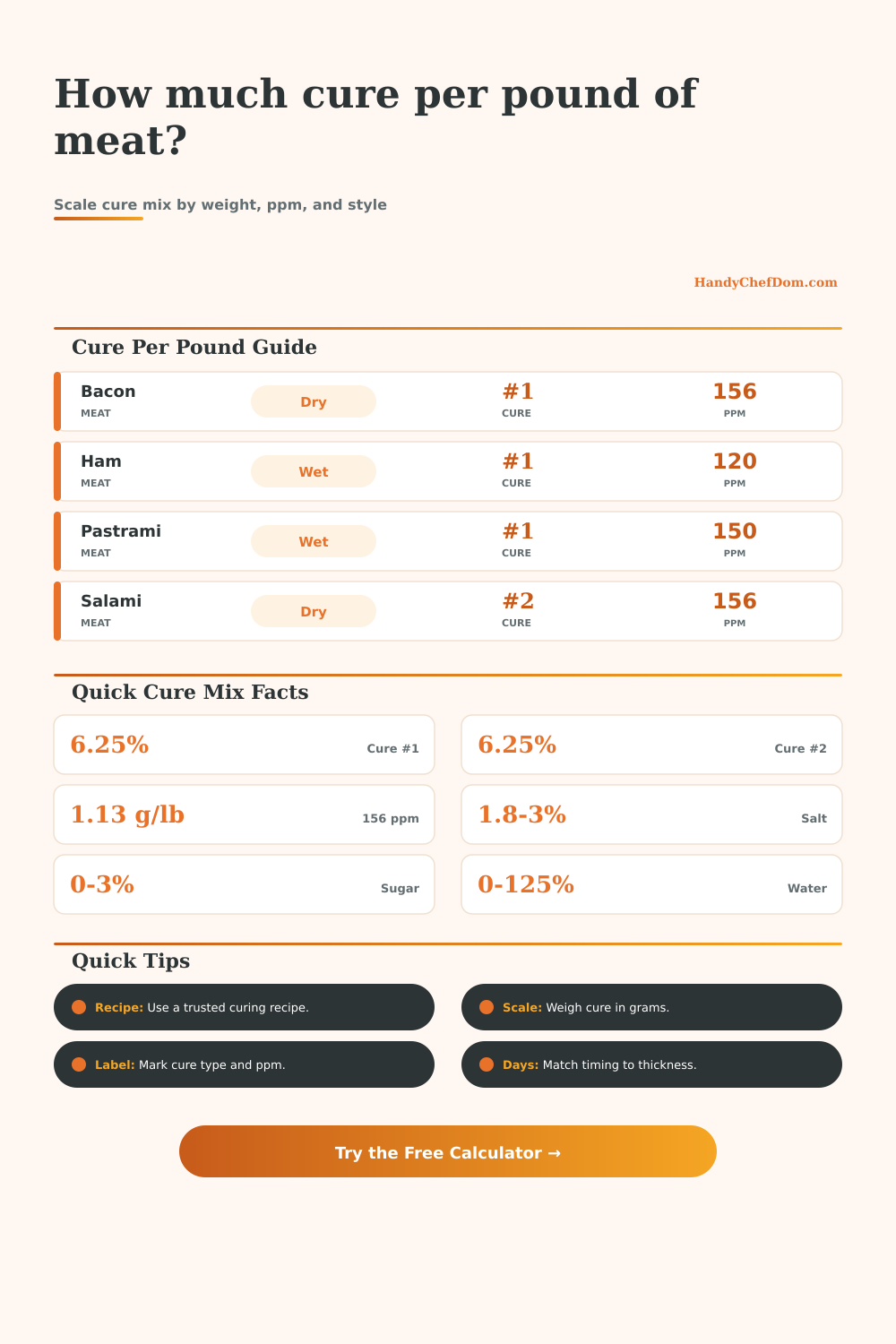
Scale a complete cure mix by meat weight, cure style, nitrite cure type, kosher salt percent, sugar percent, brine percent, target ppm, thickness, and curing days.
Use trimmed meat weight as the basis. Dry cures use meat weight only. Wet cures add the water or brine percentage so the mix sheet can show brine weight and estimated brine strength.
| Target PPM | Cure #1 Per lb | Cure #1 Per kg | Typical Use |
|---|---|---|---|
| 100 ppm | 0.73 g | 1.60 g | Only when a trusted recipe calls for it |
| 120 ppm | 0.87 g | 1.92 g | Some lean meat or wet cure formulas |
| 140 ppm | 1.02 g | 2.24 g | Moderate target in some equilibrium cures |
| 150 ppm | 1.09 g | 2.40 g | Corned beef or pastrami recipe target |
| 156 ppm | 1.13 g | 2.50 g | Common Cure #1 or #2 calculation point |
| 200 ppm | 1.45 g | 3.20 g | Recheck recipe limits before using |
| Cure Style | Water or Brine % | Salt Range | Timing Note |
|---|---|---|---|
| Dry rub cure | 0% | 2.0% to 3.0% | Mix is rubbed directly on the meat surface |
| Equilibrium bag cure | 0% to 10% | 2.0% to 2.8% | Sealed bag holds the calculated mix with the meat |
| Wet cover brine | 75% to 125% | 1.8% to 3.0% | Water weight is shown for brine strength context |
| Pump plus cover | 80% to 150% | 1.8% to 2.8% | Use only with a recipe written for pumping |
| Ground sausage | 0% to 5% | 1.5% to 2.2% | Short rest; mix cure evenly through the grind |
| Long dry cure | 0% | 2.5% to 3.2% | Cure #2 appears only in long dry-cure recipes |
| Meat Thickness | Dry Cure Check | Wet Cure Check | Planning Note |
|---|---|---|---|
| 1/2 inch / 1.3 cm | 1 to 2 days | 1 to 2 days | Thin strips or jerky cure quickly |
| 1 inch / 2.5 cm | 3 to 4 days | 2 to 4 days | Turn or redistribute as recipe directs |
| 2 inch / 5 cm | 6 to 8 days | 5 to 7 days | Common slab and loin planning range |
| 3 inch / 7.6 cm | 9 to 12 days | 7 to 10 days | Check that the recipe fits the cut shape |
| 4 inch / 10 cm | 12 to 16 days | 10 to 14 days | Large roasts often need tested brine directions |
| 5 inch+ / 13 cm+ | Recipe only | Recipe only | Do not extrapolate without a trusted process |
| Conversion | Imperial | Metric | Use In This Calculator |
|---|---|---|---|
| Meat weight | 1 lb | 453.6 g | Main cure mix basis |
| Cure #1 at 156 ppm | 1.13 g/lb | 2.50 g/kg | Common 6.25% nitrite result |
| Kosher salt at 2.5% | 11.34 g/lb | 25.00 g/kg | Total salt target before cure subtraction |
| Sugar at 1.0% | 4.54 g/lb | 10.00 g/kg | Sweetness and browning input |
| Water at 100% | 1 lb water/lb meat | 1 L/kg | Wet brine planning shortcut |
| Approx cure volume | 1 tsp | About 5.6 g | Estimate only; weigh grams instead |
It’s measured in grams, not guesses, grams being the difference between vibrant pink slices of bacon and those which turn as pale as wet cardboard. To be sure: curing your own meats is one of cooking’s most patience-challenged chemistry experiments. The margin for error are slim.
By adding sodium nitrite to your muscle tissue you’re managing an ongoing biological process, one that prevents bacteria from forming and stabilizes color over time. Works like a charm… But only if you get the concentration just right. Not enough and you have spoiled goods on your hands. Too much and you’ve created a chemical nightmare that tastes sharply metallic in back of your throat.
How to Use the Curing Calculator
This is what the calculator is for: nobody should of guess a pinch of curing salt into a five pound slab of pork belly without it. To get it all going, simply input your desired meat type and weight (the calculator will handle the rest), and it spit out a number for you to weigh onto the meat itself: no guesswork about conversions and factors required.
That number is the amount of nitrite you aim to have in your meat, expressed as parts per million (PPM). PPM is an abstract way to talk about a concentration of something, but once you understand what those numbers translate into, you’ll be confident using them for curing. Typically, for the home curer who’s making ham or bacon, this number lands somewhere near 156 ppm.
Then the tool kicks back to that number, taking into account your curing salt blend’s strength, to calculate precisely how much liquid or powdered cure to apply to hit your mark. Dry cures are what most folks begin with, these seem more under their control, more tactile. Here, you mix the curing salt with kosher salt and sugar, rub it on the meat, and then wait…letting nature handle all the hard work.
In this case, the tool only looks at weight of the raw meat. A bit of a nuance here: Curing salts has salt in them. That’s why if a recipe calls for three percent of total salt by weight but your curing salt is only twenty percent salt, you’ll want to subtract the salt in the curing salt from the amount of plain kosher salt you measure. Do this to make sure you’re not creating something disgustingly salty. The tool does this subtraction for you so you don’t have to worry about it. It matters. A little bit.
Water weight is another variable that comes into play with wet brines. Because we’re immersing meat in brine, the cure will diffuse at a different rate then it does if you use a dry rub. To help estimate how much liquid volume of brine you’ll need to cover your meat, you can enter a percentage of water into the calculator. It’s critical to know the right amount of solution so that you have the proper strength brine. Use too little water and some may over-cure on the bottom before others are done on the top. Use too much water without adjusting your cure, and the concentration will drop and your meat won’t cure correctly.
The page has a reference table that explains how various curing styles (such as wet cover brines vs. Various curing styles, such as wet cover brines versus equilibrium bag curing, use different water ratios but still produce the same outcome. The other thing to remember about curing time is that thickness matter. A few days will cure a very thin slice of jerky. A thick pork loin can take weeks to cure.
The calculator also has a “timecheck” feature that factors in how thick your meat is. It should remind you that diffusion is a slow physical process and can’t be hurried along by simply using more cure. In fact, trying to use more cure to hurry the process along is dangerous. Temperature and the density of your meat have huge impacts. Remember: these are timing estimates, which serve as guides but aren’t guarantees. Trust a proven recipe if you’re working with a particular cut.
Moddern favorites include using what’s called Equilibrium curing, where salt moves into meat and cure moves out until equilibrium is reached, and the process is often performed in closed bags. To use this technique, simply enter your meat weight and leave the water at zero, just focus on the meat only for the math. It will take time, but can be very forgiving as well. Just add the calculated amount of mix to the meat in a bag, shake it every so often, and wait. Your final product will likely have less salt and a more tender texture than traditional heavy brines.
You have a few more decisions to make, such as whether to use cure one or cure two. Cure one is used in short term items (ham, bacon). Cure two has nitrates which are needed in long term aged sausages such as salami. You can change the formula on the calculator from one to the other and it adjusts the math accordingly. Don’t ever replace one with the other without knowing what that means in terms of safety and time.
At the end of the day, curing is all about science and about respecting those ingredients. Do not skip weighing things. No. Absolutely. Not. Get yourself a digital scale capable of weighing down to at least 1/10th of a gram. It’s up to you to take care of it; it spits out numbers for you. You take care of the ratios and when you do, the reward is a flavor-packed, visually perfect, and above all else, SAFE slice of meat. A little bit of math in the kitchen realy does go a long way.