🥚 Protein in Egg White Calculator
Estimate egg white protein from shell count, carton volume, cooked weight, servings, recipe loss, and sodium level.
Choose whether you are counting separated whites, pouring liquid egg whites, or weighing cooked whites. The calculator converts everything to raw white weight, applies cooking yield and recipe loss, and checks protein against your serving goal.
| Egg white source | Raw weight | Protein | Calories | Sodium |
|---|---|---|---|---|
| Medium shell white | 29 g / 1.02 oz | 3.2 g | 15 kcal | 48 mg |
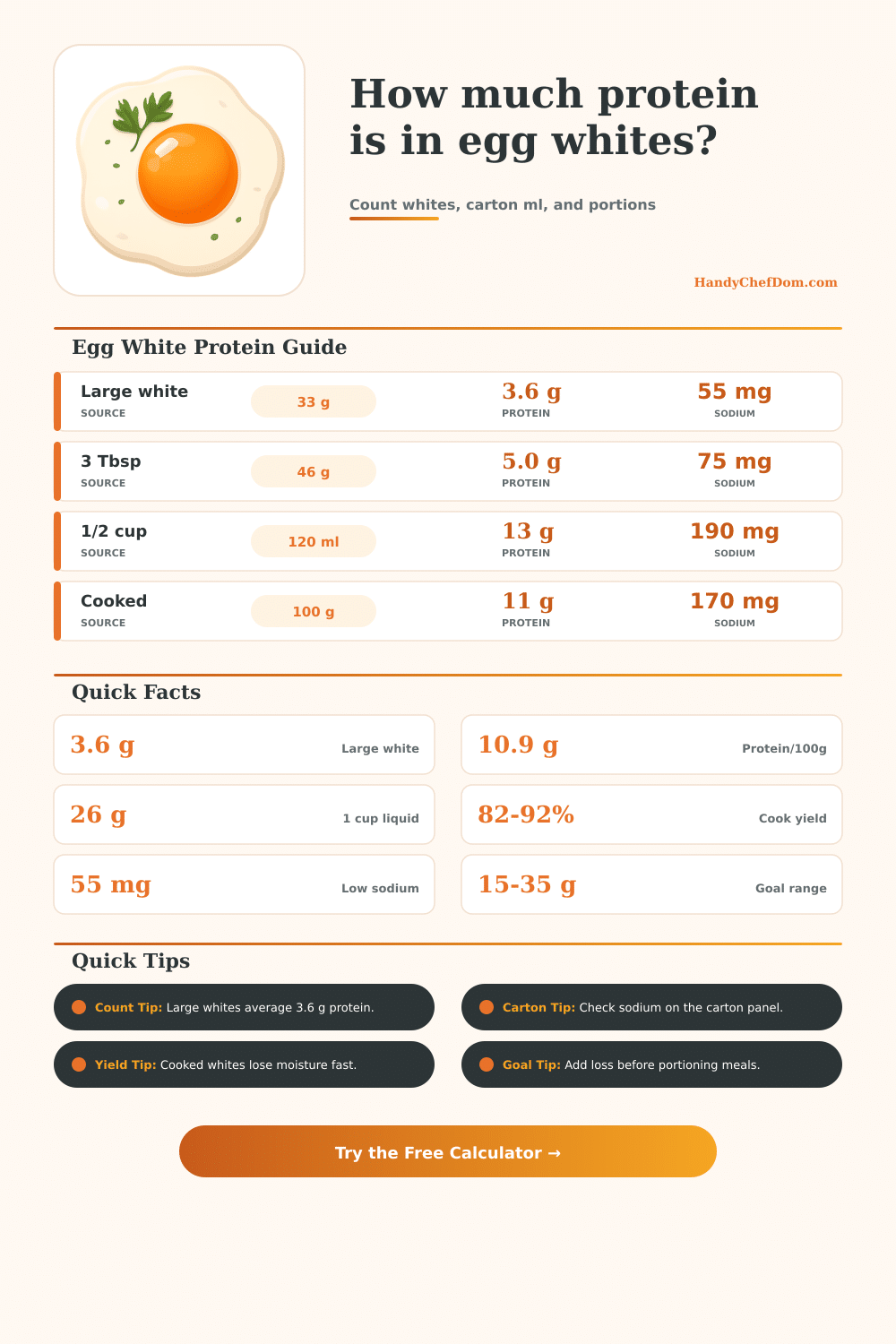
| Large shell white | 33 g / 1.16 oz | 3.6 g | 17 kcal | 55 mg |
| Extra-large shell white | 37 g / 1.31 oz | 4.0 g | 19 kcal | 61 mg |
| Jumbo shell white | 42 g / 1.48 oz | 4.5 g | 22 kcal | 70 mg |
| Plain carton whites | 46 g / 3 Tbsp | 5.0 g | 25 kcal | 75 mg |
| Salted carton whites | 46 g / 3 Tbsp | 5.0 g | 25 kcal | 115 mg |
| Rehydrated powdered whites | 43 g serving | 4.7 g | 23 kcal | 78 mg |
| Foodservice liquid whites | 46 g / 3 Tbsp | 5.0 g | 25 kcal | 90 mg |
| Liquid white measure | Approx grams | Large white equivalent | Protein | Sodium range |
|---|---|---|---|---|
| 1 tablespoon | 15 g | 0.45 white | 1.6 g | 25-38 mg |
| 3 tablespoons | 46 g | 1.4 whites | 5.0 g | 75-115 mg |
| 1/4 cup | 60 g | 1.8 whites | 6.5 g | 98-150 mg |
| 1/3 cup | 80 g | 2.4 whites | 8.7 g | 130-200 mg |
| 1/2 cup | 120 g | 3.6 whites | 13.1 g | 196-300 mg |
| 1 cup | 240 g | 7.3 whites | 26.2 g | 392-600 mg |
| Raw or cooked basis | Protein retention | Weight yield | Planning use | Calculator treatment |
|---|---|---|---|---|
| Raw liquid white basis | 100% | 100% | Cartons and separated whites | No cooked moisture reduction |
| Soft-set cooked whites | 99% | 92% | Gentle scrambles and bowls | Small moisture and pan loss |
| Firm scrambled whites | 98% | 86% | Meal prep pans | More evaporation and sticking |
| Baked egg white cups | 97% | 82% | Muffin cups and casseroles | Highest moisture loss |
| Folded white omelet | 99% | 88% | Wraps and plates | Moderate fold and pan loss |
| Serving goal | Large whites before loss | Liquid whites | Cooked yield note | Sodium note |
|---|---|---|---|---|
| 10 g protein | 3 whites | about 1/3 cup | Light snack portion | 165 mg shell estimate |
| 15 g protein | 5 whites | about 1/2 cup | Lean breakfast base | 275 mg shell estimate |
| 20 g protein | 6 whites | about 3/4 cup | Common meal prep target | 330 mg shell estimate |
| 25 g protein | 7 whites | about 1 cup | Large entree base | 385 mg shell estimate |
| 30 g protein | 9 whites | about 1 1/4 cup | Athlete-style serving | 495 mg shell estimate |
| 35 g protein | 10 whites | about 1 1/3 cup | Very high white-only meal | 550 mg shell estimate |
Values use common USDA-style egg white averages and typical carton serving labels. Exact cartons vary, so use the product panel when precision matters.
Egg whites contains protein, but no fat like the yolks of the eggs do. For those looking to incorporate protein into there diet but limit the fat they consume, egg whites are a beneficial food item to include in their diets. For those looking to incorporate egg whites into their diets with specific protein goals, it is essential for those individuals to determine the amount of protein that is contain within egg whites.
By entering specific data regarding the egg whites that an individual will consume, the calculator can provide an estimate of the protein that will be consumed. The method in which the person measure the egg whites will affect the calculation of the protein content of the egg whites. If the egg whites that are to be consumed are those that have been separated from the shells, each large egg white contains approximately 33 gram of egg white.
How Much Protein Is in Egg Whites
If the egg whites that are to be consumed are the liquid egg whites from the carton, an additional processing step is perform upon the egg whites, and they are measured more different than egg whites separated from their shells. If the egg whites are cooked, the measurement of the egg whites will need to account for the loss of moisture that occurs during the cooking process. The calculator accounts for the loss of moisture when the individual cooks.
In addition to the loss of moisture, protein is also lost during the cooking process of the egg whites. As the egg whites are mixed with another substance, it is possible for the egg whites to stick to the bowl or pan in which they are prepared. This loss of the egg whites is referred to as “transfer loss.” The calculator allows for the entry of the percentage of transfer loss that may occur during the preparation of the egg whites.
By entering a high percentage of transfer loss, the amount of protein from the egg whites will be lower than if no transfer loss occured. Thus, accounting for the loss during preparation will ensure the accuracy of the protein calculation. The amount of sodium that egg whites contain may also vary.
For instance, egg whites separated from their shells contain a small amount of sodium naturaly, but the liquid egg whites from the carton may contain added sodium to ensure the longevity of the product. Thus, the calculator can help to identify the differences in sodium content, but isnt a replacement for reading the nutritional label on the carton of egg whites that are to be consumed. When egg whites are cooked, the weight of the egg whites change due to the evaporation of the water content of the liquid.
Thus, the protein of the egg whites become more concentrated when cooked. The calculator accounts for this change in retention of protein through the use of a retention factor. Furthermore, the calculator is also able to reverse this cooking process by entering the weight of the cooked egg whites instead of the raw egg whites.
Thus, using the calculator and entering the weight of the cooked egg whites will provide the same amount of protein as the raw egg whites that were cooked. Not all egg whites contain the same amount of protein. For instance, a jumbo egg white will contain more protein than a medium egg white of the same shell.
Furthermore, a carton of liquid egg whites that is salted will contain slightly more protein than a carton that dont contain salt. To account for these differences, the calculator includes a selector that allows the individual to select the type of egg whites that will be consumed. Each of the different types of egg whites contain slightly different amount of protein, so it is important to account for this difference in the preparation of meals.
The calculator allows individuals to reach their protein goals. By entering the amount of protein that they require, the calculator will indicate the number of egg whites that must be consumed to reach the required amount of protein. This is beneficial for those who must prepare meals for others, or who must ensure that meals contains a certain amount of protein.
By using the egg white protein calculator, individuals can make better decision about the number of egg whites that must be cooked. For instance, it is possible to determine if three egg whites will provide enough protein to meet the protein target, or if additional amount of liquid egg whites must be used. Using this calculator enables individuals to make decisions regarding the amount of protein that will result from the cooking of egg whites.