🫘 Cornstarch for Tofu Calculator
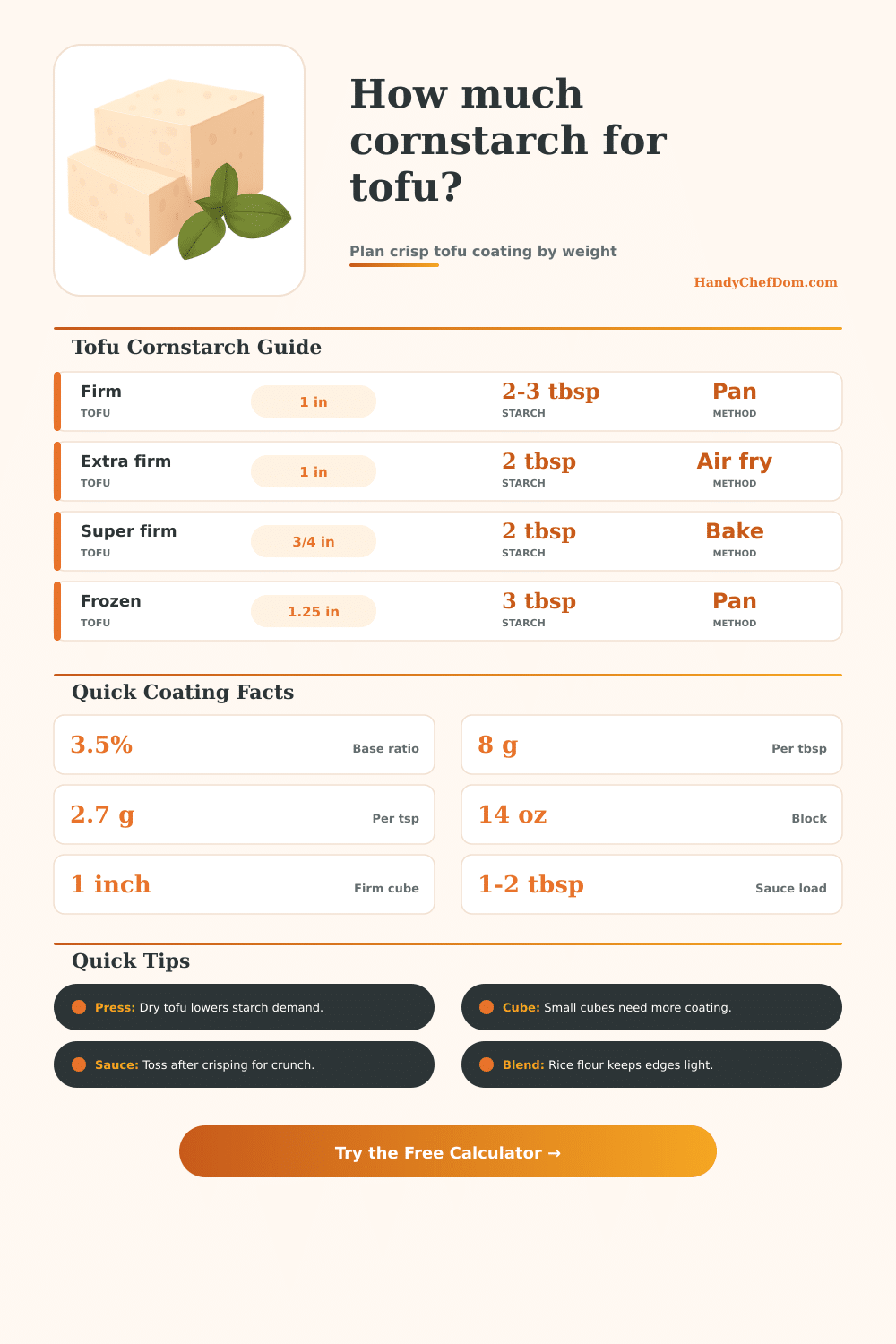
Estimate cornstarch grams, tablespoons, total dry blend, cube coating ratio, sauce buffer, and per-serving amounts for crisp tofu.
The calculator converts tofu to grams, adjusts for cube surface area, tofu moisture, coating thickness, cooking method, sauce load, servings, and your starch blend. Use drained tofu weight when possible.
Tofu Style Multipliers
| Tofu Style | Moisture Feel | Multiplier | Best Coating Use |
|---|---|---|---|
| Silken tofu | Very delicate | 1.30 x | Wide pieces with gentle dusting |
| Soft tofu | High moisture | 1.22 x | Pan-seared slabs |
| Medium tofu | Moderate moisture | 1.12 x | Careful skillet cubes |
| Firm tofu | Standard block | 1.00 x | Classic cubes |
| Extra firm tofu | Lower moisture | 0.92 x | Air fryer and stir-fry |
| Super firm tofu | Dense and dry | 0.84 x | Thin dusting or meal prep |
| Frozen-thawed tofu | Spongy surface | 1.08 x | Nugget texture |
| Pressed high-protein | Very dense | 0.78 x | Small snack squares |
Coating Thickness for One 14 oz Block
| Coating Goal | Base Ratio | Approx Cornstarch | Texture Cue |
|---|---|---|---|
| Thin dusting | 2.3% | 9 g or 1 tbsp | Light matte surface |
| Light crisp coat | 3.0% | 12 g or 1.5 tbsp | Edges crisp, center tender |
| Classic crisp tofu | 3.5% | 14 g or 1.8 tbsp | Even opaque coating |
| Crunchy edges | 4.4% | 17 g or 2.1 tbsp | Visible dry ridges |
| Nugget-style coating | 5.4% | 21 g or 2.6 tbsp | Thicker crust for sauces |
Cooking Method Adjustments
| Method | Multiplier | Oil Contact | Coating Note |
|---|---|---|---|
| Pan fried | 1.00 x | Direct skillet | Balanced default for cubes |
| Air fryer | 0.90 x | Spray or light oil | Too much starch can taste powdery |
| Baked sheet pan | 1.08 x | Light surface oil | Extra dry coat helps browning |
| Deep fried | 0.85 x | Full oil contact | Lower starch still crisps quickly |
| Wok stir-fry | 0.95 x | Fast hot oil | Use light, even dusting |
| Sheet pan meal prep | 1.12 x | Longer dry heat | Extra coating protects edges |
Starch Blend Planning
| Blend | Cornstarch Share | Total Dry Mix | Best Use |
|---|---|---|---|
| 100% cornstarch | 100% | Same as starch | Glossy crisp coating |
| Cornstarch and rice flour | 70% | More dry mix | Light, brittle edges |
| Cornstarch and potato starch | 60% | Most dry mix | Extra crunch |
| Cornstarch and flour | 65% | Seasoned crust | Heavier diner-style coating |
| Cornstarch and fine panko | 50% | Crumb coating | Nugget-style bites |
| Cornstarch and spices | 80% | Light seasoning | Dry rub style tofu |
Crispy tofu tends to be finicky: one batch will come out golden brown and light; another, well, it’ll be gummy or it’ll fall apart when it hits the pan. It’s the texture of starch that sticks to its surface before cooking that makes difference. But amount varies depending on what type of tofu (weight), the amount of water in your package, the size of cubes. You get the idea: hard to guess right every time.
To start with, a simple 3.5% cornstarch by drained tofu weight is a good starting point. So if your package say there’s a 14 ounce block, that’s probably about 14 grams, un-adjusted, for a good base number. After that, just plug in your own block size (the calculator do all the rest), then adjust up/down based off how wet tofu surface seems, and whether cubes is going into sauce before or after cooking.
How to Get Crispy Tofu Every Time
Why? A pressed block sheds starch; a wet surface sucks it up. And if you’re adding a sauce early on, you’ll need more liquid so it doesn’t get a pasty coating. On the other hand, as cube size increase, this equation flips: More surface area means smaller pieces require more coating to weigh the same amount. When you go below an inch in size, base amount gets scaled up by surface factor (and pulled down for larger pieces). That way you don’t under-coat bite-sized piece or over-coat larger chunks.
There’s one more wrinkle: how are you planning to cook it? Deep-frying and air-frying will dry the outside surface quicker, allowing for slightly less starch. On the other hand baking and sheet-pan roasting take more time, so adding a little extra insurance allow the ends to crisp without over-drying. The calculator includes multipliers for each method. However, it doesn’t know if your oven is already running hot enough to use low end, or if it needs an extra cushion against uneven browning.
Starch type also changes texture rather than the overall weight. Potato starch give it some crunch but requires additional volume. Rice flour makes it light and cracker-like. A panko mixture will make it more like a nugget crust. This is what tool displays; not just amount of dry ingredients in the coating, but the amount of cornstarch used as well (so you know how much additional stuff you’re adding).
We also ignore amount we lose as we prepare it. That’s a few grams per toss from falling onto floor (or back into the bowl) and a couple more as I scoop out last batch of bare cubes. If you allow an extra 8 to 12 percent, there is no disappointment when you run dry. When you take that waste margin into account, total is good enough to reproduce.
This reasoning applies at group cooking scale as well. Proportions will be the same for larger batches (just divide by number of servings to get each person’s share), but there will be less total starch per serving. Why does that matter? Because if you’re doing some meal prep, you want leftovers with just enough coating for reheating and not mushy from sitting in fridge. And it lets you adjust your servings without having to measure again. The calculator will split based on number of servings so you don’t have to do that math yourself.
You aren’t aiming for perfection so much as repeatability. Once you have the starch dialed to match your cooking technique, the cubes cut evenly, and the surface is well dried, it is no longer guesswork. You should of used the first toss gets you close, then you eyeball the adjustment on the second go-round. You are not staring at a blank slate every time you make it.