Dessert Per Person Calculator
Estimate how much dessert to buy and prep by guest count, service format, appetite profile, menu share, and breakage risk. Get tray-rounded purchasing numbers that fit real event execution.
📌Preset Scenarios
⚙Calculator Inputs
Pick your lead dessert and service format first. Then tune appetite, variety, and handling loss to mirror your real pass, buffet, or station workflow.
📐Serving Benchmarks
📑Reference Tables
| Dessert type | Yield | Base oz ea | Best fit |
|---|---|---|---|
| Layer cake slice | 88% | 5.0 | Plated, parties |
| Mini tart | 84% | 3.2 | Buffet, cocktail |
| Brownie bar | 92% | 3.5 | Buffet, office events |
| Mousse cup | 90% | 4.0 | Plated, stations |
| Cheesecake wedge | 86% | 5.5 | Plated course |
| Macaron mix | 80% | 2.4 | Tasting spreads |
| Gelato scoop | 76% | 3.8 | Live station |
| Mini donut wall | 82% | 3.0 | Celebration tables |
| Guests | 3 oz ea | 5 oz ea | 7 oz ea |
|---|---|---|---|
| 12 guests | 2.3 lb | 3.8 lb | 5.3 lb |
| 24 guests | 4.5 lb | 7.5 lb | 10.5 lb |
| 40 guests | 7.5 lb | 12.5 lb | 17.5 lb |
| 60 guests | 11.3 lb | 18.8 lb | 26.3 lb |
| 90 guests | 16.9 lb | 28.1 lb | 39.4 lb |
| 120 guests | 22.5 lb | 37.5 lb | 52.5 lb |
| 180 guests | 33.8 lb | 56.3 lb | 78.8 lb |
| 260 guests | 48.8 lb | 81.3 lb | 113.8 lb |
💡Planning Tips
A dessert per person calculator is a tool that will allow you to calculate the amount of dessert that you will need to purchase for a groups of people. Many people struggle with determining how much dessert a group of individual will consume, as each person may consume one portion or multiple portion of dessert. A dessert per person calculator will help to eliminate these uncertainties in providing you with a plan for how much dessert to purchase by utilizing specific data regarding your event to formulate a plan for you to follow.
You can input data regarding your guests, the types of dessert that will be provided, and a variety of other factor into the calculator, which will then provide you with the total weight of the dessert that you should purchase for your event. To utilize the calculator, you will first be required to input the type of dessert that you will be providing. Different types of dessert have different properties that may impact how much dessert each individual guest will consume.
How to calculate dessert per person
For instance, layer cake tend to be more stable than minis tarts, yet both types of desserts may experience some loss of that dessert due to the handling of that dessert by the cooks, bakers, and guests. Similarly, scoops of gelato will melt at a faster rate than a single bar of brownie. Therefore, you may have to purchase more gelato than brownie to ensure that each guest receives a portion of dessert.
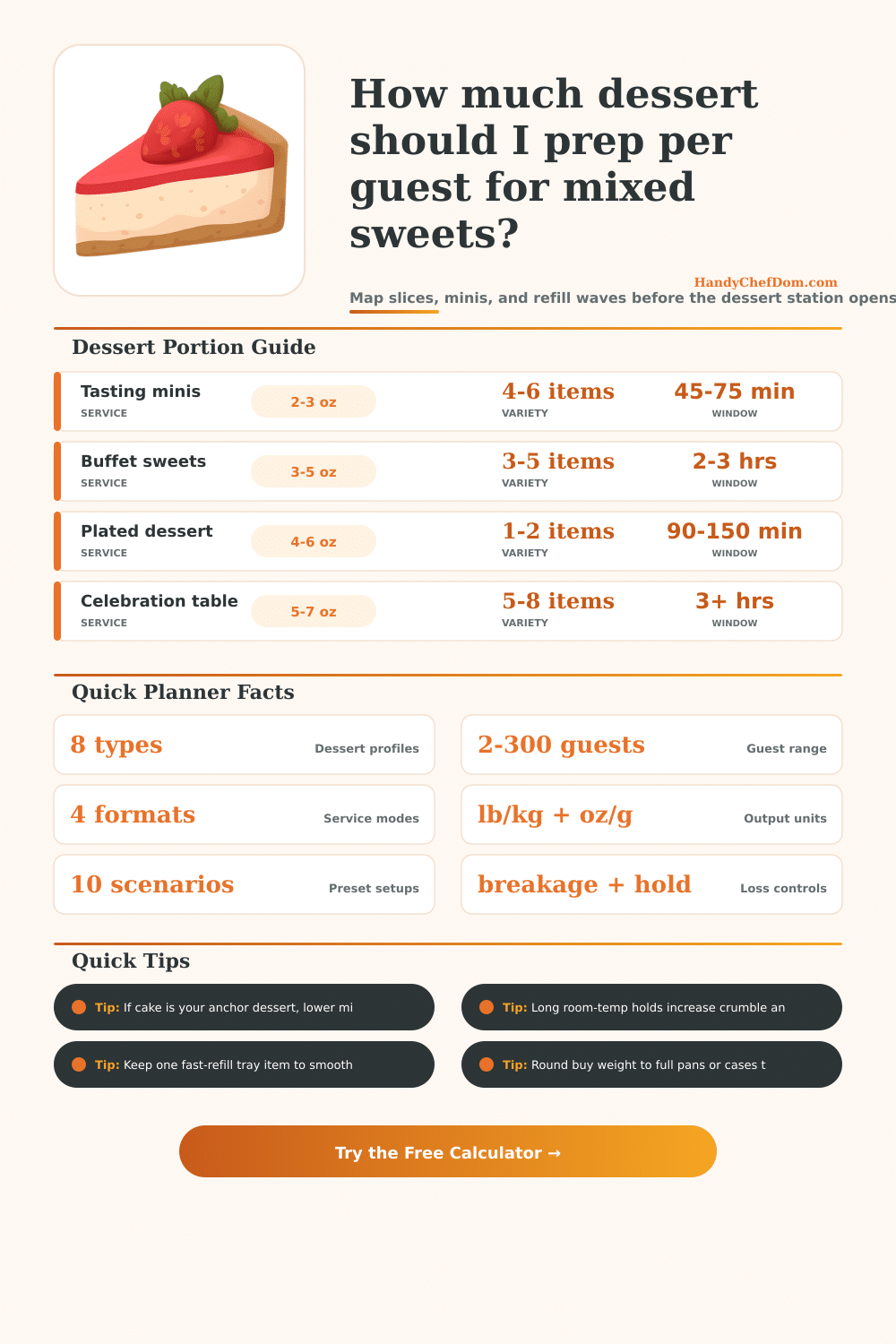
Following selection of the type of dessert that will be provided, you will be prompted to select the format in which the dessert will be provided to the guests. For instance, you can select if the dessert will be provided in a plated format, wherein each guest will receive a single portion of dessert, or if the dessert will be provided as a buffet that is available for a period of time to the guests. At a dessert buffet, guests may take portions of dessert beyond those that is provided to each guest for viewing.
Thus, the dessert per person calculator will change the target amount of ounces of dessert per guest based on the choice of format of dessert that is to be provided. Following selection of the format for the dessert, you must also decide the level of appetite that each guest will exhibit at the event, as well as the role of the dessert in the event. For instance, guests at an event that includes a variety of different types of food may have more appetite for dessert than guests at an event with few types of food.
Furthermore, if the dessert is to be the main event at the event, guests will consume more of the dessert than if the dessert is just one of the sweet to be provided at the event. These factor will alter the target weight of dessert that must be purchased for the guests. The duration in which the dessert will be provided is another factor that the calculator will ask of you.
For instance, if the dessert will be provided for a longer period of time than others that will be provided at the event, guests will have more opportunities to visit the dessert table. Thus, more dessert will be consumed at the event. Similarly, variety in the types of dessert that are to be provided will indicate that each guest will consume less of each dessert if there are a variety of available desserts.
Beyond these factor, the calculator will also prompt you for adjustments in two separate aspect of the dessert that will be provided to the guests. The first is in relation to the breakage and melt loss that may occur in the dessert. Breakage is introduced if any guest drops any of the dessert items.
Melt loss can occur if items like gelato and ice cream are provided, as they may melt before any guest consumes them. The percentage of the dessert that may be lost due to these factors can be provided to the calculator. The second adjustment is in relation to a service buffer.
A service buffer is provided to account for the fact that there may be more guests at the event than you have counted, or that some guests may desire more dessert than others. The percentage of the dessert that will be provided in this “service buffer” can also be provided to the calculator. Following the dessert per person calculator’s questions of the type of dessert that will be provided, the format in which the dessert will be provided, the appetite of the guests, the role of the dessert in the event, the length of the event in which the dessert will be available, the variety of the dessert that will be provided, the potential for breakage in the dessert, the potential for melt loss in the dessert, and the creation of a service buffer for the event, the calculator will provide you a rounded weight in your selected unit of measurement for the amount of dessert that you should purchase for the guests.
This weight is the amount that you should purchase from your supplier of the dessert; it accounts for the size of the tray or case of the dessert that will be provided to the guests. In addition to the buy weight of the dessert that should be purchased, the calculator will also show the edible amount of the dessert. The edible amount is the weight of the dessert after some of the dessert is lost to waste during the preparation of the dessert and the providing of the dessert to the guests.
Even with the dessert per person calculator, there are some factor that the calculator cannot measure. Factors like the temperature of the room in which the event will occur, the time of day that the event will occur, and the presence of alcohol at the event may impact the amount of dessert that each guest consumes. These factor cannot be accounted for in the calculator, but it is important for you to remember these factors when reviewing the outcome of the calculator.
Some of the most common mistakes when utilizing the dessert per person calculator are to not adjust the target ounces of dessert per guest for each of these factors, and to set the percentage for potential breakage and melt loss to zero. Each of these factor will inevitably occur in the providing of dessert to the guests, so it is important to account for these errors in your calculations. Therefore, it is suggested that you run the dessert per person calculator twice with each of these factors changed to see how significant the difference in the amount of dessert that should be purchased is with each adjustment.
The dessert per person calculator is valuable in that it forces you to make decision in relation to the dessert that will be provided at the event. By utilizing the calculator to decide the type of dessert that will be provided, the length of time during which it will be available, the variety of desserts that will be provided, and any other factors mentioned above, you will feel confident in the number of portion of dessert that the dessert per person calculator calculates that should be provided to your guests. Thus, it is another tool that you can utilize to find a balance between purchasing enough dessert to ensure that each guest receives at least one portion of dessert, and purchasing too much dessert that may sit at the dessert table and waste in relation to the number of guests that attended the event.