🧂 Sodium in Salt Calculator
Convert teaspoons, tablespoons, grams, and salt types into estimated sodium per recipe batch and per serving.
Enter the salt amount from a recipe, choose the salt style, then scale the batch and split the result by servings. Values are kitchen estimates because crystal size and packing vary by brand.
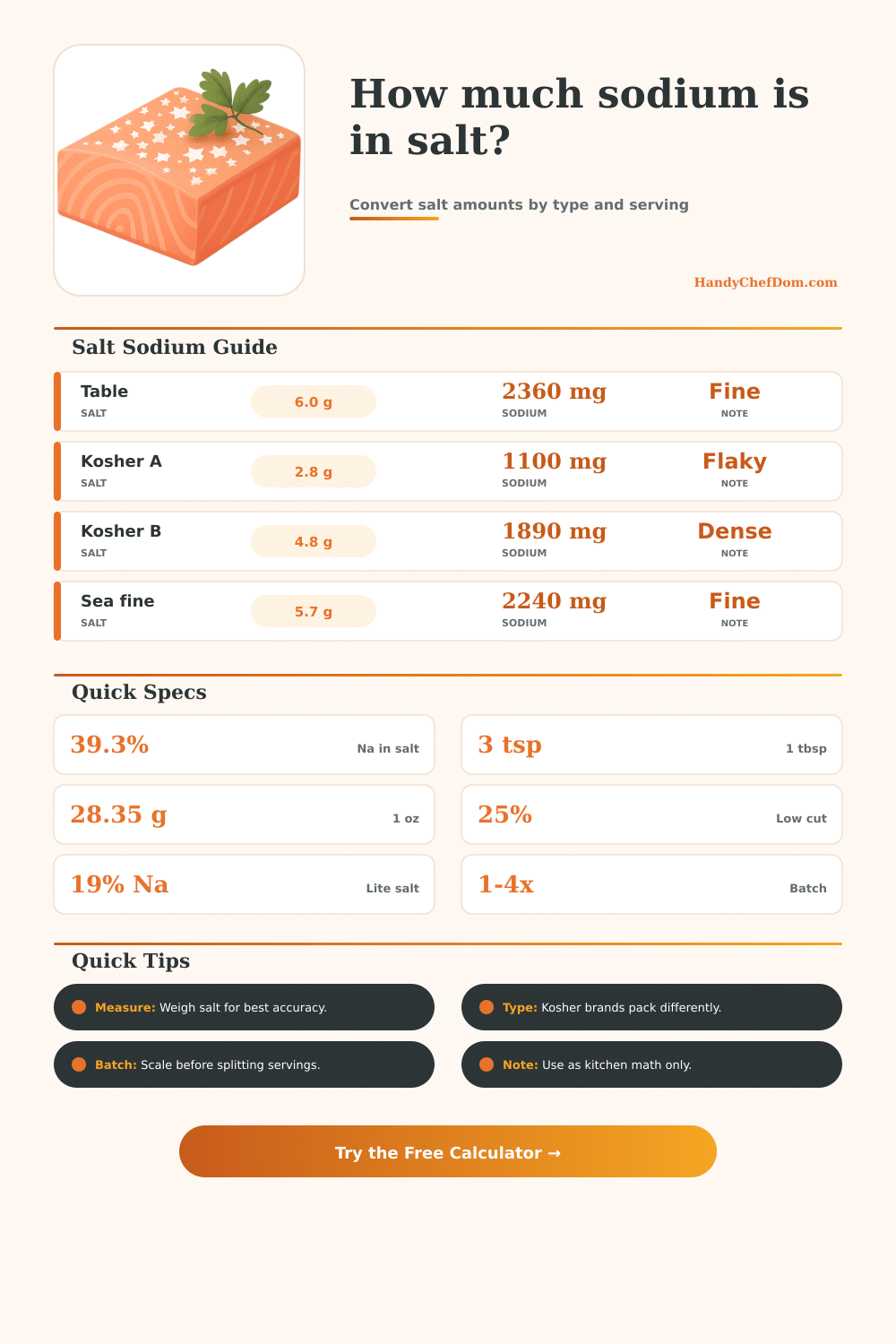
| Salt type | Approx g per tsp | Sodium % default | Best use in calculator |
|---|---|---|---|
| Table salt, fine iodized | 6.0 g | 39.3% | Recipes written for fine salt |
| Kosher salt, airy flakes | 2.8 g | 39.3% | Large flake kosher conversions |
| Kosher salt, dense flakes | 4.8 g | 39.3% | Denser kosher conversions |
| Fine sea salt | 5.7 g | 39.3% | Fine-grain sea salt recipes |
| Coarse sea salt | 4.9 g | 39.3% | Coarse cooking salt estimates |
| Flaky finishing salt | 1.7 g | 39.3% | Finishing pinches and toppings |
| Fine pink mineral salt | 5.8 g | 38.8% | Fine pink salt substitutions |
| Lite salt blend | 5.6 g | 19.0% | Reduced-sodium blend labels |
| Measurement | Teaspoon equivalent | Fine table salt | Airy kosher salt |
|---|---|---|---|
| 1 pinch | 1/16 tsp | 0.38 g | 0.18 g |
| 1/4 teaspoon | 0.25 tsp | 1.50 g | 0.70 g |
| 1/2 teaspoon | 0.50 tsp | 3.00 g | 1.40 g |
| 1 teaspoon | 1.00 tsp | 6.00 g | 2.80 g |
| 1 tablespoon | 3.00 tsp | 18.00 g | 8.40 g |
| 1 cup | 48.00 tsp | 288.00 g | 134.40 g |
| Recipe amount | Table salt sodium | Fine sea sodium | Lite blend sodium |
|---|---|---|---|
| 1/4 teaspoon | 590 mg | 560 mg | 266 mg |
| 1/2 teaspoon | 1,179 mg | 1,120 mg | 532 mg |
| 1 teaspoon | 2,358 mg | 2,240 mg | 1,064 mg |
| 1 tablespoon | 7,074 mg | 6,720 mg | 3,192 mg |
| 2 tablespoons | 14,148 mg | 13,440 mg | 6,384 mg |
| 1/4 cup | 28,296 mg | 26,880 mg | 12,768 mg |
| Low-sodium adjustment | Salt kept | Sodium kept | Kitchen meaning |
|---|---|---|---|
| No reduction | 100% | 100% | Use the recipe amount as written |
| Trim by 10% | 90% | 90% | Small taste-preserving change |
| Trim by 20% | 80% | 80% | Moderate recipe adjustment |
| Trim by 25% | 75% | 75% | Easy quarter reduction |
| Trim by one-third | 67% | 67% | Noticeable sodium decrease |
| Trim by half | 50% | 50% | Large recipe change |
Salt is a substance that is used in a variety of ways within the cooking process. Additionally, salt is an ingredient that contain sodium. Thus, the amount of salt that is used in a recipe will impact the amount of sodium that is contained within the prepared meal.
Salt come in a variety of forms, and those forms can contain different crystal size. Additionally, the densities of the salts of the different crystal sizes can impact the weight of the salt that is measured within a recipe. Different weight of salt will impact the amount of sodium that is contained within the prepared meal.
How Different Salts Change Sodium in Food
Fine table salt is typically more denser than other forms of salt, such as kosher salt. As a result, fine table salt will often have a greater weight within a spoonful than the other type of salt. Kosher salt is less dense than fine table salt, and contains large flake of the salt.
As a result, kosher salt will have less weight within a spoonful than fine table salt. Because the weight of the salt impacts the amount of sodium that is contained within the food, the difference in weights of these two types of salt will lead to different amounts of sodium within the food. A calculator can be used to determine the weight of the salt that is to be use in a recipe, and the amount of sodium that will result from that type of salt.
In addition to the difference in weight of the different types of salt, the shape of the salt crystals also impacts the way in which salt interact with food. Large flakes of salt will dissolve slow on the surface of the food, and may make the food feel salty even if the food contains little salt. Fine salt grains will dissolve quickly into a liquid, and will allow the salt to even distribute within the liquid.
Because the rate at which salt dissolves in a food or liquid can change, the impact of salt on the flavor of food will differ according to the type of salt that is used. A conversion tool allow for the change from one type of salt to another, allowing cooks to determine the amount of sodium that will be introduced into a recipe based off the type of salt that is to be used. Due to the health effects of excessive sodium consumption, many cooks may wish to reduce the amount of salt that is used in a recipe.
Reducing the salt by a given percentage will reduce the amount of sodium by that same percentage. Beyond sodium, however, salt can also impact the flavor of food that is prepared. For instance, if salt is reduced by 20%, many cooks will find that it is relatively easy to compensate for the loss of salt through the addition of herbs to the dish.
However, reducing salt by 50% may be more challenging, as the reduction of salt to 50% of the level in the original recipe may alter the flavor of the dish. A calculator allows cooks to determine how much sodium will be saved at each percentage reduction of salt, and this information can assist cooks in making a decision about whether the reduction of sodium is worth the alteration of the flavor of the food. The amount of salt that is required in a recipe may need to be scale to prepare large batches of food.
When a recipe is doubled, for instance, the size of the batch of food increases. However, the evaporation rates of the liquid in the food, as well as the surface area of the pan in which the food is cooked, also change with the batch size. The change in evaporation rates and surface area can impact the amount of salt that should be used in the doubled batch of food.
A batch multiplier can compensate for these changes, ensuring that the amount of salt is accurate for the doubled batch of food. A common mistake in the kitchen is treating the measurements for different types of salt as if they are the same. Many cooks will measure kosher salt as if it were table salt, for instance.
Using too much salt will lead to an increase in the sodium content of the food, while using too little salt may lead to the food having an under-seasoned flavor. Weighing the salt that is to be used is one way to avoid adding too much or too little salt to a food. However, volume measurements can still be used if the density of the salt is known.
In addition to salt, there are a variety of other ingredient that may contain sodium. Ingredients like cheese, broth, and cured meats contain sodium. Thus, cooks must account for the amount of sodium that is contained within these ingredient, in addition to the amount of salt that is added to the food.
Reference tables can show the weight of the salt for various volume of salt. Additionally, these reference tables can show how much sodium is contained within each type of salt. Beyond the amount of salt that is used in cooking, the tables can also show the amount of sodium that is saved with the reduction of salt in a recipe.
These tables are useful in understanding the amount of sodium that is contained within food. Understanding the amount of sodium within the food is one way to season foods while managing the sodium content of your diet.