🍞 Grams of Flour in a Cup Calculator
Convert flour cups to grams with flour type, scoop style, sifting, humidity, recipe scaling, and target-gram reverse math.
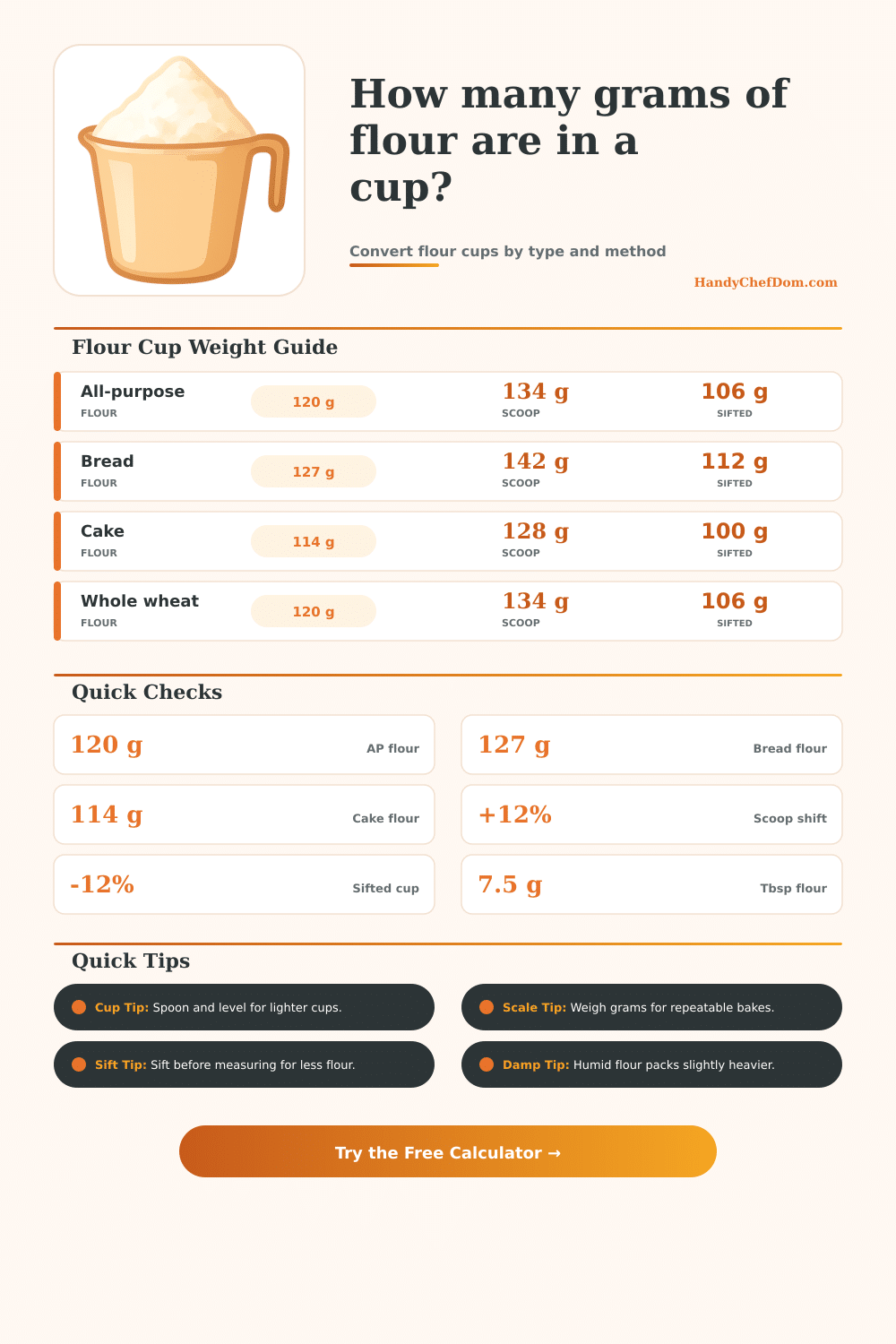
Use the default spoon-and-level values for recipe writing, or choose a heavier scoop style to estimate what is actually in your cup.
| Flour Type | US Cup | Metric Cup | Typical Bake |
|---|---|---|---|
| All-purpose flour | 120 g | 127 g | Cookies, muffins, pancakes |
| Bread flour | 127 g | 134 g | Bread, pizza, bagels |
| Cake flour | 114 g | 120 g | Cakes and soft crumbs |
| Pastry flour | 106 g | 112 g | Pie crust and scones |
| Whole wheat flour | 120 g | 127 g | Loaves and hearty muffins |
| Rye flour | 102 g | 108 g | Rye bread and starters |
| Italian 00 flour | 116 g | 123 g | Pizza and pasta dough |
| Gluten-free 1:1 blend | 140 g | 148 g | Cakes, cookies, quick breads |
| Measuring Method | Adjustment | 1 Cup AP Estimate | Best Use |
|---|---|---|---|
| Spoon into cup and level | 1.00x | 120 g | Most modern recipes |
| Dip cup into flour and sweep | 1.12x | 134 g | Estimating older cup habits |
| Firm packed scoop | 1.20x | 144 g | Diagnosing dense bakes |
| Fluffed, spooned, very light | 0.95x | 114 g | Soft batters and light hands |
| Recipe standard weight | 1.00x | 120 g | When author gives gram weights |
| Condition | Adjustment | How the Cup Changes | Practical Note |
|---|---|---|---|
| Sifted before measuring | 0.88x | Lighter cup | Use only when recipe says sift first |
| Measured first, then sifted | 1.00x | No weight change | Common recipe wording |
| Settled bag flour | 1.06x | Slightly heavier | Stir bag before measuring |
| Dry pantry, recently fluffed | 0.98x | Slightly lighter | Good for dry climates |
| Humid kitchen, soft clumps | 1.04x | Slightly heavier | Break clumps before scooping |
| Damp or compacted storage | 1.07x | Heavier cup | Expect denser measuring cups |
| Recipe Scale | 1 Cup AP | 2 Cups Bread | 3 Cups Cake |
|---|---|---|---|
| 50% | 60 g | 127 g | 171 g |
| 75% | 90 g | 191 g | 257 g |
| 100% | 120 g | 254 g | 342 g |
| 125% | 150 g | 318 g | 428 g |
| 150% | 180 g | 381 g | 513 g |
| 200% | 240 g | 508 g | 684 g |
When measuring flour for recipe, it is important to understand how different method for measuring flour can lead to change in the weight of the flour that is measure. Using a measuring cup to measure flour will cause the weight of the flour to change according to the type of flour that is being use. An grams of flour in a cup calculator will allow cooks to accurately convert the cup measurements of flour to gram measurement, accounting for the different variable in cooking with flour.
The type of flour that is being use can play a majorly role in the weight of that flour. Different type of flour contain different amount of protein. All purpose flour contains a moderate amount of protein, while bread flour contain more protein than all-purpose flour.
How to Measure and Convert Flour from Cups to Grams
Additionally, cake flour contains less protein than bread flour because it is mill to a fine texture. The amount of protein that is present in flour can impact the weight of the flour, as protein can act on the flour to absorb liquid and create structure within the baked good. The grams of flour in a cup calculator allow cooks to select the type of flour that is to be used in the recipe, allowing for calculation to be made according to that type of flour.
In addition to the type of flour that is used, the way that the flour is measured also have the potential to alter the weight measurement of flour. If flour is spooned into a measuring cup until it reach the top of the cup, the flour will be aerated. Most recipe call for flour to be measured in this manner.
However, flour can also be measured by dip the measuring cup into the flour bag and allowing the flour to sweep off the bag into the measuring cup. This method of measuring flour package the flour more tight into the cup, adding approximately twelve percent more weight to the flour measured in this manner. The grams of flour in a cup calculator can be used to adjust for different method of measuring flour to ensure the weight of the flour to be use in the recipe.
Another variable in measuring flour is the step of sift the flour. Sifting flour remove some of the air that can be within the flour and break apart any clump of flour. Sifted flour will weigh less than flour that has not being sifted.
Recipes that require the flour to be “one cup sifted flour” indicate that the flour should be sifted prior to measure. Recipes that require flour to be “one cup flour, sifted” require the flour to be measured before it is sifted. The grams of flour in a cup calculator account for these type of variable instruction in the recipe.
The weight of the flour may also be affect by the humidity in the kitchen in which the flour is measured. Flour will weigh less in a dry climate than in a humid climate due to the ability of flour to absorb moisture from the humid air. The inclusion of a humidity setting in the grams of flour in a cup calculator account for this variable in the recipe.
Finally, scaling a recipe will require cook to use accurate measurement of the ingredient. If a recipe is to be doubled or halved, the measurement of the ingredient must be multiplied. If the initial recipe did not use precise measurement of ingredient, then the scaled measurement of those ingredient will not be precise, either.
The grams of flour in a cup calculator account for scaling recipe to double or halve the ingredient according to the original recipe. The best way to bake flour is to weigh the flour using a scale instead of measuring cup. Using the grams of flour in a cup calculator, cooks can determine the weight of flour that will fill a measuring cup under the condition of the kitchen.
Once cooks know the number of gram of flour that fill a measuring cup, the flour can be weighed out by gram with a scale each time that the cook desiring to bake. Using a scale to measure flour will ensure that cooks always use the same weight of flour for each recipe, and will eliminate the uncertainty of using measuring cup to measure flour.