🍚 Rice Serving Calculator
Plan dry rice, cooked rice, and leftover buffer for weeknight bowls, buffets, meal prep, and rice-as-the-main dinners.
Choose how many people you are feeding, whether rice is a side or main, and how much extra you want for refills or leftovers.
| Rice Type | Dry Cup Weight | Cooked Yield | Cooked Cup Weight |
|---|---|---|---|
| Long-grain white rice | 185 g per cup | 3.0x | 158 g per cup |
| Jasmine rice | 185 g per cup | 3.0x | 158 g per cup |
| Basmati rice | 180 g per cup | 3.2x | 150 g per cup |
| Brown rice | 190 g per cup | 2.6x | 170 g per cup |
| Short-grain sushi rice | 190 g per cup | 2.8x | 165 g per cup |
| Arborio rice | 195 g per cup | 3.0x | 175 g per cup |
| Wild rice blend | 160 g per cup | 3.5x | 150 g per cup |
| Parboiled rice | 185 g per cup | 3.0x | 160 g per cup |
| Meal Role | Dry Per Person | Cooked Per Person | Best Match |
|---|---|---|---|
| Light side dish | 35-40 g | 1/2-2/3 cup | Buffets, mixed sides |
| Standard side dish | 45-50 g | 3/4 cup | Chicken, fish, vegetables |
| Bowl or curry base | 55-65 g | 1-1 1/4 cups | Curries, stews, saucy plates |
| Rice-heavy main | 70-85 g | 1 1/3-1 2/3 cups | Fried rice, jambalaya, bowls |
| Meal prep box | 55-70 g | 1-1 1/3 cups | Portioned lunches |
| Kids or tasting plate | 25-35 g | 1/3-1/2 cup | Small servings |
| Guest Count | Side Dish Dry Rice | Main Dish Dry Rice | Cooked Yield Range |
|---|---|---|---|
| 4 guests | 3/4-1 cup | 1 1/3-2 cups | 2 1/4-6 cups |
| 6 guests | 1 1/4-1 1/2 cups | 2-3 cups | 3 3/4-9 cups |
| 10 guests | 2-2 1/2 cups | 3 1/2-5 cups | 6-15 cups |
| 20 guests | 4-5 1/2 cups | 7-10 cups | 12-30 cups |
| 25 guests | 5-7 cups | 9-12 1/2 cups | 15-38 cups |
| 50 guests | 10-14 cups | 18-25 cups | 30-75 cups |
| Buffer Choice | Use When | Add To Dry Rice | Serving Effect |
|---|---|---|---|
| No buffer | Portioned plates | 0% | Exact servings only |
| Small buffer | Normal family dinner | 5-10% | A few spoonfuls extra |
| Standard buffer | Guests and seconds | 10-15% | Comfortable refills |
| Party buffer | Self-serve pans | 15-25% | Extra tray coverage |
| Meal prep buffer | Packed lunches | 10-20% | Fills containers evenly |
| Feast buffer | Rice is central | 25-35% | Plenty for seconds |
When planning a meal for a groups of people, it is important to ensure that an amount of dry rice that is cooked is the correct amount. If there is too much rice, there will be leftovers. If there is not enough rice, then the group wont have enough to eat.
The amount of dry rice that should be cooked is difficult to determine due to the expansion of the rice when it is cooked, as well as due to the fact that different types of rice expand at different rate. To make this calculation more easier, cooks can use a rice calculator to determine the amount of dry rice that will be needed for their meal. The rice calculator takes into account the number of people that will be eating, the appetite of each of those individuals, the type of rice that will be used, and even the role that the rice will have within the meal to arrive at the amount of dry rice that will be needed.
How Much Dry Rice to Cook for a Group
The amount of dry rice that will be needed for each individual is dependent upon the appetite of each of those individuals. Those with smaller appetites will require less rice then those with larger appetites. Additionally, individuals who will be eating rice as the main component of the meal will eat more rice than those who will only have rice as a side dish.
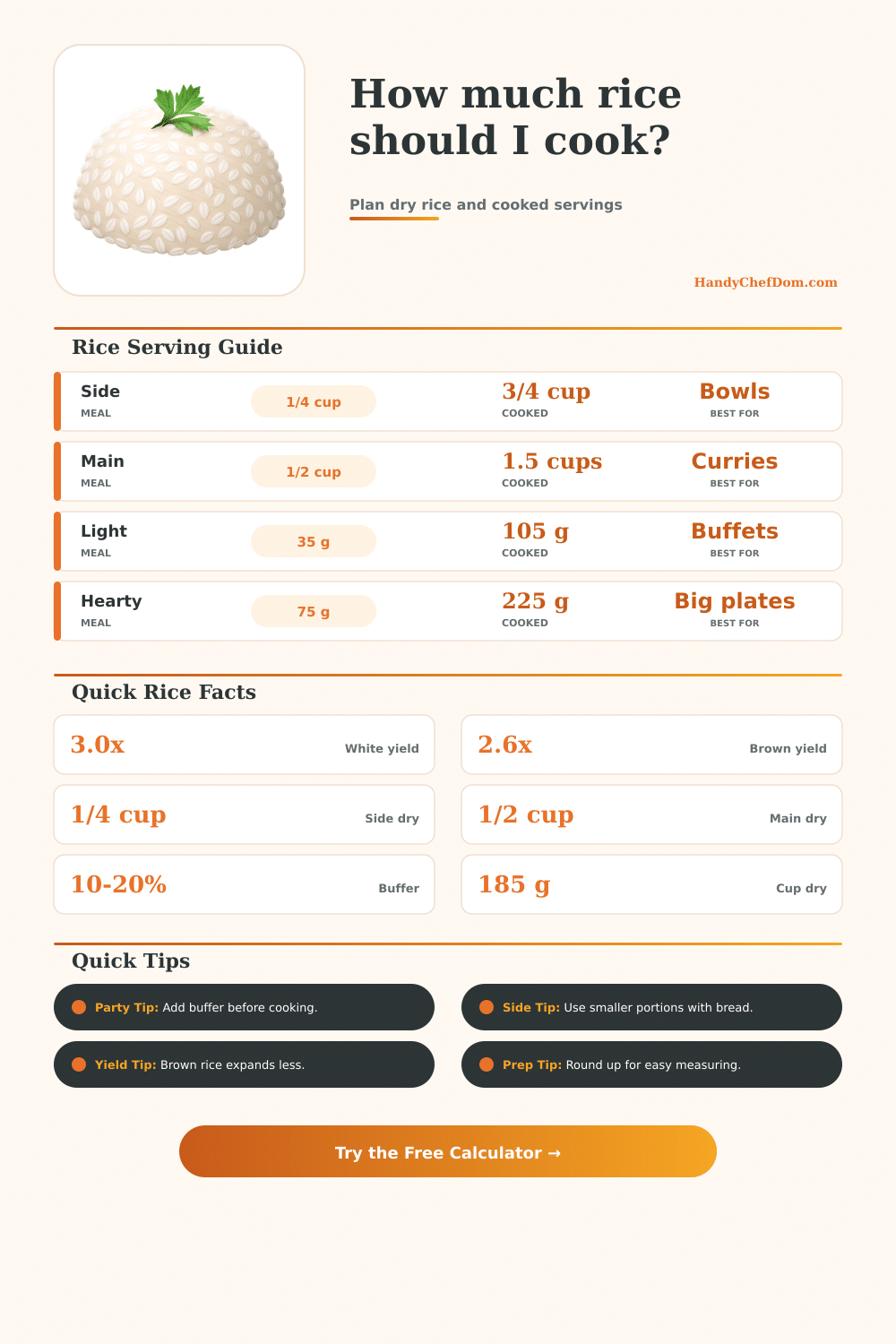
For individuals who are having rice as a side dish, 0.25 cup of dry rice is required per person. For those who are having rice as the main component of the meal, however, the cook requires 0.5 cup of dry rice per person. These values can be selected in the rice calculator, which will adjust for the different appetites for each individual.
The type of rice that will be used in the recipe will change the amount of rice that is cooked. For instance, white rice will triple in volume when cooked, but brown rice will only increase to two and a half times its original volume when cooked. Thus, if you are to use brown rice in the recipe, there will need to be more dry brown rice to obtain the same amount of cooked rice as white rice.
Additionally, different varieties of rice (such as Basmati rice or wild rice) expands at different rates. Thus, the recipe will also need to account for these types of rice to determine the amount of dry rice that is needed. It is also important to include a buffer in the calculation for dry rice.
Buffers are used to account for the fact that some of the individuals may eat second helpings of the rice, or that additional individuals may show up to the meal who were not accounted for in the initial calculation. A buffer of 10% to 20% of the calculated amount of dry rice should be added to the amount of dry rice that is to be cooked. This buffer will ensure that there is enough rice for each individual.
However, if the buffer is too large, there may be too much rice for each individual. Common mistake in cooking rice include using cooked rice measurements rather than dry rice measurements, and forgetting to include a buffer for the rice. Using cooked rice measurements will lead to incorrect calculation of the amount of dry rice that must be cooked.
Additionally, if there is no buffer for the rice, there may not be enough rice for each individual. Therefore, using a rice calculator will help to avoid these mistake. The rice calculator will use dry rice measurements, and will include a buffer for the rice.
By calculating the amount of dry rice that will be cooked for a meal, cooks can ensure that they have the correct amount of rice to prepare the meal. The cooks will be able to prepare the correct amount of rice to purchase from the store, as well as to prepare the correct number of container of rice if preparing meals in advance for those who will eat the meal. Thus, using a rice calculator will ensure that the amount of rice that will be cooked for the meal matches the amount of people who will eat the meal, and ensures that the amount of rice matches the type of rice that will be used in the recipe.