🍲 Protein in Lentils Calculator
Estimate lentil protein by variety, dry or cooked form, cups, grams, cooking yield, servings, role in the meal, and target protein.
Use dry form for batch planning or cooked/canned form for leftovers and ready-to-eat portions. The role setting compares lentils against the share of protein you expect them to carry in the meal.
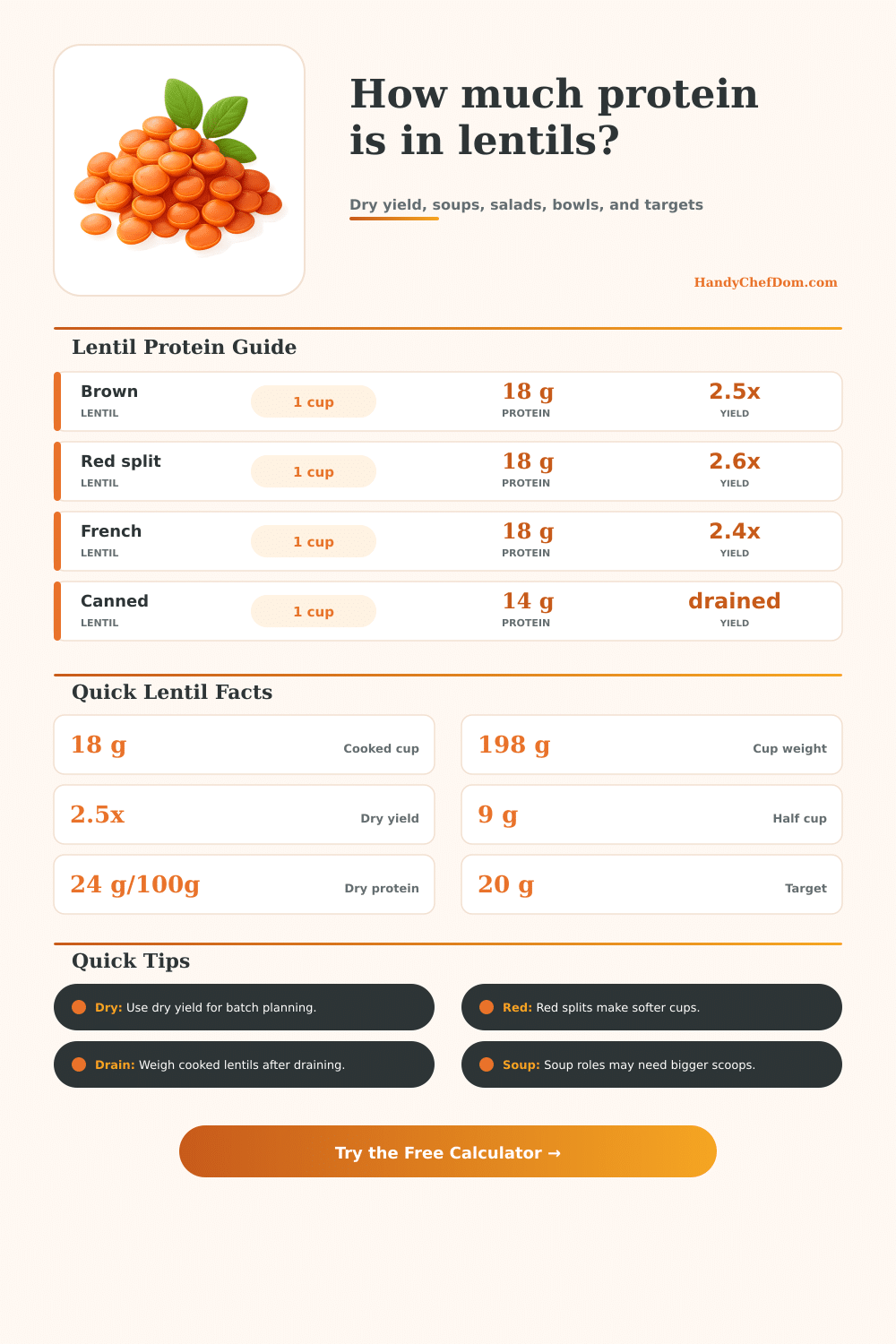
| Lentil type | Protein per cooked cup | Typical cup weight | Dry-to-cooked yield |
|---|---|---|---|
| Brown lentils | 17.9 g | 198 g | 2.5x to 2.6x |
| Green lentils | 17.8 g | 198 g | 2.4x to 2.5x |
| Red split lentils | 17.8 g | 198 g | 2.6x to 2.7x |
| French green or Puy lentils | 18.2 g | 200 g | 2.3x to 2.4x |
| Black beluga lentils | 17.6 g | 196 g | 2.3x to 2.5x |
| Yellow split lentils | 16.3 g | 196 g | 2.6x to 2.8x |
| Canned drained lentils | 13.9 g | 180 g | Ready to use |
| Sprouted cooked lentils | 17.0 g | 190 g | 2.1x to 2.3x |
| Dry lentils | Cooked yield estimate | Protein estimate | Best use |
|---|---|---|---|
| 1/4 cup dry | 2/3 cup cooked | 11 g to 12 g | Single salad scoop |
| 1/2 cup dry | 1 1/4 cups cooked | 23 g to 24 g | Two light servings |
| 1 cup dry | 2 1/2 cups cooked | 46 g to 48 g | Family side batch |
| 1 1/2 cups dry | 3 3/4 cups cooked | 70 g to 72 g | Meal prep container |
| 2 cups dry | 5 cups cooked | 92 g to 96 g | Soup pot or dal |
| 3 cups dry | 7 1/2 cups cooked | 138 g to 144 g | Large batch cooking |
| Meal role | Role share used | Common lentil portion | Planning note |
|---|---|---|---|
| Soup protein base | 45% of meal target | 2/3 to 1 cup | Broth spreads protein across more volume |
| Lentil salad center | 70% of meal target | 3/4 to 1 cup | Works as the main salad protein |
| Dal or stew main | 80% of meal target | 1 to 1 1/4 cups | Usually carries most of the protein |
| Grain bowl protein | 65% of meal target | 3/4 cup | Balances grains, greens, and sauces |
| Side dish support | 35% of meal target | 1/2 cup | Assumes another protein source |
| Meal prep anchor | 75% of meal target | 1 cup | Useful when lentils drive the box |
| Lentil serving | Calories | Protein | Fiber and carbs |
|---|---|---|---|
| 1/2 cup cooked brown lentils | 115 | 9.0 g | 7.8 g fiber, 20 g carbs |
| 1 cup cooked green lentils | 229 | 17.8 g | 15.4 g fiber, 40 g carbs |
| 1 cup cooked red split lentils | 226 | 17.8 g | 15.0 g fiber, 40 g carbs |
| 1 cup cooked French lentils | 232 | 18.2 g | 16.0 g fiber, 40 g carbs |
| 1 cup drained canned lentils | 166 | 13.9 g | 11.5 g fiber, 29 g carbs |
| 1 cup sprouted cooked lentils | 202 | 17.0 g | 13.5 g fiber, 35 g carbs |
Lentils are a foods source that provide protein. Furthermore, lentils are also a food source that is convenient to prepare. Dry lentils can be purchased in quantity that will provide a large amount of cooked lentils that will provide a source of protein for several day.
The amount of protein that lentils contain can be difficult to determine. Lentil absorb water when cooked. As a result of this absorption of water, the volumes of the lentils increases.
How to Measure Protein in Lentils
This increase in volume change the protein density of the lentils. A calculator can help to determine the amount of protein that the lentils will contain by using information regarding the specific type of lentils that will be measured, the yield that the lentils will have when cooked, and the target protein level that is to be achieved. Depending on the types of lentils that is to be used in a recipe, the types of meals that can be prepared with those lentils may change.
For instance, types of lentils like brown lentils and green lentils hold well to there shape after they are cooked. Thus, the cook can use lentils of this type in a salad. In contrast, lentils like red split lentils break down during the cooking process.
Thus, these type of lentils are best used in a soup that thicken with the lentils. Other lentil types, like French lentils and black lentils, do not break down during cooking, but retain their texture after they are cooked. These lentils are best used in a recipe that requires a texture from the lentils.
Finally, canned lentils do not require cooking. However, because the manufacture processed the canned lentils during their manufacture, their protein density is lower than lentils that are dry and need to be cook. The calculator allows the individual to select the types of lentils that will be used in the meal.
Thus, the protein estimates provided by the calculator will match the type of lentils that are measured. The way that lentils are measured can change depending on if the lentils are to be measured when they are dry or when they are cooked. When lentils are dry, they will absorb water when cooked and expand in size.
One cup of dry lentils will expand to contain approximately two and a half cups of cooked lentils. Because of the expansion of the lentils, the protein density of the lentils decreases with cooking. Thus, one cup of cooked lentils will contain less protein than one cup of dry lentils.
If preparing lentils for the week, it will be easiest to first weigh the dry lentils. Using the calculator, it is possible to determine how many cooked lentils will be made from the weighed amount of dry lentils. Using this information, it is also possible to determine how many serving that the cooked lentils will provide.
The calculator also allows the individual to set the role of lentils in the meal prepared with those lentils. Lentils contain more protein when they are the main ingredient in the meal than they will when they are just one component of that meal. The yield of lentils when cooked changes depending on the amount of liquid that remain within those lentils.
If the lentil dish contains alot of broth, the weight of the dish will be heavier than if the lentils are drained of any residual cooking liquid. The calculator allows the individual to change the default settings for the yield of lentils, indicating that the calculator can reflect the cooking habits of the individual. By changing the default settings for the yield, the calculator will still accurately calculate the amount of protein in the meal when the amount of lentils to be cooked change.
The portion size of lentils change depending on the other food components of the meal. If the meal contains proteins like chicken or eggs, a half-cup serving of lentils may provide enough protein for the meal. However, if the lentils are the primary source of protein for a vegetarian meal, that same half cup of lentils may not provide enough protein for that meal.
The calculator includes a portion for the protein contribution of the other components of the meal. Thus, the individual doesnt have to remember the protein contribution of the other components of the meal to use the calculator proper. By seeing how the calculated portion size of lentils compares to the protein target of the meal, the cook can determine if more lentils should be added to the meal or if protein from other sources should be added to the meal.
Using a calculator allows the cook to have clarity in the kitchen while preparing a meal. Instead of guessing how many cooked lentils are needed to provide the amount of protein required for several people, the cook can use the calculator to determine the exact number of cooked lentils that contain the necessary amount of protein. This ability to calculate the amount of protein in lentils can help to avoid food waste.
Additionally, this ability to calculate the amount of protein in lentils will also help the cook to avoid the addition of other proteins to the meal. Using the calculator, the cook can maintain consistency in the amount of protein that is provided by lentils if lentils are used in both a salad and a soup. Thus, the calculator is a useful tool for anyone that desire to track the amount of protein that is contained in their meals.