🌾 Grams to ML Flour Converter
Convert flour weight to volume (or volume to weight) for any flour type — accurate & instant
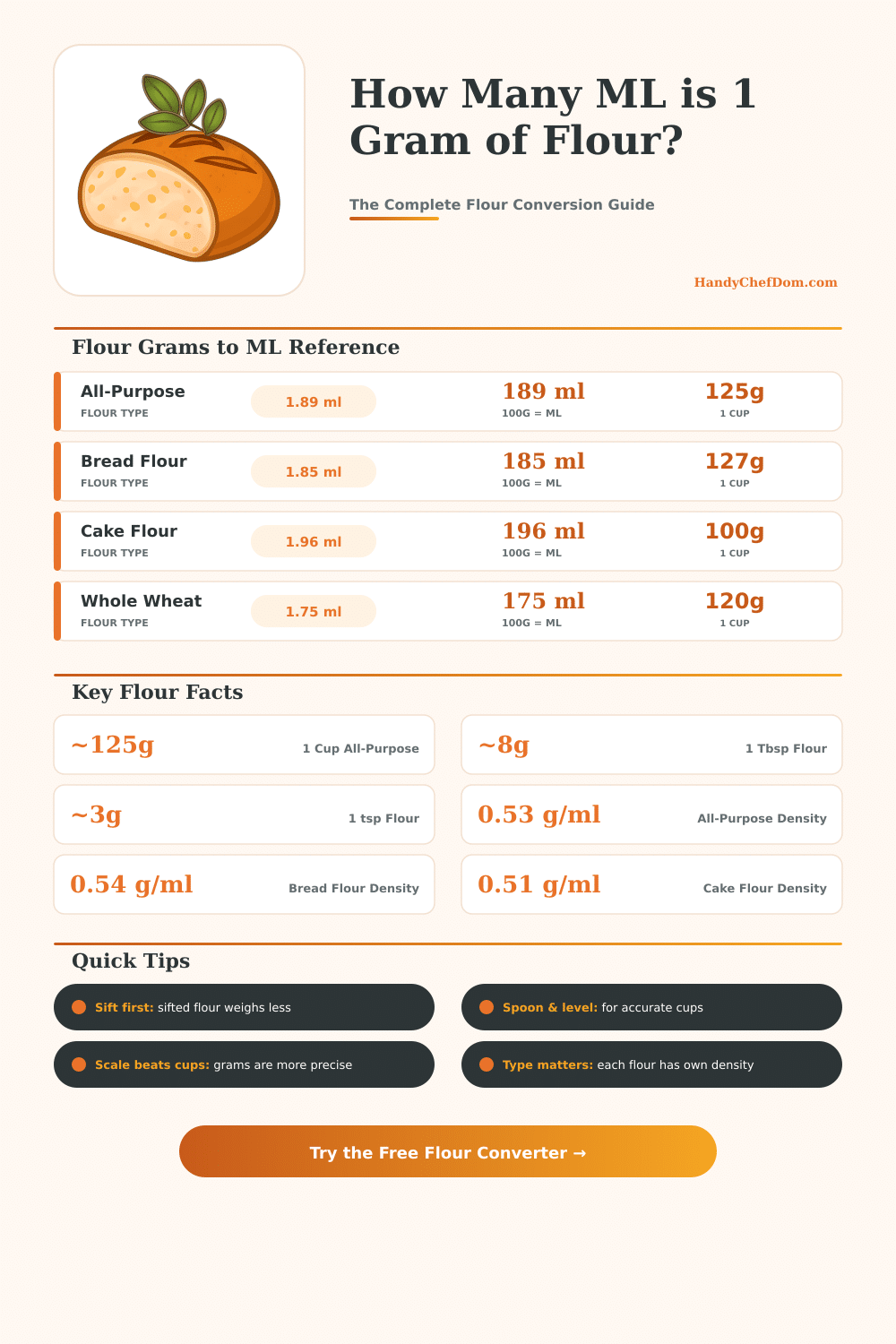
| Flour Type | Density (g/ml) | 1g = ML | 100g = ML | 1 Cup (ml) = g |
|---|---|---|---|---|
| All-Purpose | 0.529 | 1.89 ml | 189 ml | 240ml = 127g |
| Bread Flour | 0.541 | 1.85 ml | 185 ml | 240ml = 130g |
| Cake Flour | 0.510 | 1.96 ml | 196 ml | 240ml = 122g |
| Whole Wheat | 0.571 | 1.75 ml | 175 ml | 240ml = 137g |
| Self-Rising | 0.529 | 1.89 ml | 189 ml | 240ml = 127g |
| Almond Flour | 0.476 | 2.10 ml | 210 ml | 240ml = 114g |
| Rice Flour | 0.625 | 1.60 ml | 160 ml | 240ml = 150g |
| Cornflour | 0.641 | 1.56 ml | 156 ml | 240ml = 154g |
| Rye Flour | 0.526 | 1.90 ml | 190 ml | 240ml = 126g |
| Spelt Flour | 0.537 | 1.86 ml | 186 ml | 240ml = 129g |
| Measure | Grams (g) | Millilitres (ml) | Cups (US) |
|---|---|---|---|
| 1 Teaspoon | 2.6g | 5 ml | 1/48 cup |
| 1 Tablespoon | 7.8g | 15 ml | 1/16 cup |
| 1/4 Cup | 32g | 60 ml | 0.25 cup |
| 1/3 Cup | 42g | 80 ml | 0.33 cup |
| 1/2 Cup | 63g | 120 ml | 0.50 cup |
| 3/4 Cup | 94g | 180 ml | 0.75 cup |
| 1 Cup | 125g | 237 ml | 1 cup |
| 2 Cups | 250g | 473 ml | 2 cups |
| 1 kg Bag | 1000g | 1890 ml | ~8 cups |
| Condition | 1 Cup (g) | Density Factor | Notes |
|---|---|---|---|
| Scooped (packed) | ~145–155g | +15% | Most flour, compressed |
| Spooned & Leveled | ~120–130g | Baseline | Standard recipe method |
| Sifted | ~100–110g | –15% | Airy, least dense |
Flour is powder to make many kinds of foods, for instance baked goods and thickened dishes. You make it from ground grains, beans, nuts, seeds, roots or vegetables with a mill Most commonly you use cereal flour, especially from wheat, as main ingredient for bread, that forms basic food in many cultures.
You classify wheats in six kinds, and there are more than eight flour types. Flour you can make also from non-wheat grains or seeds. Rice, soy, rye, pea and oat flours help to cook breads, cookies and cakes, but only wheat nucleus has gluten, that locks and give structure to the cookies.
Flour: What It Is, Types and How to Use It
Protein amount identifies the flour kinds. From two wheat kinds you grind flour. Hard winter-wheat, rich in protein, works for bread flour.
Pastry flour from soft wheat has litle of protein. In United States cake flour has 5 to 8 percent of protein, pastry flour 8 to 9 percent, and all-purpose flour 9 to 12 percent. For bread you take white flour from hard, protein-rich wheat with around 12, 13 percent protein.
Although wheat flour mostly is made up of carbs, it has also 10, 15 percent protein. When you add water and mix, some proteins join in gluten, that is sticky and elastic. It helps the dough hold air, similar to little balloons.
Commercial mills use fast steel rollers, that create a lot of heat. They give white, cheap flour, but throw out germ and bran, whose nutrients, oils and taste go away. Stone milling on the other hand crush whole grains to fresh, delicious and nutritious flours.
Volume measurement of flour is wrong, because a cup weighs 4 to 6 units depending on fluffing or packing. One brand of all-purpose flour has 10,5 percent protein, other 11,7 percent, what alters baking results.
Raw flour is not for eating and needs full cooking to avoid bacteria. Wash hands, utensils and surfaces after touching it.
Strong floury taste in baked goods commonly come because of too much flour, bad mixing, old or bad flour, wrong type or wrong proportions, that dries the crumb. Oat flour with other mixed give well textured cake. Whole wheat flour works to substitute white in many recipes.
Whole wheat pastry flour act most similarly to white while baking.