🫘 Fiber in Black Beans Calculator
Estimate fiber from canned, cooked, or dry black beans, including cups, grams, drained weight, cooking yield, servings, and daily fiber comparison.
Start with the black bean form you have: a drained can, cooked cups, dry beans before cooking, or an exact gram/ounce weight. The calculator normalizes everything to edible cooked bean weight before estimating fiber.
| Black Bean Form | Kitchen Measure | Edible Weight | Estimated Fiber |
|---|---|---|---|
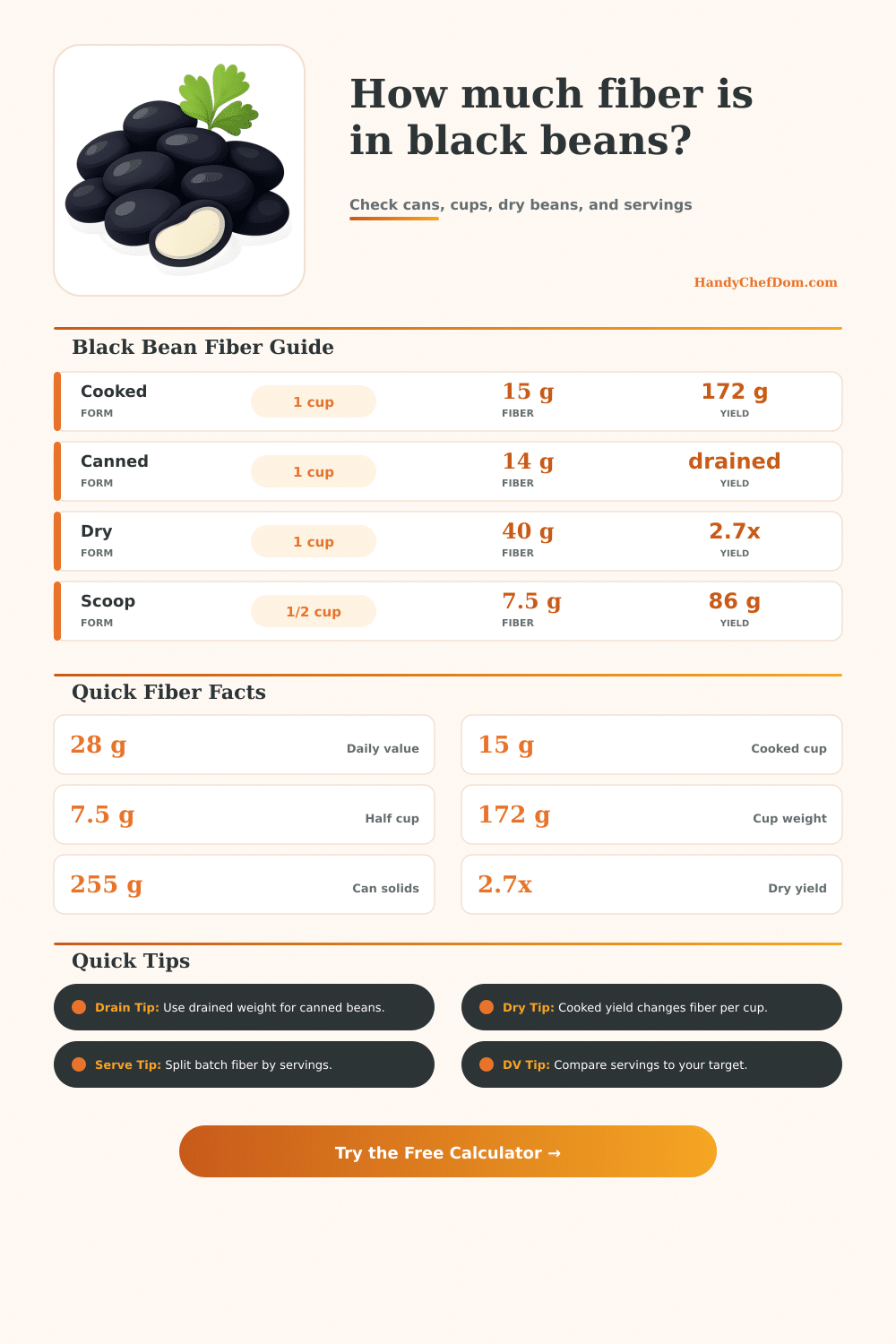
| Cooked black beans | 1 cup | 172 g | 15.0 g |
| Cooked black beans | 1/2 cup | 86 g | 7.5 g |
| Canned drained beans | 1 cup drained | 170 g | 13.6-14.8 g |
| Standard 15 oz can | About 60% solids | 255 g drained | 20-22 g |
| Dry black beans | 1 cup dry | About 520 g cooked | 40-45 g |
| Mashed black beans | 1/2 cup packed | 95 g | 7-8 g |
| Yield or Conversion | Imperial Estimate | Metric Estimate | Fiber Planning Note |
|---|---|---|---|
| Cooked cup weight | 1 cup | 172 g | Best for bowls and sides |
| Dry to cooked yield | 1 lb dry to 6-7 cups | 454 g dry to 1.2 kg cooked | Yield affects cooked cups, not dry fiber |
| Standard can solids | 15 oz can to 1.5 cups | 425 g can to 255 g drained | Drain before comparing servings |
| Half cup serving | 4 fl oz volume | 86 g cooked beans | Common taco or side scoop |
| Three-quarter cup bowl | 6 fl oz volume | 129 g cooked beans | Hearty bowl portion |
| One cup hearty serving | 8 fl oz volume | 172 g cooked beans | Large bean-centered meal |
| Meal Type | Typical Black Beans | Approx Fiber | Daily Value Share |
|---|---|---|---|
| Taco filling scoop | 1/4 cup | 3.8 g | 13% |
| Side dish | 1/2 cup | 7.5 g | 27% |
| Grain bowl | 3/4 cup | 11.2 g | 40% |
| Chili or soup bowl | 2/3 cup | 10.0 g | 36% |
| Bean dip serving | 1/3 cup | 5.0 g | 18% |
| Bean-centered entree | 1 cup | 15.0 g | 54% |
| Daily Fiber Target | Target Fiber | Black Bean Cups | Black Bean Notes |
|---|---|---|---|
| Light meal comparison | 14 g | About 1 cup | Useful for a single high-fiber meal |
| Daily Value label | 28 g | About 1.9 cups | Standard nutrition label comparison |
| Balanced adult goal | 30 g | About 2 cups | Simple daily planning target |
| Higher adult goal | 38 g | About 2.5 cups | Often split across several foods |
| Half-cup side | 7.5 g | 1/2 cup | About one-quarter of the daily value |
| Three-quarter cup bowl | 11.2 g | 3/4 cup | Strong lunch or dinner contribution |
Black beans contains a significant amount of fiber, but the amount of fiber that the beans contain change depending on how you measure the black beans. The total amount of fiber that is contained within a serving of black beans can change based off if the black beans that are being measured are dry, canned, or cook from scratch. Because the form of the black beans can impact the density of the beans, an calculator is necessary to find the exact amount of fiber that will be contained within your serving of black beans.
The density of fiber that is contained within black beans isnt the same no matter the form in which the beans are measured. For example, dry black beans contain more fiber per unit of measurement then canned black beans, which contain less fiber per unit of measurement than cooked black beans. This is due to the fact that dry black beans contain less water than canned black beans, and cooked black beans contain water.
How to Calculate Fiber in Black Beans
If you measure a cup of dry black beans and calculate the fiber content of that cup of beans, the amount will be higher than if you measured the same amount of dry black beans after cooking them, because cooked black beans contains water. The calculator accounts for this difference, as it will convert the weight of the dry beans to the cooked weight of the beans prior to calculating the fiber content of the cooked black beans. The number of servings of black beans that you eat will impact the amount of fiber that you consume from that type of bean.
For example, you may prepare a large batch of black beans to cook and store for later meal, but you may only eat a small portion of those black beans prepared in a batch during one meal. The calculator can account for this by allowing you to enter the number of servings that you will make and the size of those servings. For example, the calculator can account for serving sizes in quantities in increments of a quarter cup or a three-quarter cup bowl of black beans.
These specific servings sizes can help you to understand whether or not a single meal will help you to reach your goal of consuming the daily fiber amount that your body require. By entering a specific serving size, you can be sure that you are not underestimating the amount of fiber that you will consume during that meal. The context in which black beans are consumed can change the number of servings of black beans that are used in those meals.
For instance, the amount of black beans that is typically used in a taco filling are less than the amount of black beans that is used within a burrito bowl. Additionally, black beans used as a dip contain less of that bean than a taco filling. The calculator allows you to account for these difference within the recipes in which black beans are used.
The calculator not only allows you to adjust for these differences in recipes, but it also displays the fiber content of the portion of black beans that you use relative to your goal for the day of consuming a target amount of fiber. Variables can impact the fiber content within cooked black beans. The variables that may impact the fiber content of cooked black beans may include the soaking time of the dry beans prior to cooking those beans, as well as cooking methods.
For instance, if you prepare the black beans with a higher yield than other recipes for black beans, the expanded volume of black beans that is cooked indicates that there is less fiber per cup of cooked black beans. The calculator allows for the users to adjust for these differences in volume with the adjustment of a yield multiplier. Additionally, the weight of canned black beans can vary from brand to brand.
Some brands may contain more water than others, and some brands may contain less water but more sodium. You can enter the weight of the drained black beans into the calculator to determine the fiber content of those cooked black beans, as compared to using the manufacturers estimated weight of the canned black beans. The total amount of fiber that will be contained within black beans is the result of the form of the black beans, the way in which they are measured, and the size of the portions of black beans that are eaten.
Each of these factors can be accounted for in the use of the calculator, which transforms the measurement of black beans to a specific number that represent the amount of fiber that will be provided by that ingredient in your meals throughout the day.